



In short ⚡
Full-time Connection refers to a permanent, continuous linkage between two points in a supply chain or transportation network, ensuring uninterrupted flow of goods, data, or services. Unlike occasional or on-demand connections, full-time connections maintain operational readiness 24/7, enabling real-time tracking, automated processing, and immediate response capabilities critical for modern international logistics operations.
Introduction
In international trade, fragmented communication between stakeholders causes an estimated 28% of shipment delays. Full-time connections eliminate these gaps by establishing permanent digital or physical channels between supply chain partners.
This concept proves essential across customs clearance, warehouse management, and carrier coordination. Without continuous connectivity, shipments face documentation errors, missed pickup windows, and regulatory compliance failures.
Key characteristics of full-time connections include:
- Persistent availability: Systems remain operational without manual activation
- Real-time synchronization: Data updates propagate instantly across connected systems
- Automated workflows: Pre-configured rules trigger actions without human intervention
- Redundancy protocols: Backup channels ensure continuity during primary system failures
- Bidirectional communication: Information flows both ways between connected entities
Modern freight forwarding relies on these permanent connections to coordinate activities across multiple time zones, regulatory environments, and transportation modes simultaneously.
Technical Framework & Operational Expertise
Full-time connections operate through three primary infrastructure types: dedicated network links, API-based integrations, and cloud-hosted platforms. Each serves specific logistical requirements based on data volume, security needs, and system compatibility.
Dedicated network links establish physical or virtual private circuits between facilities. Major shipping hubs use fiber-optic connections rated at 10+ Gbps to handle continuous customs clearance submissions. These connections support Electronic Data Interchange (EDI) protocols that automatically transmit bills of lading, commercial invoices, and packing lists to authorities.
API-based integrations connect disparate software systems through standardized programming interfaces. A freight forwarder’s TMS communicates with carrier tracking systems, customs portals, and client ERPs simultaneously. RESTful APIs typically refresh shipment status every 60 seconds, while webhook implementations push updates instantaneously when events occur.
Cloud-hosted platforms centralize data access through browser-based interfaces. Stakeholders access the same information repository without installing specialized software. Leading solutions maintain 99.95% uptime through distributed server architecture across multiple geographic regions.
At DocShipper, we implement triple-redundant connection architectures combining all three methods. Our systems automatically failover to alternative channels when primary connections experience disruptions, ensuring clients maintain visibility throughout the shipping cycle.
Security frameworks for full-time connections must comply with international standards. The ISO/IEC 27001 standard defines requirements for information security management systems. Implementations include AES-256 encryption for data in transit, multi-factor authentication, and role-based access controls limiting information exposure to authorized personnel only.
Network monitoring tools provide real-time visibility into connection health. Automated alerts trigger when latency exceeds 200ms, packet loss surpasses 0.1%, or authentication failures occur. This proactive approach prevents disruptions before they impact shipment processing.
Practical Applications & Performance Data
Full-time connections deliver measurable improvements across key performance indicators. Industry data reveals specific advantages in operational efficiency, cost reduction, and customer satisfaction metrics.
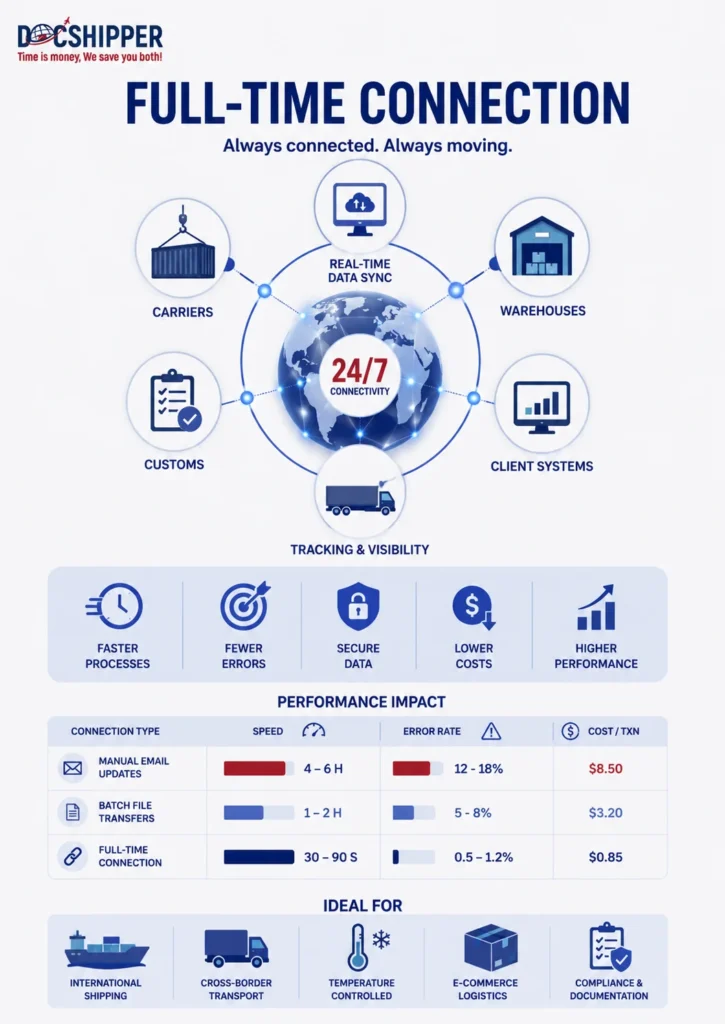
| Connection Type | Processing Speed | Error Rate | Cost per Transaction |
|---|---|---|---|
| Manual Email Updates | 4-6 hours | 12-18% | $8.50 |
| Batch File Transfers | 1-2 hours | 5-8% | $3.20 |
| Full-time API Connection | 30-90 seconds | 0.5-1.2% | $0.85 |
A practical scenario demonstrates these differences. An electronics importer receives 150 containers monthly from Asian suppliers. With manual processing, customs documentation preparation required 12 staff hours per container. Implementing full-time connections between the ERP system, customs broker platform, and port authority reduced this to 45 minutes per container.
The automated system validates HS codes against current tariff schedules, calculates duties based on real-time exchange rates, and submits declarations during the ocean transit. Customs release occurs within 2 hours of vessel arrival versus the previous 18-hour average.
Cost analysis reveals total annual savings of $287,000 through reduced labor, faster inventory turnover, and fewer demurrage charges. The connection infrastructure investment of $42,000 achieved full ROI within 8 weeks.
Five critical success factors for full-time connection implementations:
- Standardized data formats: All systems must exchange information using compatible schemas
- Exception handling protocols: Automated rules address 80% of variations without human review
- Performance SLAs: Contractual guarantees ensure connection uptime and response times
- Scalability provisions: Infrastructure supports transaction volume growth without degradation
- Continuous monitoring: Real-time dashboards track connection health and throughput metrics
Temperature-controlled pharmaceutical shipments particularly benefit from full-time connections. IoT sensors transmit readings every 5 minutes to monitoring platforms. When temperatures deviate outside the 2-8°C range for more than 15 minutes, the system automatically alerts logistics teams, notifies carriers, and initiates corrective protocols.
One pharmaceutical client reduced temperature excursions by 89% after implementing full-time monitoring connections, preventing $1.2M in annual product losses.
Conclusion
Full-time connections transform logistics operations from reactive coordination to proactive automation. The technology eliminates communication gaps that historically caused delays, errors, and increased costs throughout international supply chains.
Need expert guidance implementing connection strategies for your shipments? Contact DocShipper for a customized integration assessment.
📚 Quiz
Test Your Knowledge: Full-time Connection
What fundamentally distinguishes a full-time connection from periodic data synchronization?
A logistics manager claims full-time connections guarantee 100% uptime without any backup systems. Is this interpretation correct?
Your pharmaceutical client ships temperature-sensitive products requiring immediate alerts when deviations occur. Which connection approach best addresses this requirement?
🎯 Your Results
📞 Free Customized QuoteFAQ | Full-time Connection: Definition, Calculation & Practical Examples
Full-time connections maintain permanent open channels that transmit information immediately when events occur. Periodic synchronization operates on schedules (hourly, daily) regardless of actual activity. Full-time systems reduce response latency from hours to seconds, critical for time-sensitive shipments requiring immediate action on status changes or exceptions.
Robust implementations include redundant pathways through multiple network providers and protocols. When primary connections fail, systems automatically route traffic through backup channels. Message queuing ensures no data loss during brief outages, with transactions processing once connectivity restores. Enterprise solutions maintain 99.9%+ availability through geographic server distribution.
Permanent connections expand attack surfaces requiring comprehensive security frameworks. Primary risks include unauthorized access attempts, data interception, and denial-of-service attacks. Mitigation strategies employ end-to-end encryption, intrusion detection systems, regular vulnerability assessments, and zero-trust network architectures that verify every access request regardless of source.
Cloud-based platforms democratized access to enterprise-grade connectivity. Small importers handling 5-10 shipments monthly achieve benefits through SaaS solutions requiring minimal upfront investment. Scalable pricing models charge based on transaction volume, making advanced automation accessible without large infrastructure commitments. ROI typically appears within 3-6 months.
Middleware platforms bridge modern APIs with older technologies using protocol translation. EDI gateways convert XML or JSON formats into X12 or EDIFACT standards for systems lacking native API support. Database connectors enable real-time queries against legacy warehouses. Many solutions provide pre-built adapters for common freight forwarding and customs software packages.
Minimum recommendations vary by operation scale. Small forwarders handling documentation only function adequately with 10 Mbps symmetrical connections. High-volume operations processing 500+ daily shipments require 100+ Mbps to prevent bottlenecks. Operations incorporating video feeds from warehouses or IoT sensor networks may need 1 Gbps+ dedicated circuits for optimal performance.
Compliance requires careful architecture design. GDPR mandates that EU citizen data remain within the European Economic Area unless adequate safeguards exist. China's Cybersecurity Law restricts cross-border data transfers for critical infrastructure operators. Modern platforms offer regional data residency options, ensuring information storage and processing occur within legally compliant jurisdictions while maintaining connection functionality.
Timeline depends on complexity and existing infrastructure. Simple single-integration projects connecting two cloud platforms complete within 2-4 weeks. Comprehensive implementations linking multiple legacy systems, establishing redundant networks, and conducting security audits require 3-6 months. Phased rollouts allow partial benefits realization while minimizing operational disruption during transition periods.
Key indicators include transaction success rate (target: >99.5%), average response latency (under 500ms for APIs), system uptime percentage (aim for 99.9%+), data throughput volume, error rate trends, and security event frequency. Advanced monitoring tracks business metrics like customs clearance time reduction and documentation accuracy improvements attributable to automated connections.
Interoperability represents a core design principle. Standards-based protocols like REST APIs, SOAP web services, and SFTP file transfers enable cross-platform communication. Integration platforms as a service (iPaaS) solutions provide visual workflow builders connecting disparate systems without custom coding. Most modern logistics software includes pre-built connectors for popular platforms, simplifying multi-vendor integrations.
Total cost of ownership includes software licensing (typically $200-$2000 monthly based on scale), network bandwidth charges, security certificate renewals, system maintenance contracts, staff training programs, and ongoing support. Cloud solutions shift capital expenses to operational expenses, eliminating server hardware costs but introducing subscription dependencies. Budget 15-25% of initial implementation costs annually for maintenance.
Digital connectivity reduces physical documentation requirements, eliminating paper-based processes. Optimized routing through real-time data sharing decreases empty miles and fuel consumption. Predictive analytics enabled by continuous data flow identify efficiency opportunities. One shipper reduced carbon emissions by 14% through better container utilization derived from full-time supply chain visibility across all partners.
Need Help with
Logistics or Sourcing ?
First, we secure the right products from the right suppliers at the right price by managing the sourcing process from start to finish. Then, we simplify your shipping experience - from pickup to final delivery - ensuring any product, anywhere, is delivered at highly competitive prices.


Fill the Form
Prefer email? Send us your inquiry, and we’ll get back to you as soon as possible.
Contact us




