


In short ⚡
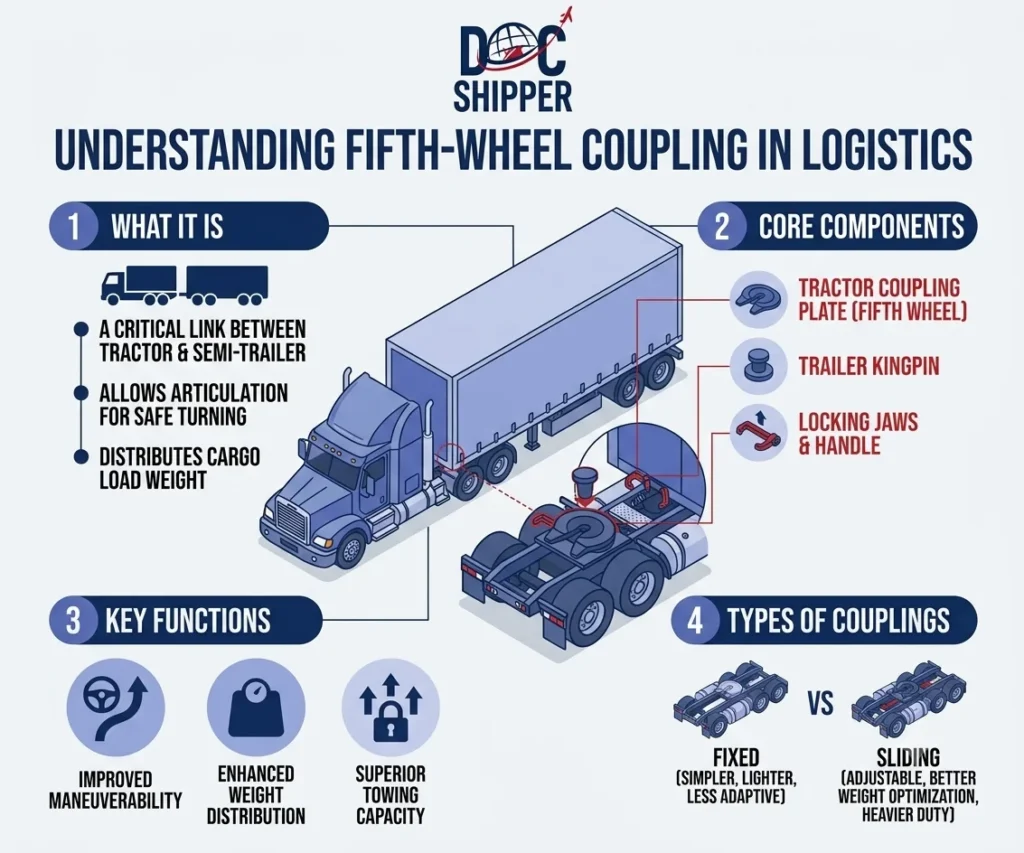
The fifth wheel is a heavy-duty coupling mechanism mounted on the chassis of a tractor unit, enabling it to connect and support semi-trailers in articulated truck configurations. This horseshoe-shaped device allows pivoting movement between tractor and trailer, facilitating maneuverability while distributing weight loads safely. Essential to modern freight logistics, fifth wheels bear substantial vertical and horizontal forces during transport operations.
Introduction
Many freight professionals underestimate how fifth wheel selection impacts operational efficiency and safety compliance. A poorly matched coupling can cause trailer instability, premature wear, or regulatory violations during cross-border shipments.
In international logistics, fifth wheels represent the critical junction point for articulated heavy goods vehicles (HGVs). They determine payload capacity, turning radius, and compliance with axle weight regulations across different jurisdictions.
Key characteristics include:
- Vertical load capacity: Ranges from 18,000 kg to 27,000 kg depending on model and classification
- Locking mechanism: Jaws or wedge systems that secure the kingpin automatically upon connection
- Height adjustability: Sliding or fixed mounting positions affecting trailer nose height
- Greasing requirements: Top plate surface needs regular lubrication to reduce friction during articulation
- Regulatory compliance: Must meet ECE R55 (Europe), FMVSS 393 (USA), or equivalent standards for coupling devices
Technical Mechanisms & Load Distribution
The fifth wheel operates through mechanical interlocking between its jaws and the semi-trailer’s kingpin. When the tractor reverses beneath the trailer, the kingpin enters the throat opening and triggers the locking jaws to close automatically.
Understanding load transfer dynamics is crucial. The device channels vertical forces from the trailer’s front axle onto the tractor’s rear bogie, redistributing weight across multiple axles. Improper positioning shifts this balance, risking axle overload penalties during weighbridge inspections.
Two primary mounting configurations exist: fixed installations bolted directly to the chassis, and sliding mechanisms allowing fore-aft adjustment. Sliding fifth wheels enable operators to optimize weight distribution when hauling variable cargo densities or navigating regions with different bridge formula requirements.
The oscillation mechanism permits limited rotational movement around horizontal axes, preventing rigid stress concentration during uneven terrain navigation. Advanced models incorporate automated locking indicators and pneumatic release systems for enhanced safety.
According to UNECE transport regulations, all fifth wheels used in international freight must display permanent markings indicating maximum vertical load capacity and manufacturing compliance standards.
At DocShipper, we systematically verify fifth wheel capacity ratings match your shipment’s declared weight during pre-departure inspections, preventing costly rejections at border crossings or weigh stations.
Types, Specifications & Industry Data
Fifth wheels are classified by vertical load capacity and operational environment. Selection depends on typical payload weights, regional road conditions, and coupling frequency.
| Type | Capacity (kg) | Primary Use Case | Typical Installation |
|---|---|---|---|
| Standard Fixed | 18,000 – 22,000 | General freight, regional distribution | Direct chassis mounting |
| Heavy Duty Sliding | 24,000 – 27,000 | Heavy machinery, construction materials | Sliding rail system (200-300mm travel) |
| Compensating | 20,000 – 25,000 | Off-road, quarry operations | Oscillating mount (±10° articulation) |
| Ultra-Low Profile | 18,000 – 20,000 | Oversized cargo requiring reduced height | Recessed chassis installation |
Industry benchmark data reveals that sliding fifth wheels reduce weight distribution violations by 34% compared to fixed installations when operators haul mixed cargo types across multiple regulatory zones.
Case study: A European automotive parts shipper reduced border inspection delays by 22 hours monthly after upgrading to sliding fifth wheels with automated weight monitoring. This allowed real-time adjustment of trailer positioning before reaching mandatory weighbridge checkpoints on the A1 corridor.
Maintenance intervals significantly impact operational uptime. Greasing frequency should occur every 10,000 km for standard operations, reducing to 5,000 km in dusty or marine environments. Jaw inspection protocols require quarterly visual checks for wear indicators, with replacement thresholds typically at 15% material loss.
Compatibility verification is mandatory: SAE (Society of Automotive Engineers) 50mm and 90mm kingpin diameters require matching fifth wheel throat dimensions. Mismatched combinations void insurance coverage and create liability exposure during accidents.
Modern fleets increasingly adopt sensor-equipped fifth wheels that transmit real-time coupling status to fleet management systems, providing 96% improvement in detecting incomplete connections before vehicle departure.
Conclusion
The fifth wheel remains the foundational component enabling efficient articulated freight transport, directly affecting safety compliance, operational flexibility, and cost management across international supply chains.
Need expert guidance on coupling equipment specifications for your import/export operations? Contact DocShipper for tailored logistics solutions.
📚 Quiz
Test Your Knowledge: Fifth Wheel
What is the primary function of a fifth wheel in freight transport?
A shipper wants to transport a 26,000 kg gross trailer weight. What is the correct fifth wheel capacity requirement?
Why are sliding fifth wheels particularly valuable for international freight operations?
🎯 Your Result
📞 Free Quote in 24hFAQ | Fifth Wheel: Definition, Types & Practical Examples in Freight Transport
A fifth wheel uses a horizontal locking plate mechanism for semi-trailers, while pintle hooks employ a vertical hook-and-eye connection for full trailers or drawbar applications. Fifth wheels distribute weight over tractor rear axles, whereas pintle hitches create tongue weight on the towing vehicle's rear frame.
No. The fifth wheel's rated capacity must meet or exceed the maximum vertical load transferred from the trailer, typically 20-25% of gross trailer weight. A 26,000 kg trailer requires minimum 24,000 kg fifth wheel capacity to maintain safety margins and regulatory compliance.
Standard operations require greasing every 10,000 km or monthly. High-frequency coupling environments (yard spotting, intermodal terminals) need weekly application. Use lithium-based extreme pressure greases rated for 120°C minimum operating temperatures to prevent plate seizure.
Primary causes include: improper kingpin engagement creating incomplete locking, corrosion from road salt exposure, impact damage from reversing errors, and material fatigue from exceeding rated capacity. Regular inspection of locking jaw edges prevents 78% of preventable failures.
Not universally mandated, but highly recommended for cross-border operations. Different countries enforce varying axle weight limits—sliding mechanisms allow adjustment to meet EU's 11,500 kg drive axle limit or North America's bridge formula calculations without cargo redistribution.
Correct height positions the semi-trailer's undercarriage rails parallel to ground when coupled. Excessive nose-up angle increases tractor rear axle load; nose-down positions reduce trailer braking effectiveness. Use spirit levels and measure kingpin to ground clearance against manufacturer specifications.
With proper maintenance, standard fifth wheels last 8-12 years or 800,000-1,200,000 km. Heavy-duty mining or construction applications reduce lifespan to 5-7 years due to increased stress cycles and abrasive environments requiring more frequent component replacement.
Yes. Smart fifth wheels with embedded sensors detect incomplete coupling, monitor locking jaw position, and alert drivers to connection failures before movement. Fleet data shows 92% reduction in trailer separation incidents when using automated verification systems.
Operators must provide: manufacturer's capacity rating plate photograph, maintenance log showing lubrication dates, jaw wear measurement records, and coupling/uncoupling training certifications. Annual third-party inspections are mandatory in most EU jurisdictions per Directive 2014/45/EU.
Forward positioning increases trailer nose weight on drive axles, improving traction but raising rolling resistance by 3-5%. Rearward placement reduces fuel consumption by 2-4% but may violate bridge formula calculations. Optimal positioning balances regulatory compliance with operational efficiency.
Mismatched components void commercial vehicle insurance, create liability during accidents, and trigger immediate vehicle grounding during roadside inspections. Kingpin-to-throat dimensional incompatibility causes premature wear, increasing breakdown risk by 340% according to transport safety authority data.
Not necessarily. The coupling mechanism remains identical, but refrigerated trailers often carry heavier payloads requiring higher-capacity fifth wheels. Additionally, reefer units add 900-1,200 kg to trailer tare weight, necessitating recalculation of vertical load distribution to prevent axle overloading.
Need Help with
Logistics or Sourcing ?
First, we secure the right products from the right suppliers at the right price by managing the sourcing process from start to finish. Then, we simplify your shipping experience - from pickup to final delivery - ensuring any product, anywhere, is delivered at highly competitive prices.


Fill the Form
Prefer email? Send us your inquiry, and we’ll get back to you as soon as possible.
Contact us




