


In short ⚡
Force Majeure is a contractual clause that excuses parties from fulfilling their obligations when extraordinary events beyond their control—such as natural disasters, wars, or pandemics—make performance impossible or impractical. This legal provision protects businesses from liability when unforeseeable circumstances prevent contract execution in international trade.Introduction
In international logistics, delayed shipments can cost thousands of dollars daily. But what happens when a typhoon closes your departure port? Or when civil unrest prevents cargo pickup? Many businesses misunderstand their rights when extraordinary events disrupt their supply chain. Force majeure clauses exist precisely for these situations.
This legal concept serves as a critical safety valve in global trade contracts. It determines whether a party can legally suspend or terminate obligations without facing penalties. Understanding force majeure is essential for anyone managing international freight, procurement, or supply chain operations.
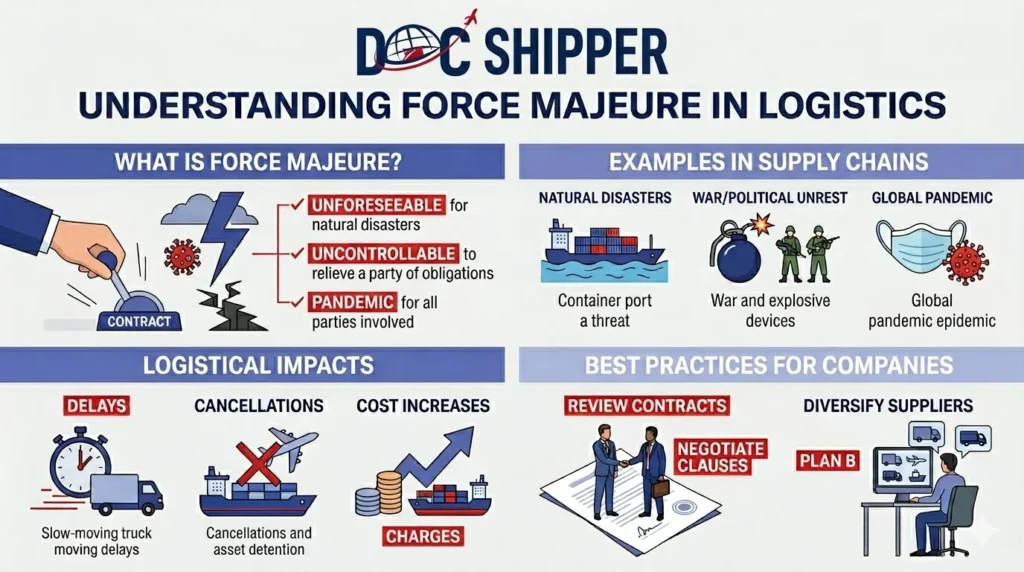
Key characteristics of force majeure include:
- Unforeseeable events that could not have been reasonably anticipated at contract signing
- External causation beyond the control of either contracting party
- Impossibility of performance rather than mere inconvenience or increased cost
- Contractual activation requiring explicit clause inclusion in agreements
- Notification obligations compelling affected parties to promptly inform counterparts
Legal Framework & Implications
Unlike common law systems, civil law jurisdictions often recognize force majeure as an implicit legal doctrine. The French Civil Code, for instance, automatically applies this principle even without explicit contractual mention. However, in common law countries like the United States and United Kingdom, parties must explicitly include force majeure clauses in contracts.
The International Chamber of Commerce (ICC) provides standardized force majeure clauses that many international trade contracts reference. According to ICC guidelines, qualifying events typically include natural disasters, war, terrorism, government actions, labor strikes, and epidemics. The specific wording determines which events activate the clause.
Three critical legal requirements must be met for valid invocation. First, the event must be unforeseeable—parties could not have reasonably predicted it when signing. Second, it must be unavoidable—no reasonable alternative means of performance exist. Third, the event must create genuine impossibility, not merely economic hardship or increased costs.
The burden of proof falls entirely on the party invoking force majeure. They must demonstrate that the event directly caused their inability to perform. Courts examine whether reasonable mitigation efforts were attempted. Simply claiming force majeure without evidence rarely succeeds in litigation.
Notification procedures carry significant weight. Most clauses require the affected party to notify counterparts within a specific timeframe—often 48 to 72 hours. At DocShipper, we systematically advise clients to document all force majeure events immediately and maintain detailed communication records to protect their contractual position.
Practical Examples & Scenarios
The COVID-19 pandemic triggered unprecedented force majeure invocations globally. In 2020, over 60% of international trade contracts faced performance issues, with parties citing government-mandated lockdowns, port closures, and supply chain disruptions. Chinese suppliers frequently invoked force majeure for delayed manufacturing, supported by certificates issued by the China Council for the Promotion of International Trade.
Consider a shipping scenario where a European importer ordered 500 tons of electronics from Vietnam with a March 2020 delivery deadline. When Vietnam implemented strict COVID-19 border controls, the manufacturer couldn’t obtain components from Chinese suppliers. The manufacturer invoked force majeure, providing government shutdown notices and supplier certificates. The contract was suspended for 90 days rather than terminated, protecting both parties from damages.
| Event Type | Typical Acceptance Rate | Documentation Required | Average Resolution Time |
|---|---|---|---|
| Natural Disasters | 85-90% | Government reports, weather data | 30-60 days |
| Government Actions | 75-85% | Official decrees, legal notices | 60-120 days |
| Labor Strikes | 40-50% | Union notices, media coverage | 14-45 days |
| Pandemics | 70-80% | WHO declarations, government certificates | 90-180 days |
| War/Terrorism | 90-95% | International news, embassy advisories | Variable (60+ days) |
Another concrete case involved the 2021 Suez Canal blockage. When the Ever Given container ship grounded for six days, over 400 vessels were delayed. Shipping lines invoked force majeure for delivery delays, but success varied. Contracts with specific “navigation obstruction” clauses succeeded, while generic force majeure language faced legal challenges. This highlighted the importance of precise clause drafting.
Financial implications prove substantial. According to international trade insurance data, successful force majeure claims average $120,000 in protected liability per incident. However, improperly documented claims cost businesses an average of $85,000 in legal disputes and damages. The difference lies entirely in procedural compliance and evidence quality.
DocShipper assists clients in navigating these complex situations by maintaining updated force majeure documentation protocols, ensuring proper notification procedures, and coordinating with legal advisors across jurisdictions to maximize claim success rates while preserving business relationships.
Conclusion
Force majeure clauses represent essential risk management tools in international logistics. Proper understanding and documentation can mean the difference between protected operations and costly litigation. As global supply chains face increasing disruptions, mastering these contractual protections becomes non-negotiable for logistics professionals.
Need expert guidance on force majeure situations or contract review? Contact DocShipper for specialized assistance in protecting your international trade operations.
📚 Quiz
Test Your Knowledge: Force Majeure
A logistics company faces a 40% increase in fuel costs due to market fluctuations. Can they invoke force majeure to suspend contract obligations?
Which legal requirement is absolutely essential for successfully invoking force majeure in common law jurisdictions?
A typhoon closes your departure port for 10 days. You notify your client 5 days after learning about the closure, though your contract requires 72-hour notification. What is the likely outcome?
🎯 Your Result
📞 Free Quote in 24hFAQ | Force Majeure: Definition, Legal Implications & Practical Examples
A qualifying force majeure event must be unforeseen, unavoidable, and make contract performance impossible—not merely difficult or expensive. Common examples include natural disasters (earthquakes, hurricanes), war, terrorism, government actions (embargoes, sudden regulatory changes), and pandemics. The specific contract language determines which events qualify, so always review your force majeure clause carefully before invoking it.
Generally, no. Economic hardship, market fluctuations, or increased costs rarely qualify as force majeure unless the contract explicitly includes them. Courts distinguish between impossibility and impracticability—performance must be genuinely impossible, not simply more expensive. However, if a government suddenly bans fuel exports causing complete unavailability, that might qualify depending on contractual wording.
Most international trade contracts require notification within 48 to 72 hours of the force majeure event or when you reasonably should have known about it. Delayed notification can invalidate your claim entirely. Document everything immediately—the event itself, how it prevents performance, and your mitigation efforts. Send formal written notice via multiple channels (email, registered mail) to create an indisputable record.
Not necessarily. Force majeure typically suspends obligations temporarily while the extraordinary event persists. Termination only occurs if the contract specifically allows it or if the suspension extends beyond a defined period (often 90-180 days). Many contracts include provisions for renegotiation or alternative performance once the force majeure event ends. Always check your specific contractual terms.
Strong documentation includes: official government declarations or orders, certificates from trade promotion councils (like China's CCPIT), weather reports or natural disaster confirmations, news coverage from credible sources, communication records showing immediate notification, and evidence of mitigation attempts. The more comprehensive your documentation, the stronger your legal position. Courts scrutinize force majeure claims carefully, so thorough record-keeping is essential.
This depends on contract wording and jurisdiction. Some contracts include "upstream supplier" provisions allowing force majeure claims based on supply chain disruptions. However, many jurisdictions require parties to demonstrate they attempted alternative sourcing. If you rely on a single supplier without backup options, courts may find you assumed that risk. Diversified supply chains strengthen your position in these situations.
Absolutely. Civil law countries (France, Germany, China) often recognize force majeure as an implicit legal principle, even without explicit contract clauses. Common law countries (UK, USA, Australia) require explicit contractual inclusion. Islamic law jurisdictions may have different interpretations based on Sharia principles. International contracts should specify which country's laws govern and include detailed force majeure definitions to avoid ambiguity.
"Act of God" typically refers only to natural events (earthquakes, floods, lightning), while force majeure encompasses broader circumstances including human-caused events like war, strikes, or government actions. Force majeure provides more comprehensive protection. Many modern contracts use force majeure clauses exclusively because they offer wider coverage for the complex risks in international logistics.
This is increasingly difficult. While COVID-19 qualified as unforeseeable in early 2020, courts now consider pandemic risks foreseeable. Invoking force majeure for COVID-19 in 2024 requires demonstrating extraordinary new circumstances—such as completely unexpected government lockdowns or variant-specific restrictions—rather than general pandemic conditions. The foreseeability test has fundamentally shifted as businesses have had years to adapt.
Yes. Even when validly invoking force majeure, you're legally obligated to take reasonable steps to minimize damages and seek alternative performance methods. Courts expect you to explore workarounds like alternative suppliers, different shipping routes, or temporary solutions. Failure to demonstrate mitigation efforts can invalidate your force majeure claim or reduce your legal protection.
Force majeure and insurance serve different functions. Force majeure excuses contractual performance without liability, while insurance compensates for losses. Some force majeure events (natural disasters, war) may be covered by cargo insurance or business interruption policies, while others aren't. Review both your contract's force majeure clause and your insurance policy to understand your complete risk protection. They should complement, not duplicate, each other.
Yes, this is possible and increasingly common in complex supply chains. For example, a port closure might prevent both the seller from shipping and the buyer from receiving goods. When both parties invoke force majeure legitimately, the contract typically suspends until the event resolves. This situation requires careful documentation and communication to preserve the business relationship and establish a mutually acceptable resolution timeline once normal operations resume.
Need Help with
Logistics or Sourcing ?
First, we secure the right products from the right suppliers at the right price by managing the sourcing process from start to finish. Then, we simplify your shipping experience - from pickup to final delivery - ensuring any product, anywhere, is delivered at highly competitive prices.


Fill the Form
Prefer email? Send us your inquiry, and we’ll get back to you as soon as possible.
Contact us




