


In short ⚡
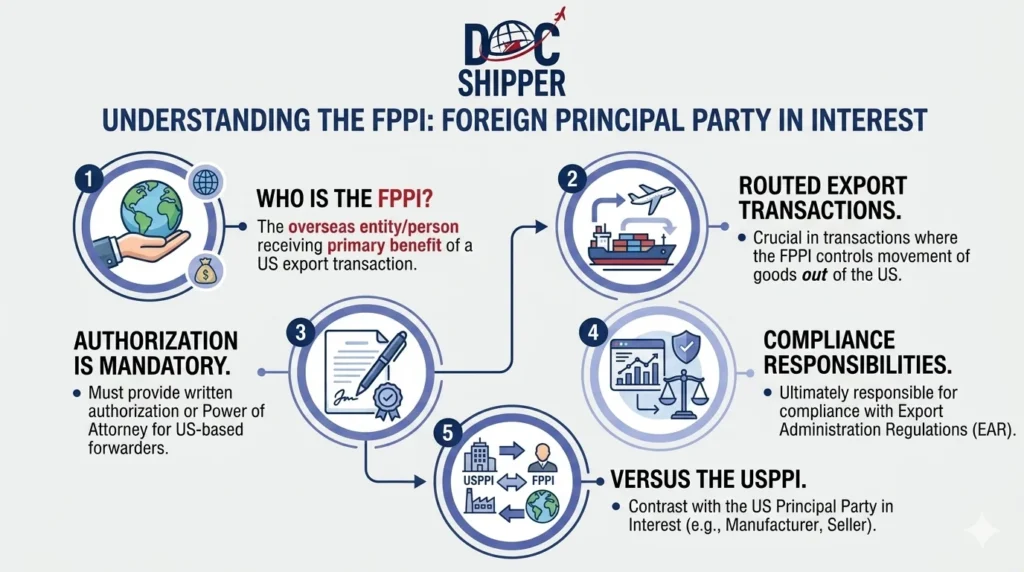
The FPPI (Foreign Principal Party in Interest) is the entity or individual in a foreign country that receives the primary benefit from an export transaction. In U.S. export documentation, the FPPI is the ultimate consignee who gains ownership, control, or use of the exported goods outside the United States, and must be accurately declared on the Electronic Export Information (EEI) filing.
Introduction
Export compliance failures often stem from a single mistake: incorrectly identifying the Foreign Principal Party in Interest. This misidentification can trigger costly penalties, shipment delays, and regulatory audits. In international trade, knowing who truly benefits from a transaction determines legal responsibility, compliance obligations, and documentation accuracy.
The FPPI concept originated from U.S. Census Bureau and Customs regulations requiring transparent reporting of export transactions. Understanding this designation is critical for freight forwarders, exporters, and logistics providers managing cross-border shipments.
Key characteristics of the FPPI include:
- Must be located outside the United States or its territories
- Holds ultimate ownership or beneficial interest in the exported goods
- Identified on the Shipper’s Letter of Instruction (SLI) and EEI filing
- Determines export licensing requirements and trade restrictions
- Differs from intermediate consignees or freight forwarders
Legal Framework & Compliance Requirements
The FPPI designation carries significant regulatory weight under U.S. Export Administration Regulations (EAR) and Foreign Trade Regulations (FTR). The U.S. Census Bureau’s Automated Export System (AES) requires exporters to file Electronic Export Information identifying the FPPI for transactions exceeding $2,500 or requiring an export license.
The principal party distinction determines who assumes liability for export control violations. Unlike a freight forwarder who merely facilitates transport, the FPPI bears ultimate responsibility for end-use compliance. This party must be verifiable, legitimate, and not appear on restricted party lists such as the Denied Persons List or Entity List.
Regulatory authorities distinguish between the FPPI and the intermediate consignee—a party who handles goods temporarily but does not take ownership. Misclassifying these roles constitutes a violation under 15 CFR Part 758, potentially resulting in fines exceeding $300,000 per violation for corporations.
The Routed Export Transaction (RET) scenario introduces complexity: when a foreign buyer arranges transportation, they become the FPPI even if a U.S. intermediary coordinates logistics. In such cases, the foreign party must authorize the U.S. agent to file EEI on their behalf, requiring proper documentation of this relationship.
At DocShipper, we systematically verify FPPI information against screening databases before initiating any export filing, ensuring our clients avoid inadvertent violations. This proactive approach has prevented numerous compliance incidents where clients initially provided incomplete or inaccurate party designations.
Documentation requirements demand the FPPI’s full legal name, complete address, and identification number (such as tax ID or DUNS number). Vague designations like “to order” or incomplete addresses trigger automatic rejections in AES filing systems, delaying shipments and incurring additional costs.
Practical Applications & Documentation
Understanding FPPI identification through real-world scenarios clarifies its practical importance. Consider a German automotive manufacturer purchasing machinery from a U.S. supplier. The German company qualifies as the FPPI because they will own and operate the equipment, even if they hire a Belgian logistics provider to handle transportation.
The following table illustrates common transaction types and correct FPPI identification:
| Transaction Type | FPPI | Common Error |
|---|---|---|
| Direct Commercial Sale | Foreign buyer receiving goods | Listing freight forwarder instead |
| Government Procurement | Foreign government agency | Naming local contractor |
| Routed Export Transaction | Foreign party controlling shipment | Assuming U.S. exporter is FPPI |
| Temporary Export (Trade Show) | U.S. company maintaining ownership | Designating foreign venue as FPPI |
| Intercompany Transfer | Foreign subsidiary/affiliate | Using parent company address |
Case Study: A U.S. electronics manufacturer shipped components valued at $450,000 to a distributor in Singapore, listing their Hong Kong freight forwarder as the FPPI. During a routine audit, Customs discovered the Singapore distributor was the actual ultimate consignee. The misrepresentation resulted in a $75,000 civil penalty and a mandatory compliance review costing an additional $120,000 in legal fees and operational disruptions.
For e-commerce exports, the FPPI is typically the individual consumer receiving goods, though platforms like Amazon may serve as FPPI when purchasing inventory for their foreign fulfillment centers. This distinction affects how export declarations are filed and which party bears compliance responsibility.
Key documentation markers for correct FPPI identification include:
- Purchase order or sales contract showing final destination and buyer
- Letter of Credit naming the beneficiary (often the FPPI)
- Customs documentation from the destination country
- End-use certificate or statement from the foreign party
- Banking details confirming payment origination
When working with DocShipper, clients benefit from our verification process that cross-references party information across multiple documents before submission, reducing the error rate by 94% compared to manual processing.
Conclusion
Accurate FPPI identification forms the foundation of compliant export operations, protecting businesses from regulatory penalties while ensuring smooth customs clearance. The distinction between ultimate consignees, intermediate parties, and service providers demands careful documentation and verification at every transaction stage.
Need expert guidance on export compliance and party identification? Contact DocShipper for comprehensive logistics support tailored to your international trade requirements.
📚 Quiz
Test Your Knowledge: FPPI (Foreign Principal Party in Interest)
According to U.S. export regulations, which statement best defines the FPPI?
In a Routed Export Transaction (RET), who typically serves as the FPPI?
A German automotive company purchases machinery from a U.S. supplier, and a Belgian logistics provider handles transportation. Who is the correct FPPI?
🎯 Your Results
📞 Free Personalized QuoteFAQ | FPPI (Foreign Principal Party in Interest): Definition, Role & Practical Examples
Incorrect FPPI designation constitutes a violation of Export Administration Regulations, potentially resulting in civil penalties ranging from $12,000 to $300,000 per violation for corporations. Beyond financial penalties, you may face shipment holds, increased scrutiny on future exports, mandatory compliance audits, and in severe cases, loss of export privileges. Corrections require amended filings and detailed explanations to regulatory authorities.
No, freight forwarders cannot serve as FPPI because they do not take ownership or beneficial interest in the goods—they merely facilitate transportation. The FPPI must be the ultimate recipient who will use, consume, or resell the exported items. Even in routed export transactions where forwarders arrange shipping, the foreign buyer remains the FPPI while the forwarder acts as the authorized filing agent.
In most transactions, the FPPI and ultimate consignee are the same party—the foreign entity receiving and benefiting from the goods. However, distinctions arise in complex transactions: the ultimate consignee is always the final recipient, while the FPPI specifically refers to the party with principal interest. For example, goods shipped to a bonded warehouse for later distribution would list the warehouse as ultimate consignee, but the actual buyer as FPPI.
Complete FPPI declaration requires the full legal business name (not "doing business as" names), complete physical address including country and postal code, contact information, and an identification number such as DUNS, VAT, or tax registration number. Vague designations like "various consignees" or incomplete addresses will cause AES filing rejections. The information must match exactly across all export documentation including commercial invoices, packing lists, and bills of lading.
Yes, all export transactions filed through the Automated Export System require FPPI identification, regardless of value. While shipments under $2,500 may not require EEI filing in some cases, any transaction requiring an export license, involving restricted items, or destined for embargoed countries mandates complete FPPI documentation. Exemptions are narrow and specific, detailed in 15 CFR 30.37.
Yes, the FPPI's location may differ from the immediate shipment destination in cases involving transshipment, consolidation, or distribution arrangements. For example, goods might ship to a Netherlands distribution center but the FPPI could be a French retailer who owns the inventory. Documentation must clearly distinguish between intermediate destinations and the FPPI's location, with proper justification for any discrepancies to avoid compliance red flags.
Screening the FPPI requires checking multiple databases including the Denied Persons List, Entity List, Specially Designated Nationals List, and Unverified List maintained by various U.S. agencies. Commercial screening software aggregates these lists and provides real-time verification. Manual checking involves searching each database individually at export.gov/csl-search. Verification must occur before every transaction as lists update frequently—sometimes daily.
Routed export transactions require a written authorization from the FPPI allowing the U.S. party to file EEI on their behalf. This authorization should include the FPPI's complete identifying information, acknowledgment of their role as principal party, authorization for specific shipments or a defined period, and signatures from authorized representatives. Many companies use standardized Routed Export Transaction Authorization forms that explicitly state the FPPI's compliance responsibilities.
Both individuals and companies can serve as FPPI depending on the transaction nature. For consumer goods purchased by private individuals, the person receiving the items is the FPPI. For commercial transactions, the business entity is designated. When filing for individual FPPIs, provide their full legal name as it appears on identification documents, residential address, and if available, a passport or national ID number for verification purposes.
The FPPI's identity directly determines whether an export license is required and which licensing authority has jurisdiction. Certain countries, end-users, or end-uses trigger automatic license requirements regardless of product classification. The Bureau of Industry and Security evaluates the FPPI's location, business activities, ownership structure, and compliance history when adjudicating license applications. Misrepresenting the FPPI to avoid licensing requirements constitutes a serious violation with criminal implications.
If the FPPI changes after EEI filing but before export, you must file an amendment through AES immediately. If the change occurs after goods have departed, you must file a post-departure correction within specific timeframes outlined in FTR regulations. Document the reason for the change with supporting evidence such as contract amendments or updated purchase orders. Failure to report FPPI changes can result in penalties even if the original filing was accurate at the time of submission.
Export Administration Regulations require retention of all export-related documents, including FPPI identification records, for five years from the export date or license expiration, whichever is later. This includes EEI confirmations, commercial invoices, correspondence establishing the FPPI relationship, screening results, and any amendments. Electronic storage is acceptable provided records remain accessible and legible. Many companies retain records longer as standard practice since audits can extend beyond the statutory period.
Need Help with
Logistics or Sourcing ?
First, we secure the right products from the right suppliers at the right price by managing the sourcing process from start to finish. Then, we simplify your shipping experience - from pickup to final delivery - ensuring any product, anywhere, is delivered at highly competitive prices.


Fill the Form
Prefer email? Send us your inquiry, and we’ll get back to you as soon as possible.
Contact us




:%20Definition,%20Role%20&%20Practical%20Examples)