


In short ⚡
Free Out (FO) is a maritime shipping term indicating that the unloading costs at the destination port are the responsibility of the consignee or receiver, not the carrier. Under FO terms, the freight rate covers only ocean transport and loading at origin, leaving discharge expenses to be negotiated separately or handled by the cargo owner.Introduction
In international shipping, confusion about who pays for discharge operations causes unexpected delays and cost disputes at destination ports. Free Out (FO) clauses shift unloading financial responsibility away from the ocean carrier, fundamentally altering freight cost structures and port logistics coordination.
Understanding FO terms is critical for importers managing landed costs and terminal operations. This term directly impacts budget forecasting, vendor negotiations, and compliance with port regulations.
- Cost allocation clarity: Separates ocean freight from discharge expenses
- Operational responsibility: Consignee arranges stevedoring and equipment
- Contractual precision: Must be explicitly stated in shipping agreements
- Port-specific variations: Discharge rates vary dramatically by terminal
- Comparison with liner terms: Differs from FILO, LIFO, and berth terms
Deep Dive & Expert Insights
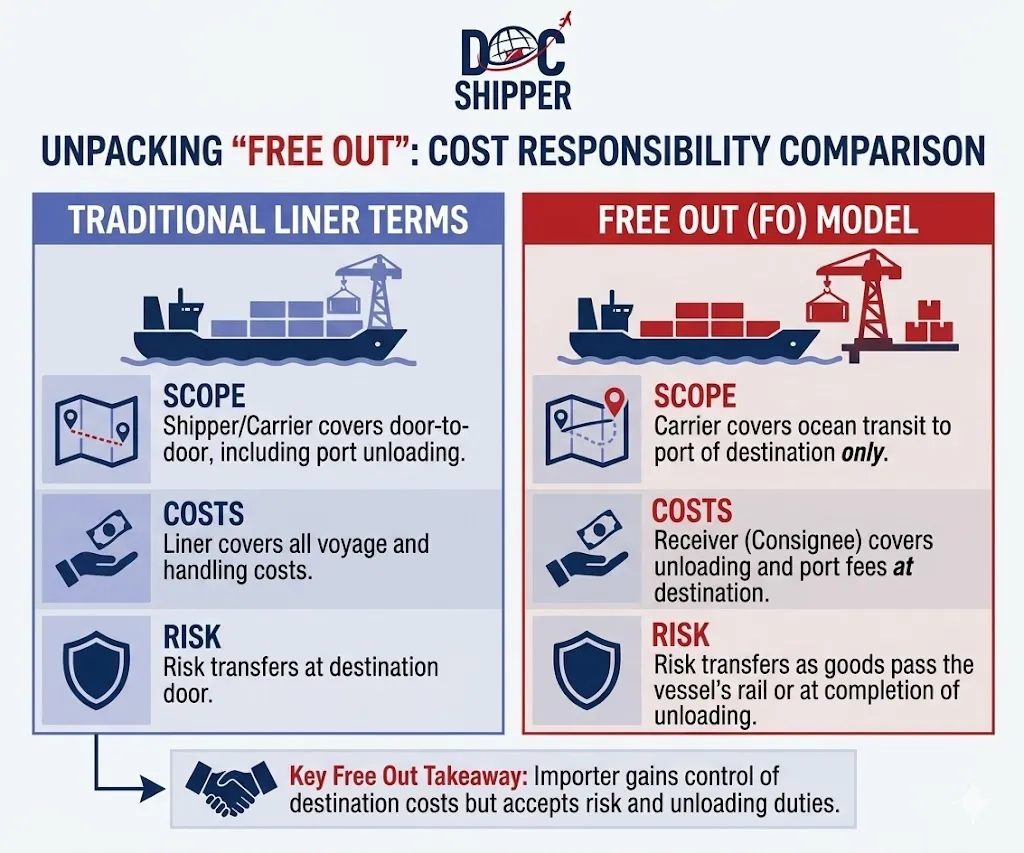
Free Out terms create a bifurcated cost structure where ocean freight and discharge operations are priced independently. The carrier’s liability ends when cargo is ready for unloading at the ship’s rail or hatch, leaving stevedoring, crane hire, and terminal handling charges to the receiver.
This arrangement stems from tramp shipping practices where cargo owners negotiate directly with port operators. Unlike liner terms (where discharge is included), FO provides pricing flexibility in markets with volatile terminal costs or specialized handling requirements.
The legal framework governing FO clauses relies on the shipping contract’s explicit language. The Hague-Visby Rules and Hamburg Rules establish carrier liability limits but defer to contractual terms for cost allocation. According to UK Maritime & Coastguard Agency guidelines, carriers must clearly document discharge exclusions to avoid liability disputes.
In practice, discharge cost components under FO include stevedore labor, crane operations, lashing removal, dunnage disposal, and terminal entry fees. Importers must secure discharge quotes before cargo arrival to prevent demurrage penalties.
Chez DocShipper, we systematically verify FO clauses during contract review and coordinate with local stevedoring companies to obtain competitive discharge quotes, ensuring our clients avoid unexpected port charges and delays.
The risk profile shifts significantly under FO terms. While carriers reduce operational exposure, consignees assume discharge coordination risks including equipment breakdowns, labor strikes, and terminal congestion—all of which can trigger costly vessel delays.
Real-World Examples & Cost Data
Consider a 20-foot container of industrial machinery shipped from Hamburg to Los Angeles under FO terms. The ocean freight quote is $1,200, covering only sea transport and loading in Hamburg.
| Cost Component | FO Terms (Consignee Pays) | Liner Terms (Carrier Includes) |
|---|---|---|
| Ocean Freight | $1,200 | $1,450 |
| Loading (Hamburg) | Included | Included |
| Discharge (LA) | $380 (separate quote) | Included |
| Terminal Handling | $150 (consignee pays) | Included |
| Total Landed Cost | $1,730 | $1,450 |
This comparison reveals FO terms result in $280 higher total costs for this shipment, despite lower quoted freight. However, FO becomes advantageous when consignees negotiate bulk discharge rates or use dedicated terminals.
Use Case: Breakbulk Steel Coils
A steel importer ships 500 tons of coils from Shanghai to Houston under FO terms. Ocean freight: $45/ton. The importer contracts directly with a specialized stevedore for $12/ton discharge—30% cheaper than the carrier’s liner rate of $17/ton. Total savings: $2,500 on discharge alone, justifying the FO arrangement.
Key advantages emerge when consignees have:
- Volume leverage: Regular shipments enabling stevedore contracts
- Specialized equipment needs: Heavy-lift cranes not included in liner terms
- Terminal access: Private wharves or dedicated berths
- Cost transparency: Preference for itemized charges over bundled rates
- Operational control: Ability to schedule discharge during off-peak hours
Conclusion
Free Out terms fundamentally restructure shipping cost allocation, transferring discharge responsibilities and expenses to consignees while offering potential savings for sophisticated importers with negotiating power. Success requires precise contract language and proactive discharge coordination.
Need expert guidance on FO terms or discharge cost optimization? Contact DocShipper for tailored logistics solutions that minimize your landed costs.
📚 Quiz
Test Your Knowledge: Free Out (FO) Shipping Terms
Under Free Out (FO) terms, who is responsible for unloading costs at the destination port?
What is a common misconception about Free Out freight rates compared to liner terms?
A steel importer ships 500 tons under FO terms with ocean freight at $45/ton. They negotiate direct stevedore discharge at $12/ton versus the carrier's liner rate of $17/ton. What is the correct cost advantage of using FO?
🎯 Your Result
📞 Free Quote in 24hFAQ | Free Out (FO): Definition, Calculation & Real-World Examples
FO covers loading at origin but excludes discharge, while FIO (Free In/Out) excludes both loading and discharge costs. Under FIO, the cargo owner pays for all stevedoring operations at both ports, whereas FO includes loading in the freight rate. FIO is common in charter parties for bulk commodities where the charterer controls both terminals.
The consignee or their appointed logistics agent arranges and pays for stevedoring, crane operations, and terminal handling at the destination port. The shipping line typically provides a list of approved stevedores, but consignees may negotiate directly with any licensed operator meeting port safety regulations and insurance requirements.
Yes, though FO is more common in breakbulk and bulk shipping. For containers, FO means the container discharge from vessel and terminal handling charges are the consignee's responsibility, separate from ocean freight. Most container lines prefer inclusive liner terms, but FO applies in specialized terminals or when shippers negotiate direct stevedore contracts.
Delay costs typically fall on the party responsible for discharge operations. Under FO, if the consignee's stevedore causes delays, the consignee may incur demurrage charges from the shipping line for vessel detention. Contracts should specify force majeure provisions and responsibility limits to prevent disputes over weather delays or equipment failures.
FO terms don't directly change cargo insurance requirements, but discharge operations introduce additional risk exposure. Consignees should ensure their cargo policy covers discharge activities and verify that contracted stevedores carry adequate liability insurance. The transition of custody from carrier to stevedore creates a critical point requiring clear documentation of cargo condition.
Not necessarily. While FO freight quotes appear lower by excluding discharge, total landed costs may exceed liner term shipments depending on local stevedore rates. FO becomes cost-effective when consignees have negotiating leverage with terminal operators or ship high volumes enabling bulk discharge contracts. Small importers often pay premium discharge rates, negating freight savings.
Essential documents include the Bill of Lading with explicit FO notation, stevedore service contracts, terminal entry permits, and discharge completion certificates. The B/L must clearly state "Free Out" or "FO" to prevent disputes. Consignees need pre-arrival authorization from port authorities and proof of stevedore insurance before discharge operations commence.
Yes, FO is compatible with Incoterms as they govern different aspects of the transaction. Incoterms define seller-buyer responsibility transfer points, while FO specifies carrier-consignee discharge cost allocation. For example, CIF terms mean the seller pays freight and insurance, but if the contract specifies FO, the buyer still pays discharge at destination despite the seller covering ocean freight.
Port authorities require licensed stevedores meeting safety, environmental, and insurance standards. Discharge operators must comply with ISPS Code security protocols and local labor regulations. Most ports mandate advance notification of FO arrangements and reserve the right to approve stevedore selection. Non-compliance can result in cargo detention or forced use of port-designated operators at premium rates.
Standard charges include stevedore labor (often $50-150/hour per gang), crane rental ($200-500/hour depending on capacity), lashing and securing material removal, dunnage disposal, and terminal gate fees. Additional costs may include overtime premiums for after-hours discharge, specialized equipment for heavy or oversized cargo, and environmental surcharges for hazardous materials handling.
Request detailed discharge quotes from at least three stevedores before cargo departure, accounting for equipment needs, cargo characteristics, and expected discharge duration. Build in a 15-20% contingency for unforeseen delays or complications. Compare total landed costs (freight + discharge) against liner term quotes to determine actual savings. Establish standing agreements with stevedores for regular shipments to lock in competitive rates.
Contract amendments require consent from all parties—carrier, shipper, and consignee. Transferring discharge responsibility mid-voyage is complex and may incur administrative fees or require new documentation. Most carriers refuse post-booking changes to FO terms, as they've already priced the freight excluding discharge. Any modifications should be negotiated before vessel departure and documented in a contract addendum.
Need Help with
Logistics or Sourcing ?
First, we secure the right products from the right suppliers at the right price by managing the sourcing process from start to finish. Then, we simplify your shipping experience - from pickup to final delivery - ensuring any product, anywhere, is delivered at highly competitive prices.


Fill the Form
Prefer email? Send us your inquiry, and we’ll get back to you as soon as possible.
Contact us




:%20Definition,%20Calculation%20&%20Real-World%20Examples)