


In short ⚡
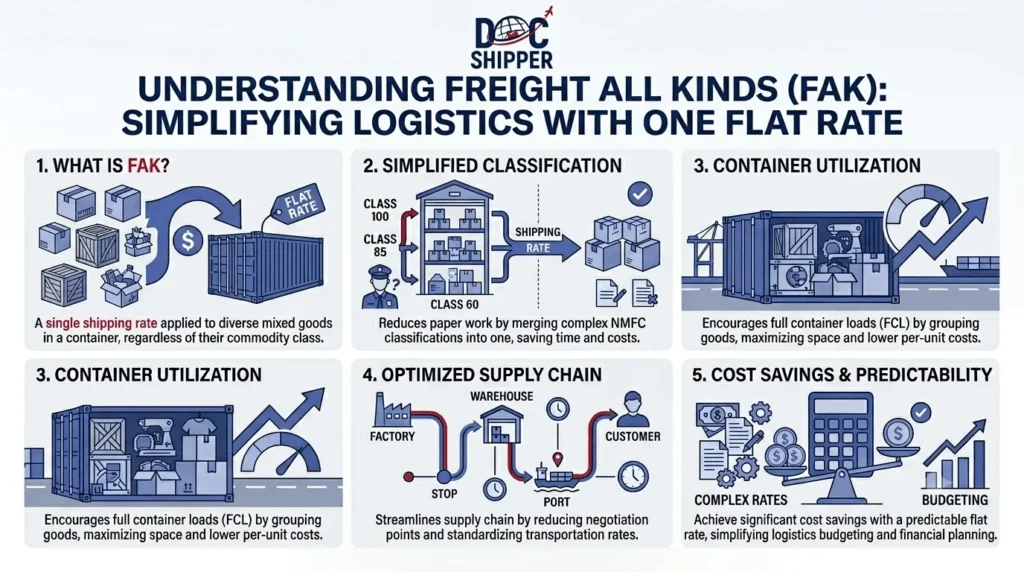
Freight-All-Kinds (FAK) is a simplified freight classification system where shipments are charged at a uniform rate regardless of commodity type. This pricing model eliminates the complexity of individual class-based tariffs, making it particularly advantageous for mixed cargo or Less-Than-Truckload (LTL) shipments containing multiple product categories.
Introduction
Shippers frequently struggle with the 18-class freight classification system established by the National Motor Freight Traffic Association (NMFTA). Each commodity receives a specific class from 50 to 500 based on density, stowability, handling, and liability. This complexity creates pricing unpredictability and administrative burden.
FAK rates resolve this challenge by applying a single negotiated class to all goods in a shipment. This approach transforms international and domestic logistics by standardizing costs and accelerating quote generation.
Key characteristics of FAK pricing include:
- Uniform freight classification across diverse commodities
- Pre-negotiated rates between shipper and carrier
- Elimination of item-by-item class verification
- Simplified billing and reduced documentation errors
- Optimal for high-volume shippers with varied inventory
Technical Framework & Strategic Applications
FAK agreements function as contractual rate structures where carriers assign a blanket classification (typically Class 55, 65, or 70) to all shipments from a specific customer. This replaces the traditional NMFTA density-based system where freight classes range from low-density items like ping-pong balls (Class 500) to high-density products like steel (Class 50).
The operational mechanism involves three components. First, the baseline class designation establishes the universal rate applied to all commodities. Second, minimum shipment thresholds often require consistent monthly volumes to qualify for FAK pricing. Third, exclusion parameters may apply to hazardous materials or oversized freight that cannot conform to standard classifications.
From a regulatory perspective, FAK rates must comply with Federal Motor Carrier Safety Administration guidelines while respecting contractual transparency requirements. Unlike standard tariffs published publicly, FAK agreements remain confidential commercial arrangements negotiated individually.
Strategic advantages emerge for specific shipper profiles. E-commerce retailers shipping apparel, electronics, and home goods benefit from consolidated pricing despite vastly different product densities. Manufacturing exporters with mixed component shipments avoid the administrative cost of classifying hundreds of SKUs. Third-party logistics providers leverage FAK rates to offer predictable pricing to end clients.
At DocShipper, we negotiate customized FAK agreements with our carrier network to secure optimal rates for clients shipping mixed containers. Our compliance team ensures all commodity exclusions are clearly documented to prevent unexpected surcharges.
Practical Examples & Cost Analysis
To illustrate FAK value, consider a typical scenario where an importer ships a mixed LTL load from Shanghai to Los Angeles containing furniture (Class 125), electronics (Class 70), and textiles (Class 60). Under traditional classification, each category incurs separate rates.
| Pricing Model | Furniture (2,000 lbs) | Electronics (1,500 lbs) | Textiles (1,000 lbs) | Total Cost |
|---|---|---|---|---|
| Traditional Class | $1,240 (Class 125) | $780 (Class 70) | $480 (Class 60) | $2,500 |
| FAK Class 70 | $780 | $585 | $390 | $1,755 |
| Savings with FAK | $745 (29.8%) |
This comparison demonstrates how FAK rates provide substantial cost reductions for mixed shipments. The savings compound with increased shipment frequency, making FAK particularly valuable for importers processing 10+ LTL loads monthly.
Another practical application involves ocean freight consolidation. A textile importer shipping 15 different fabric types in a 40-foot container would traditionally require individual commodity codes and class calculations. With a FAK Class 60 agreement, all fabrics receive uniform treatment, reducing customs documentation preparation time by approximately 70%.
Key implementation factors include:
- Volume commitments: Most carriers require minimum monthly shipment volumes (often 10,000-20,000 lbs) to justify FAK pricing
- Commodity restrictions: Hazmat, refrigerated goods, and oversized items typically excluded from FAK agreements
- Geographic scope: FAK rates may apply only to specific lane pairs or terminal zones
- Contract duration: Agreements typically span 12-24 months with rate lock provisions
- Audit compliance: Carriers reserve rights to inspect shipments and reclassify if commodities fall outside agreed parameters
DocShipper’s freight audit team conducts quarterly FAK rate benchmarking to ensure clients maintain competitive advantages as market conditions evolve. We provide detailed shipment profiling to identify optimal FAK class designations based on historical cargo mix.
Conclusion
Freight-All-Kinds pricing represents a strategic evolution in logistics cost management, replacing classification complexity with predictable, volume-based agreements. For shippers managing diverse product portfolios, FAK rates deliver both financial savings and operational efficiency.
Need assistance negotiating FAK agreements or optimizing your freight classification strategy? Contact DocShipper’s logistics experts for customized rate analysis and carrier negotiations.
📚 Quiz
Test Your Knowledge: Freight-All-Kinds (FAK)
What is the primary characteristic of Freight-All-Kinds (FAK) pricing?
A shipper exclusively ships high-density automotive parts (Class 50-55). Which statement is most accurate regarding FAK pricing for this scenario?
An e-commerce retailer ships mixed LTL loads containing electronics (Class 70), apparel (Class 60), and furniture (Class 125). Which pricing model offers the greatest operational advantage?
🎯 Your Results
📞 Free Personalized QuoteFAQ | Freight-All-Kinds (FAK): Definition, Calculation & Concrete Examples
Density-based pricing calculates freight charges using the shipment's weight-to-volume ratio (pounds per cubic foot), while FAK applies a pre-negotiated class regardless of density. FAK simplifies billing but requires minimum volume commitments, whereas density pricing applies transactionally to individual shipments without contractual obligations.
Yes, though less common than in domestic trucking. Ocean carriers occasionally offer FAK-equivalent structures called "Freight-All-Kinds" rates for consolidated containers with mixed commodities. These typically apply to specific trade lanes and require annual volume commitments exceeding 100 TEUs. Always verify commodity restrictions, as certain goods like lithium batteries or refrigerated cargo may be excluded.
Carriers analyze a shipper's historical shipping profile, calculating the weighted average freight class across all shipments over 6-12 months. The assigned FAK class typically falls near this average, adjusted for risk factors like claims history and commodity volatility. Shippers with predominantly low-class goods (high density) receive lower FAK classes, reducing costs compared to traditional classification.
Excluded items revert to standard class-based pricing or require separate shipment under non-FAK terms. Common exclusions include hazardous materials (UN classified), oversized freight exceeding dimensional limits, and high-value goods requiring special handling. Carriers typically provide a published exclusion list within the FAK agreement to prevent billing disputes.
Not universally. FAK benefits shippers whose cargo mix includes high-class (low-density) items that would otherwise incur premium rates. If you exclusively ship low-class commodities like steel or automotive parts, traditional classification may yield lower costs. Conduct a 90-day shipment analysis comparing both models before committing to FAK agreements.
FAK rates do not alter carrier liability limits, which remain governed by the Carmack Amendment (domestic US) or international conventions like the CMR (European road transport). However, some carriers impose stricter packaging requirements under FAK agreements to mitigate claims risk across diverse commodity types.
Increasingly, yes. While historically reserved for high-volume shippers, third-party logistics providers now pool smaller clients to meet carrier volume thresholds. Businesses shipping 5,000+ pounds monthly across multiple LTL loads can often access FAK rates through 3PL aggregation programs, though rates may be less competitive than enterprise-level agreements.
Carriers typically require 12 months of shipment history showing commodity descriptions, weights, dimensions, and origin-destination pairs. You'll also need to provide a detailed commodity list with proposed exclusions, annual volume projections, and preferred payment terms. Some carriers request audited financial statements for creditworthiness assessment before finalizing agreements.
Most agreements include annual review clauses allowing rate adjustments based on fuel cost indices, inflation metrics, or significant volume changes. Mid-contract renegotiation is possible if shipping patterns deviate more than 20% from projections, though carriers may impose early termination fees. Strategic shippers initiate renegotiations 60-90 days before contract expiration to maximize leverage.
No. FAK agreements cover only base linehaul transportation costs. Accessorial fees for liftgate service, inside delivery, residential shipments, or detention time apply separately according to the carrier's published tariff. Always request a comprehensive accessorial fee schedule alongside FAK rate quotes to calculate total landed costs accurately.
Yes, though structures vary by carrier. Some providers offer tiered FAK rates where the assigned class decreases as monthly volumes increase (e.g., Class 70 for 10,000-20,000 lbs, Class 65 for 20,000+ lbs). Others apply percentage discounts to the base FAK rate. Negotiate both mechanisms simultaneously to maximize savings, particularly if your volumes fluctuate seasonally.
FAK rates do not affect customs valuation, which remains based on actual commodity transaction values as required by WTO agreements. However, simplified freight classification under FAK can reduce documentation errors during customs clearance, particularly for shipments with multiple HS codes. Ensure your customs broker receives detailed packing lists despite using FAK freight pricing to maintain compliance.
Need Help with
Logistics or Sourcing ?
First, we secure the right products from the right suppliers at the right price by managing the sourcing process from start to finish. Then, we simplify your shipping experience - from pickup to final delivery - ensuring any product, anywhere, is delivered at highly competitive prices.


Fill the Form
Prefer email? Send us your inquiry, and we’ll get back to you as soon as possible.
Contact us




:%20Definition,%20Calculation%20&%20Concrete%20Examples)