


In short ⚡
General Average is a maritime law principle requiring all parties in a sea venture to proportionally share losses resulting from voluntary sacrifices made to save the vessel, cargo, and crew from imminent peril. This centuries-old practice ensures fair distribution of extraordinary expenses incurred during maritime emergencies.
Introduction
Imagine a cargo ship caught in a violent storm. To prevent sinking, the captain orders containers thrown overboard. Who pays for those lost goods? This scenario illustrates one of maritime law’s oldest principles: General Average.
Unlike standard insurance claims covering individual losses, General Average creates shared financial responsibility. When a ship faces grave danger, decisions made to save the entire venture trigger complex legal and financial processes affecting all stakeholders.
For international traders and logistics professionals, understanding General Average is essential because:
- Financial exposure: Cargo owners may face unexpected costs months after shipment arrival
- Documentation requirements: Specific guarantees and bonds must be posted before cargo release
- Insurance implications: Standard marine cargo policies typically cover General Average contributions
- Supply chain delays: GA declarations can hold cargo for weeks pending security arrangements
- Legal complexity: International conventions and adjustment procedures require specialized expertise
Understanding General Average: Legal Framework & Application
The York-Antwerp Rules govern most General Average cases globally. These internationally recognized guidelines, last updated in 2016, provide standardized procedures for declaring and adjusting GA claims. The rules define which expenses qualify and how contributions are calculated across all benefiting parties.
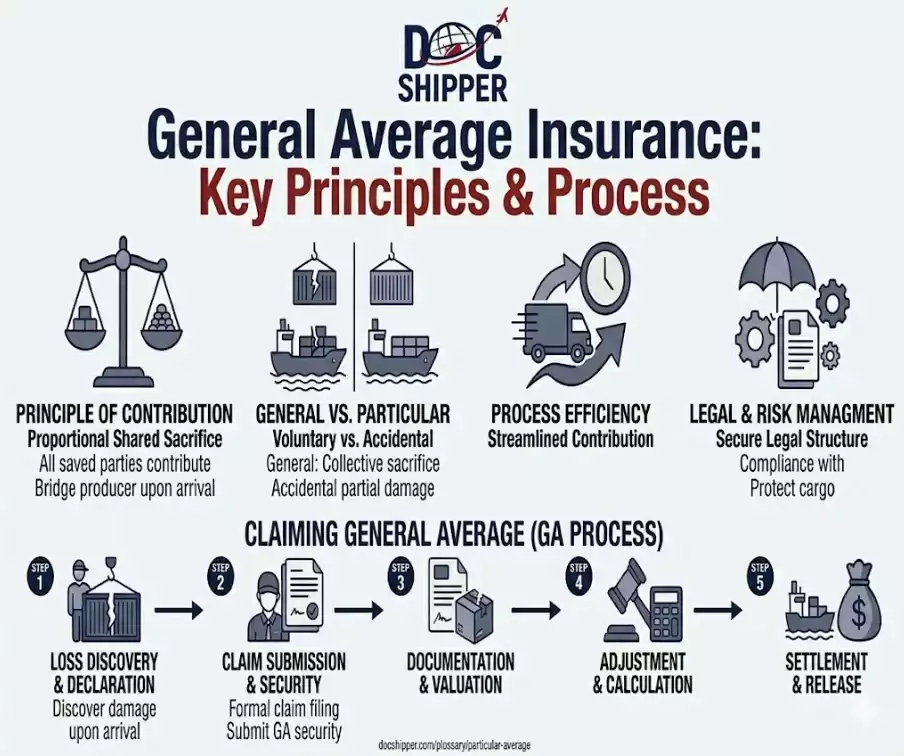
For General Average to apply, three conditions must exist simultaneously. First, the vessel must face common danger threatening all property involved in the maritime adventure. Second, the master must make a voluntary sacrifice or incur extraordinary expenses. Third, these actions must successfully preserve at least part of the common venture.
Common triggering events include jettisoning cargo to lighten the vessel, intentionally grounding to prevent sinking, firefighting expenses at sea, or emergency port refuge costs. Salvage operations, while related, follow separate legal frameworks unless specifically declared as General Average by all parties.
The adjustment process begins when the shipowner declares General Average. An appointed Average Adjuster—typically from firms like Richards Hogg Lindley or YPSA—investigates the incident and calculates each party’s contribution. This process commonly takes 12 to 24 months for complex cases.
Before cargo release, shippers must provide either a General Average Bond plus cash deposit or a General Average Guarantee from their insurance underwriter. At DocShipper, we immediately notify clients of GA declarations and coordinate with insurers to expedite these arrangements, minimizing storage costs and delivery delays.
According to International Maritime Organization statistics, approximately 200-300 General Average cases are declared annually worldwide, with values ranging from thousands to hundreds of millions of dollars depending on vessel size and cargo value.
Calculation Methods & Real-World Scenarios
General Average contributions are calculated using the contributory values principle. Each party contributes proportionally based on the saved value of their property relative to the total preserved value. The formula establishes fairness: those with more at stake pay proportionally more.
Real-World Case Study: In 2019, a container ship experienced engine failure and drifted toward rocks. The captain ordered emergency tug services costing $500,000 and refuge port expenses of $300,000. Total GA expenses: $800,000.
| Party | Property Value | Percentage | GA Contribution |
|---|---|---|---|
| Vessel Owner | $20,000,000 | 50% | $400,000 |
| Cargo Owner A | $12,000,000 | 30% | $240,000 |
| Cargo Owner B | $8,000,000 | 20% | $160,000 |
| Total | $40,000,000 | 100% | $800,000 |
The calculation uses contributory values (property values after the casualty) rather than original values. If cargo was partially lost during the incident, only the saved portion contributes. This approach prevents parties whose property was completely lost from contributing to expenses that didn’t benefit them.
Key factors affecting final contributions:
- Allowable expenses: Only costs directly related to saving the common venture qualify (crew wages excluded, special fuel costs included)
- Currency fluctuations: Multi-month adjustments can result in exchange rate impacts on final settlements
- Interest charges: Most adjustments include interest from incident date to settlement date
- Adjuster fees: Professional adjustment costs (typically 2-5% of GA amount) are distributed among contributors
- Insurance recoveries: Underwriters ultimately pay most contributions for insured cargo
According to industry data from 2023, the average General Average case takes 18 months to adjust, with cash deposits typically ranging from 10% to 40% of cargo value depending on incident severity and Average Adjuster assessment.
Conclusion
General Average remains a fundamental maritime principle balancing risk and reward across ocean transport stakeholders. Understanding your obligations protects against unexpected costs and supply chain disruptions. Proper marine cargo insurance coverage typically includes GA contributions, making adequate coverage essential for international shippers.
Need guidance navigating General Average declarations or marine insurance requirements? Contact DocShipper for expert support throughout your shipping journey.
📚 Quiz
Test Your Knowledge: General Average
General Average requires all parties in a maritime venture to share losses resulting from:
If your cargo was completely lost during the incident that triggered General Average (e.g., jettisoned overboard), you:
A container ship encounters engine failure requiring emergency tug services costing $600,000. Your cargo represents 15% of the total saved property value. Your General Average contribution would be:
🎯 Your Result
📞 Free Personalized QuoteFAQ | General Average: Definition, Calculation & Practical Examples in Marine Insurance
General Average involves voluntary sacrifices or expenses benefiting all parties in a maritime venture, with costs shared proportionally. Particular Average refers to partial losses or damages affecting only one party's property, covered individually by that party's insurance without contribution from others. The key distinction lies in whether the loss benefits the entire venture or impacts only specific cargo.
No. General Average is a legal obligation enforced through maritime lien rights. If you refuse to provide a GA bond or guarantee, the carrier can legally retain your cargo indefinitely. Additionally, refusal may breach your sales contract terms and damage business relationships. Proper marine cargo insurance eliminates personal financial exposure by covering your GA contribution obligations.
Most General Average adjustments require 12 to 24 months to complete, though simple cases may settle in 6 months while complex incidents can extend beyond 3 years. Duration depends on incident complexity, number of cargo interests involved, documentation completeness, and potential disputes. Average Adjusters must collect evidence, verify values, and calculate precise contributions before final settlement.
Yes, most marine cargo insurance policies written under Institute Cargo Clauses (A, B, or C) automatically include General Average coverage. This means your insurer pays your proportional contribution and advances the required cash deposit or guarantee. Always verify your policy includes GA coverage before shipping valuable goods, as some basic policies may exclude this protection.
You typically need: the original General Average Bond form (provided by the carrier or adjuster), cargo commercial invoice showing CIF value, packing list, Bill of Lading, and either a cash deposit (usually 10-40% of cargo value) or a General Average Guarantee issued by your marine insurance underwriter. Some adjusters also require power of attorney documentation authorizing signature.
The shipowner or vessel operator typically appoints the Average Adjuster, often selecting firms with international recognition like Richards Hogg Lindley, Burness Corlett Three Quays, or YPSA. While cargo interests don't choose the adjuster, the York-Antwerp Rules ensure impartial professional standards. Cargo owners can engage their own consultants to review adjustment calculations before accepting final settlements.
If your cargo was totally lost in the incident triggering General Average (for example, jettisoned overboard), you generally don't contribute to GA expenses since your property derived no benefit from the sacrifice. However, you must still prove total loss with documentation. Your insurance claim would cover the cargo loss itself, separate from General Average proceedings affecting saved cargo.
Yes, shipowners can declare General Average weeks or even months after delivery if they initially underestimated incident costs or later discovered qualifying expenses. However, most declarations occur before discharge to secure cargo interests' contributions. Delayed declarations complicate collection but remain legally valid. This underscores the importance of maintaining adequate insurance coverage throughout the policy period.
Contributory value is calculated as the cargo's arrived sound value at destination port, minus any damage sustained during the voyage. This typically equals CIF invoice value plus freight and insurance costs. If cargo was damaged during the incident, the reduced value (assessed by surveyors) determines contribution amount. This ensures parties only contribute based on what was actually saved by the emergency actions.
The York-Antwerp Rules provide standardized international guidelines for declaring, adjusting, and settling General Average claims. First established in 1890 and periodically updated (latest 2016 version), these rules define allowable expenses, calculation methods, and procedural requirements. Most Bills of Lading incorporate these rules by reference, creating predictable legal frameworks for multi-national maritime ventures and reducing disputes.
Absolutely. General Average fully applies to containerized shipments. In fact, container vessel GA cases have increased due to larger vessel sizes and higher cargo values at risk. If containers are jettisoned, salvaged, or if extraordinary expenses are incurred to save the vessel, all container cargo owners contribute proportionally. This makes GA coverage particularly important for FCL and LCL shipments alike.
Individual cargo owners cannot negotiate their proportional contribution percentage, as this is calculated mathematically based on saved property values under York-Antwerp Rules. However, you can challenge the Average Adjuster's calculations if you believe errors exist in expense categorization, value assessments, or mathematical computations. Legal counsel specializing in maritime law can review adjustments and file formal objections when warranted.
Need Help with
Logistics or Sourcing ?
First, we secure the right products from the right suppliers at the right price by managing the sourcing process from start to finish. Then, we simplify your shipping experience - from pickup to final delivery - ensuring any product, anywhere, is delivered at highly competitive prices.


Fill the Form
Prefer email? Send us your inquiry, and we’ll get back to you as soon as possible.
Contact us




