


In short ⚡
Gross Tonnage (GT) is a dimensionless index representing the total internal volume of a ship, calculated according to the International Convention on Tonnage Measurement of Ships (1969). It serves as the primary measurement for vessel registration, port dues calculation, and regulatory compliance in international maritime transport.
Introduction
Many shippers confuse Gross Tonnage with weight or cargo capacity, leading to miscalculations in port fees and regulatory compliance. Unlike deadweight tonnage (DWT) or displacement, GT measures the ship’s total enclosed space, not its carrying ability.
This measurement impacts every aspect of maritime logistics: from insurance premiums to crew requirements, from canal transit fees to environmental regulations. Understanding GT is essential for accurate cost forecasting in international shipping.
- Universal measurement standard: Applied globally under IMO conventions since 1982
- Non-weight metric: Represents volume (cubic meters), not mass (tons)
- Fee calculation basis: Determines port charges, pilotage fees, and canal tolls
- Regulatory threshold: Triggers safety and environmental compliance requirements
- Insurance impact: Influences premium calculations and liability limits
Technical Framework & Regulatory Applications
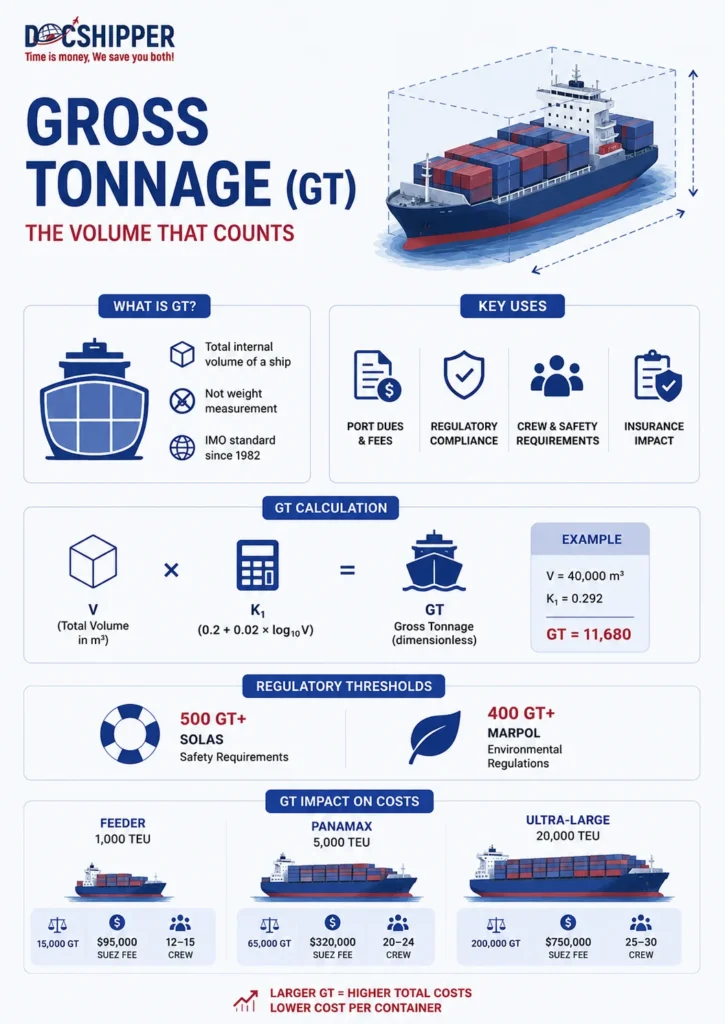
The GT calculation follows a standardized formula defined by the International Maritime Organization (IMO). The basic formula is GT = K₁ × V, where K₁ is a coefficient (0.2 + 0.02 × log₁₀V) and V represents the total volume of all enclosed spaces in cubic meters.
This measurement differs fundamentally from Net Tonnage (NT), which measures only revenue-earning spaces. GT includes all enclosed volumes: cargo holds, accommodation spaces, engine rooms, and even ballast tanks. The distinction matters because regulatory thresholds often reference GT exclusively.
Vessels above 500 GT must comply with SOLAS (Safety of Life at Sea) requirements, including specific firefighting equipment, life-saving appliances, and radio communication systems. Ships exceeding 400 GT face mandatory MARPOL environmental regulations, including pollution prevention equipment and certification.
Port authorities worldwide base their tariff structures on GT. A container ship of 50,000 GT may pay USD 15,000-25,000 in port dues per call, while a 150,000 GT ultra-large container vessel could face charges exceeding USD 60,000. These calculations make GT a critical factor in route optimization and cost planning.
The Panama Canal and Suez Canal use modified tonnage systems (PC/UMS and SCNT respectively) derived from GT principles. Understanding the relationship between these measurements prevents costly surprises during transit planning. At DocShipper, we systematically verify vessel tonnage classifications to ensure accurate transit fee estimates for our clients’ shipments.
Calculation Methods & Practical Examples
The GT formula appears complex but follows predictable patterns. For a vessel with 40,000 cubic meters of enclosed space, the calculation proceeds as follows: K₁ = 0.2 + 0.02 × log₁₀(40,000) = 0.2 + 0.02 × 4.602 = 0.292. Therefore, GT = 0.292 × 40,000 = 11,680 GT.
Real-world applications demonstrate GT’s financial impact. Consider three common vessel types transporting goods from Asia to Europe:
| Vessel Type | Gross Tonnage | Port Dues (Rotterdam) | Suez Canal Fee | Crew Requirement |
|---|---|---|---|---|
| Feeder (1,000 TEU) | 15,000 GT | €8,500 | $95,000 | 12-15 crew |
| Panamax (5,000 TEU) | 65,000 GT | €28,000 | $320,000 | 20-24 crew |
| Ultra-Large (20,000 TEU) | 200,000 GT | €65,000 | $750,000 | 25-30 crew |
The cost-per-container ratio improves with vessel size despite higher absolute GT. A 20,000 TEU vessel paying $750,000 in Suez transit costs only $37.50 per container, while a 1,000 TEU feeder pays $95 per container—a 156% difference in unit economics.
Regulatory thresholds create strategic decision points. A vessel of 499 GT avoids certain SOLAS requirements, while 501 GT triggers full compliance. Ship designers often optimize internal volumes to stay below critical GT thresholds, balancing cargo capacity against regulatory burden.
Practical use case: A logistics company planning regular shipments between Shanghai and Hamburg must factor GT-based costs into carrier selection. Choosing a 150,000 GT vessel over multiple 50,000 GT vessels reduces per-unit transit costs by approximately 30%, but requires sufficient cargo volume to justify the larger ship’s capacity.
Insurance companies use GT as a primary underwriting metric. Marine hull insurance premiums increase proportionally with GT, typically ranging from 0.15% to 0.4% of the vessel’s insured value annually. A 100,000 GT container ship valued at $120 million might carry annual insurance costs of $180,000-480,000.
Conclusion
Gross Tonnage serves as the maritime industry’s universal language for vessel measurement, directly impacting operational costs, regulatory compliance, and route economics. Accurate GT understanding enables precise logistics planning and cost forecasting in international trade.
Need expert guidance on vessel selection or international shipping cost optimization? Contact DocShipper for tailored logistics solutions that account for all tonnage-related variables in your supply chain.
📚 Quiz
Test Your Knowledge: Gross Tonnage (GT)
What does Gross Tonnage (GT) actually measure in maritime transport?
Which regulatory threshold triggers full SOLAS safety compliance requirements?
A logistics manager is comparing port costs for two vessels: a 50,000 GT feeder and a 150,000 GT ultra-large container ship. Which statement correctly describes the GT impact on unit economics?
🎯 Your Result
📞 Free Quote in 24hFAQ | Gross Tonnage (GT): Definition, Calculation & Practical Examples
Gross Tonnage measures the total enclosed volume of a ship in a dimensionless index, while Deadweight Tonnage (DWT) represents the actual weight (in metric tons) a vessel can safely carry, including cargo, fuel, crew, and provisions. GT is used for regulatory and fee purposes; DWT indicates cargo capacity.
Most ports worldwide calculate dues using a tariff-per-GT formula. A typical major port might charge €0.40-€0.80 per GT per call. For a 100,000 GT vessel, this translates to €40,000-€80,000 in port fees alone, making GT a significant cost factor in route planning and vessel selection.
Ships exceeding 500 GT must comply with full SOLAS (Safety of Life at Sea) regulations, including mandatory safety equipment, specific crew certifications, and regular inspections. This threshold significantly increases operational complexity and costs, making it a critical design consideration for shipbuilders.
Yes. Structural modifications, conversions, or major refits can alter a vessel's enclosed volume, requiring GT recalculation and re-certification. Port authorities may also reassess GT if discrepancies are discovered during inspections, potentially affecting historical fee calculations.
The Panama Canal uses PC/UMS (Panama Canal Universal Measurement System) and the Suez Canal uses SCNT (Suez Canal Net Tonnage), both derived from GT principles but with specific adjustments. These modified systems ensure fair toll calculations based on vessel size and earning capacity through the waterways.
No. Net Tonnage (NT) measures only the revenue-earning spaces within a vessel, excluding crew quarters, engine rooms, and navigation areas. NT is typically 50-70% of GT and is used primarily for certain regulatory calculations and manning requirements.
Insurers use GT as a primary risk assessment factor. Larger GT typically correlates with higher vessel value and greater potential exposure, resulting in proportionally higher premiums. Hull and machinery insurance rates often range from 0.15% to 0.5% of insured value, with GT influencing the specific rate applied.
All merchant vessels engaged in international voyages must have an International Tonnage Certificate (ITC) stating their GT. Domestic vessels may use alternative measurement systems depending on national regulations, but international trade requires IMO-compliant GT certification.
Online calculators provide approximations useful for preliminary planning, but official GT must be calculated by certified marine surveyors following precise IMO protocols. Actual measurements account for complex hull geometries and internal structures that simplified formulas cannot capture accurately.
Incorrect GT declarations can result in retroactive fee adjustments, fines, or port entry refusals. If discovered during audits, ship operators may face penalties plus interest on underpaid fees dating back several years, creating significant financial liabilities.
MARPOL environmental requirements apply differently based on GT thresholds. Ships above 400 GT must comply with specific pollution prevention standards, while vessels exceeding 5,000 GT face additional CO₂ emission reporting and efficiency requirements under the IMO's greenhouse gas strategy.
Absolutely. GT measures total enclosed volume, while cargo capacity depends on hold design and weight limits. A multi-deck ro-ro vessel might have significantly higher GT than a bulk carrier with identical cargo weight capacity, due to differences in internal space configuration and accommodation areas.
Need Help with
Logistics or Sourcing ?
First, we secure the right products from the right suppliers at the right price by managing the sourcing process from start to finish. Then, we simplify your shipping experience - from pickup to final delivery - ensuring any product, anywhere, is delivered at highly competitive prices.


Fill the Form
Prefer email? Send us your inquiry, and we’ll get back to you as soon as possible.
Contact us




