


In short ⚡
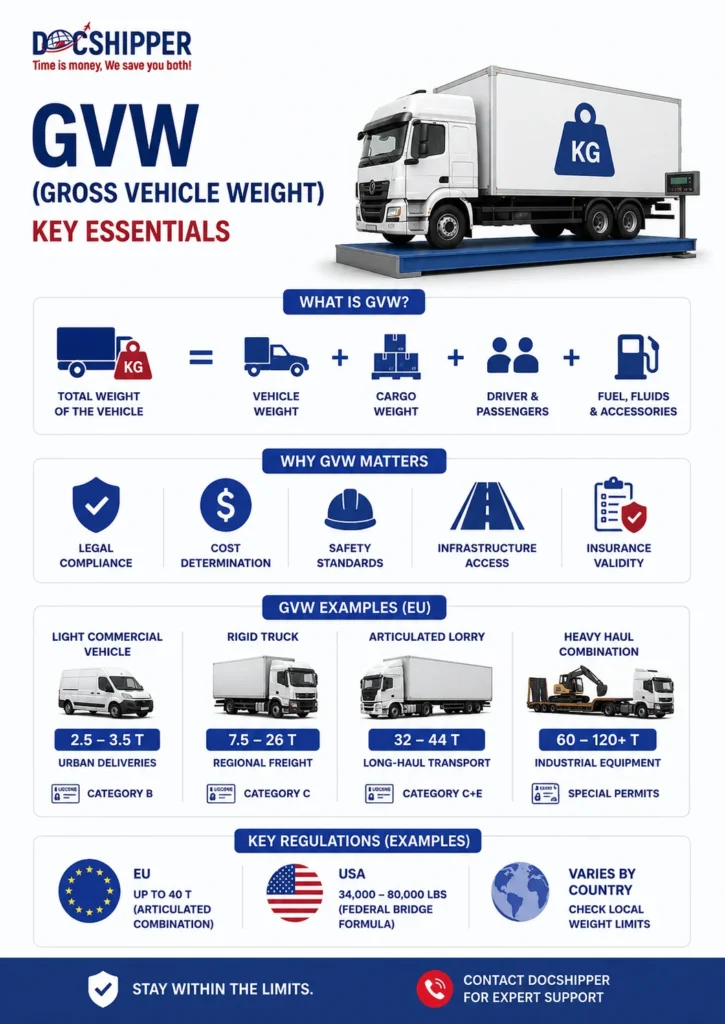
Gross Vehicle Weight (GVW) is the total weight of a vehicle including its chassis, body, engine, fluids, fuel, accessories, driver, passengers, and cargo. This metric is critical in international logistics as it determines road legality, carrier capacity compliance, and freight cost calculations across borders.
Introduction
A common confusion in freight logistics involves distinguishing between vehicle weight ratings. Shippers often mistake curb weight for GVW, leading to compliance violations and unexpected transport surcharges. Understanding Gross Vehicle Weight becomes essential when coordinating cross-border shipments where weight limits vary significantly between jurisdictions.
In international trade, GVW directly impacts route planning, carrier selection, and customs documentation. Many countries enforce strict weight regulations on highways and bridges, making accurate GVW calculation non-negotiable for successful import/export operations.
- Legal Compliance: Exceeding GVW limits triggers fines ranging from €500 to €5,000 in EU countries
- Cost Determination: Freight rates often tier by GVW brackets (under 3.5T, 7.5T, 12T, etc.)
- Safety Standards: Vehicle components are rated for specific GVW thresholds
- Infrastructure Access: Urban zones and tunnels impose GVW restrictions
- Insurance Validity: Coverage may be voided if operating above manufacturer’s GVW rating
Technical Framework & Regulatory Implications
GVW operates within a hierarchy of weight classifications. The manufacturer’s GVW rating represents the maximum safe operating weight as certified during vehicle homologation. This differs from Gross Combination Weight (GCW), which includes trailers, and from curb weight, which excludes cargo and passengers.
Regulatory bodies worldwide establish statutory GVW limits for different road categories. The European Union’s Directive 96/53/EC sets standard limits: 18 tonnes for rigid trucks with two axles, 26 tonnes for three-axle vehicles, and 40 tonnes for articulated combinations. The United States Federal Bridge Formula determines legal GVW based on axle spacing and number, ranging from 34,000 lbs (single axle) to 80,000 lbs (five-axle combination).
Calculating GVW requires precision. The formula is straightforward: Vehicle Tare Weight + Cargo Weight + Occupants. However, complications arise with partial loads, liquid cargo subject to temperature expansion, and weight distribution across axles. Improper distribution can result in legal GVW but illegal axle weights.
International shipments must navigate bilateral weight agreements. For example, trucks operating under the TIR Convention between Turkey and Germany must comply with the stricter limit of the two countries. At DocShipper, we systematically verify GVW compliance across all transit countries to prevent costly delays at weigh stations or border crossings.
Documentation requirements vary by jurisdiction. The UK requires operators to maintain Vehicle Plating Certificates displaying GVW ratings. Australia mandates Mass Management Accreditation for vehicles exceeding 4.5 tonnes GVW. Non-compliance can result in vehicle impoundment until weight is reduced. The European Weights and Dimensions Directive harmonizes enforcement across member states, though national enforcement rigor varies significantly.
Practical Examples & Data
Consider a common scenario: A manufacturer in Vietnam exports machinery to Poland using a 40-foot container. The container tare weight is 3,800 kg, cargo weighs 24,200 kg, giving a gross container weight of 28,000 kg. The receiving truck’s GVW rating is 44 tonnes (chassis: 8,500 kg, fuel and driver: 200 kg).
The calculation: 8,500 kg (truck) + 28,000 kg (container) + 200 kg = 36,700 kg total GVW. This remains within the 44-tonne rating and Poland’s 40-tonne legal limit for five-axle combinations. However, if the shipper had used a smaller chassis rated for 26 tonnes GVW, the operation would be illegal despite proper container weight.
| Vehicle Category | Typical GVW Range | Common Applications | Licensing Requirement (EU) |
|---|---|---|---|
| Light Commercial Vehicle | 2.5 – 3.5 tonnes | Urban deliveries, parcels | Category B (standard car license) |
| Rigid Truck | 7.5 – 26 tonnes | Regional freight, construction materials | Category C |
| Articulated Lorry | 32 – 44 tonnes | Long-haul international transport | Category C+E |
| Heavy Haul Combination | 60 – 120+ tonnes | Industrial equipment, wind turbines | Special permits required |
Real-world cost implications are significant. A logistics provider in Germany operates with tiered pricing: €1.20 per km for GVW under 12 tonnes, €1.65/km for 12-26 tonnes, and €2.10/km above 26 tonnes. A shipper miscalculating GVW by 500 kg could cross a pricing threshold, adding €450 to a 1,000 km journey.
Case Study: A Brazilian coffee exporter shipped 60 pallets (21,600 kg) to Rotterdam. The forwarding agent selected a truck with 40-tonne GVW rating. Upon arrival at Dutch customs, axle weight inspection revealed the rear axle exceeded 11.5 tonnes (legal limit: 11 tonnes), despite total GVW being compliant. The driver had to redistribute 8 pallets to a second vehicle, incurring €1,200 in additional handling and a 6-hour delay.
This scenario illustrates why experienced operators like DocShipper use axle load calculators alongside GVW verification. We account for cargo density, pallet positioning, and center of gravity to ensure compliance with both aggregate and distributed weight regulations.
Conclusion
Mastering GVW calculations prevents legal penalties, optimizes freight costs, and ensures operational safety in international logistics. Accurate weight management requires understanding vehicle ratings, regulatory frameworks, and distribution mechanics beyond simple addition.
Need expert guidance on weight compliance for your shipments? Contact DocShipper’s team for tailored logistics solutions that account for every regulatory nuance.
📚 Quiz
Test Your Knowledge: GVW (Gross Vehicle Weight)
What does GVW (Gross Vehicle Weight) include?
A truck complies with the total GVW limit but fails inspection. What is the most likely cause?
Your shipment from Vietnam to Poland weighs 24,200 kg in a container (tare: 3,800 kg). The truck chassis weighs 8,500 kg with 200 kg for fuel and driver. What is the correct GVW?
🎯 Your Result
📞 Free Custom Quote in 24hFAQ | GVW (Gross Vehicle Weight): Definition, Calculation & Practical Examples
GVW (Gross Vehicle Weight) is the actual total weight at any given moment, while GVWR (Gross Vehicle Weight Rating) is the maximum permissible weight determined by the manufacturer. Operating at GVW above GVWR voids warranties and violates safety standards.
Add the vehicle's unladen weight (curb weight) to the total weight of cargo, passengers, fuel, and equipment. Use certified scales for accuracy, as fuel alone can add 500-800 kg depending on tank capacity. Always cross-reference against the vehicle's GVWR plate.
Yes. While the manufacturer's GVWR remains constant, legal operating GVW limits differ by country. A truck may legally carry 44 tonnes in Germany but only 40 tonnes in France. International operators must comply with the strictest limit along their route.
Penalties vary widely: EU countries impose fines from €500-€5,000 plus potential vehicle impoundment. In the US, fines reach $16,000 for severe overloads. Repeat violations can result in operator license suspension and increased insurance premiums.
Yes, significantly. Many European toll systems (France's Télépéage, Germany's LKW-MAUT) charge based on GVW categories. A vehicle crossing from 11.9 to 12.1 tonnes GVW might see toll costs increase by 30-40% on certain routes.
Customs authorities use static weigh scales or portable axle scales. Some borders employ weigh-in-motion systems that measure GVW without stopping vehicles. Non-compliant loads face immediate unloading requirements, storage fees, and re-booking costs.
GVW is the total vehicle weight, while axle weight measures load on individual axles. A vehicle can comply with GVW limits but violate axle weight limits if cargo is improperly distributed. Both metrics must be independently verified.
Yes. Battery packs add 1,500-3,000 kg compared to diesel equivalents, reducing cargo capacity. However, EU Directive 2015/719 allows a 1-tonne GVW bonus for alternative fuel vehicles to compensate for powertrain weight, maintaining competitive payload.
Commercial vehicle insurance policies specify maximum GVW coverage. Operating above this limit voids coverage, leaving operators personally liable for accidents. Insurers may also increase premiums for vehicles frequently near maximum GVW due to higher wear-related risks.
Absolutely. Fuel efficiency decreases approximately 0.4 liters/100km for every additional tonne of GVW in long-haul operations. Accurate GVW tracking enables precise fuel budgeting and identifies opportunities for load optimization to reduce transport carbon footprint.
Required documents include the vehicle's registration certificate showing GVWR, cargo manifests with declared weights, weighbridge tickets from certified facilities, and load distribution diagrams. TIR carnet shipments require customs-verified weight declarations at each border.
Temperature variations impact liquid cargo volume (chemicals expand 0.1% per 10°C), hygroscopic goods absorb moisture (adding up to 5% weight), and fuel density changes. Winter equipment (chains, extra fuel) adds 100-200 kg. Experienced operators like DocShipper adjust calculations seasonally to maintain compliance buffers.
Need Help with
Logistics or Sourcing ?
First, we secure the right products from the right suppliers at the right price by managing the sourcing process from start to finish. Then, we simplify your shipping experience - from pickup to final delivery - ensuring any product, anywhere, is delivered at highly competitive prices.


Fill the Form
Prefer email? Send us your inquiry, and we’ll get back to you as soon as possible.
Contact us




