


In short ⚡
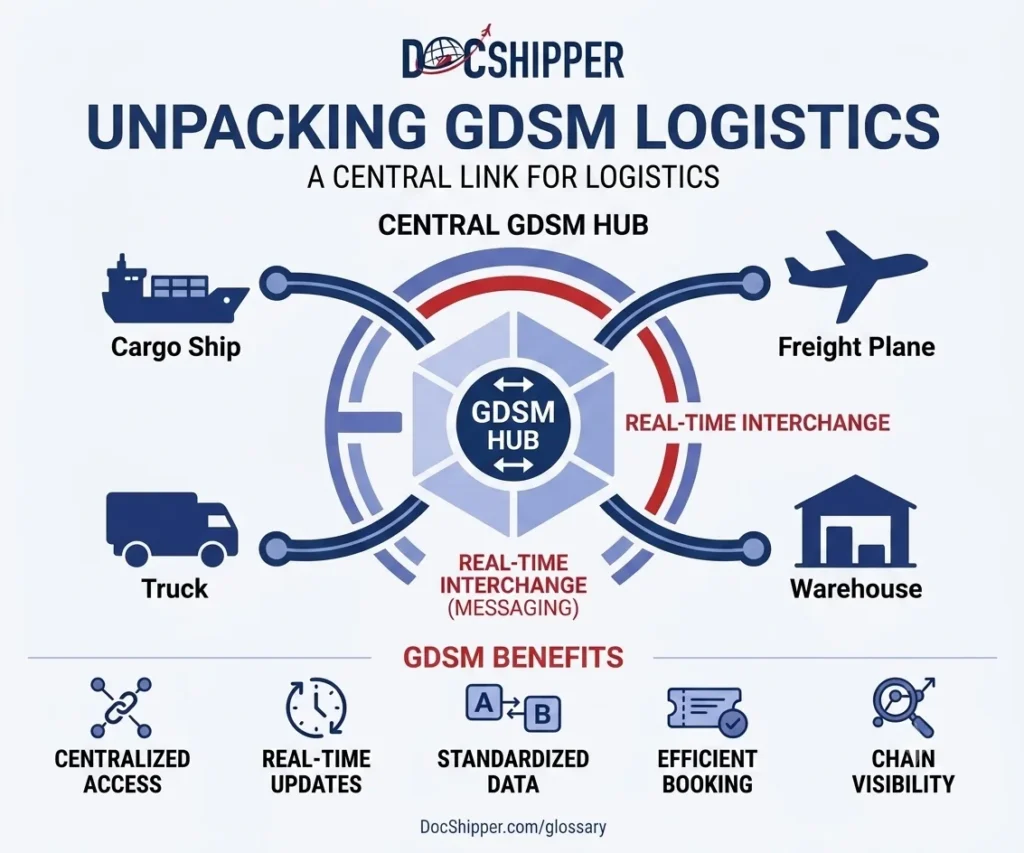
GDSM (Global Distribution Systems and Messaging) refers to integrated platforms that combine product distribution networks with standardized messaging protocols. These systems enable real-time data exchange between suppliers, logistics providers, and end customers across international supply chains, facilitating automated booking, inventory synchronization, and shipment tracking.
Introduction
Many international trade professionals struggle with fragmented communication channels that create delays, errors, and visibility gaps throughout their supply chain. The lack of standardized messaging between freight forwarders, customs brokers, and carriers often results in manual data re-entry and contradictory information across systems.
GDSM platforms emerged to solve this critical coordination challenge. Originally developed for airline reservations, these systems have evolved into comprehensive logistics infrastructures that connect multiple stakeholders through unified data protocols.
Key characteristics of GDSM platforms include:
- Real-time synchronization: Instantaneous updates across all connected parties when shipment status changes
- Standardized messaging formats: EDI, XML, API protocols ensuring universal compatibility
- Multi-modal integration: Seamless connections between air, ocean, rail, and ground transportation networks
- Automated documentation: Generation of commercial invoices, packing lists, and customs declarations from unified data sources
- Centralized inventory visibility: Single source of truth for stock levels across warehouses, transit points, and distribution centers
Technical Framework & Industry Standards
GDSM architecture relies on middleware layers that translate proprietary systems into common messaging formats. The most prevalent standard is UN/EDIFACT (United Nations Electronic Data Interchange For Administration, Commerce and Transport), which defines message structures for booking confirmations, shipment status updates, and customs declarations.
Modern GDSM platforms incorporate API-first designs using RESTful architectures and JSON payloads. This approach enables faster integration with e-commerce platforms, warehouse management systems, and transportation management systems. The shift from batch processing to event-driven messaging has reduced data latency from hours to milliseconds.
Security protocols form the foundation of reliable GDSM operations. OAuth 2.0 authentication, SSL/TLS encryption, and role-based access controls ensure that sensitive commercial data remains protected while maintaining operational transparency. Compliance with GDPR regulations requires GDSM providers to implement data residency controls and audit trails.
The message orchestration layer handles routing logic, transformation rules, and error handling. When a container vessel updates its ETA, the orchestration engine automatically notifies customs brokers, inland trucking companies, and warehouse operators according to predefined business rules. This eliminates manual notification workflows that previously consumed hours of administrative effort.
At DocShipper, we integrate our operations with major GDSM platforms to provide clients with automated milestone tracking from factory pickup to final delivery. Our systems automatically validate booking details against carrier capacity and route availability before confirming shipments.
Interoperability standards remain critical as supply chains involve dozens of software systems. The International Air Transport Association’s Cargo-XML and the International Maritime Organization’s FAL Convention define mandatory data elements that GDSM platforms must support to facilitate cross-border trade.
Operational Implementation & Performance Data
Consider a European electronics importer receiving components from three Asian manufacturers. Without GDSM integration, this company previously spent 15-20 hours weekly consolidating shipment data from email attachments, carrier websites, and phone calls with freight forwarders.
After implementing GDSM connectivity, the same operation requires 2 hours weekly of monitoring rather than active data gathering. The system automatically aggregates booking confirmations, container loading notifications, and customs clearance updates into a unified dashboard.
| Metric | Pre-GDSM | Post-GDSM | Improvement |
|---|---|---|---|
| Data entry errors per 100 shipments | 12-15 | 1-2 | 87% reduction |
| Shipment visibility updates (daily) | Manual checks 2x/day | Real-time (24/7) | 12x increase |
| Average response time to customer inquiries | 4-6 hours | 15 minutes | 95% faster |
| Documentation preparation time | 45-60 min/shipment | 5-10 min/shipment | 85% reduction |
| Customs clearance delays due to missing data | 18% of shipments | 3% of shipments | 83% reduction |
A practical use case involves temperature-controlled pharmaceutical shipments. GDSM platforms integrate with IoT sensors attached to refrigerated containers, transmitting temperature readings every 15 minutes. When temperature deviations occur, the system automatically alerts the pharmaceutical company, freight forwarder, and destination warehouse simultaneously.
This automated alert mechanism proved critical for a vaccine distributor during a summer heatwave when port congestion caused containers to remain stationary for extended periods. The early warning allowed the team to arrange priority discharge and backup refrigeration, preventing $480,000 in potential product losses.
Industry data from the International Federation of Freight Forwarders Associations indicates that companies using integrated GDSM platforms experience 27% shorter transit times due to reduced administrative delays and proactive exception management.
Key performance indicators for successful GDSM implementation:
- Message delivery success rate: Target 99.9% for critical shipment milestones
- System uptime: Minimum 99.5% availability during business hours across all time zones
- Data accuracy rate: Less than 0.5% discrepancies between source systems and GDSM records
- Integration completion time: New trading partner onboarding within 5-7 business days
- User adoption rate: 80%+ of logistics staff actively using GDSM interfaces within 90 days
Conclusion
GDSM platforms transform fragmented supply chain communications into synchronized, automated workflows that reduce costs, improve accuracy, and enable proactive decision-making. The combination of standardized messaging protocols with real-time data exchange creates competitive advantages through operational efficiency and customer service excellence.
Need expert guidance on implementing GDSM connectivity within your logistics operations? Contact DocShipper for a customized integration assessment.
📚 Quiz
Test Your Knowledge: GDSM (Global Distribution Systems and Messaging)
What is the primary purpose of GDSM platforms in international logistics?
A small freight forwarder believes GDSM technology is only suitable for Fortune 500 companies due to cost and complexity. Is this assessment accurate?
A pharmaceutical company needs to monitor temperature-controlled shipments across ocean and rail segments. Which GDSM capability would be most relevant?
🎯 Your Result
📞 Free Quote in 24hFAQ | GDSM (Global Distribution Systems and Messaging): Definition, Functionality & Real-World Applications
While traditional EDI (Electronic Data Interchange) focuses on batch-based document exchange between two parties, GDSM platforms provide real-time, multi-party messaging across entire distribution networks. GDSM systems incorporate modern APIs, mobile accessibility, and event-driven architectures that EDI lacks. However, many GDSM platforms maintain EDI compatibility for legacy system integration.
Implementation timelines vary based on system complexity and trading partner volumes. Basic GDSM connectivity for 5-10 carriers can be established within 6-8 weeks. Comprehensive implementations involving warehouse management systems, customs platforms, and ERP integration typically require 3-6 months. Cloud-based GDSM solutions generally deploy 40-50% faster than on-premise alternatives.
GDSM pricing models include subscription fees ($500-$5,000 monthly depending on transaction volume), per-message charges ($0.10-$0.50 per EDI transaction), and integration setup fees ($10,000-$50,000 for custom connections). Small-to-medium freight forwarders typically invest $25,000-$75,000 annually, while large logistics providers may spend $200,000-$500,000 for enterprise-grade GDSM capabilities.
Yes, modern GDSM platforms offer pre-built connectors for major WMS providers including Manhattan Associates, Blue Yonder, and SAP Extended Warehouse Management. Integration typically involves API configuration to synchronize inventory levels, inbound shipment notifications, and outbound order fulfillment status. Most implementations achieve full bidirectional synchronization within 4-6 weeks.
GDSM platforms automatically generate customs declarations by mapping shipment data to country-specific regulatory formats. Systems maintain libraries of HS codes, tariff schedules, and preferential trade agreement rules. When booking a shipment from Vietnam to Germany, the GDSM extracts product classifications, calculates duties under EU-Vietnam FTA provisions, and generates the required Entry Summary Declaration without manual intervention.
Enterprise GDSM providers implement multi-layered security including AES-256 encryption for data at rest, TLS 1.3 for data in transit, and tokenization for sensitive fields like pricing information. Role-based access controls ensure users only view data relevant to their responsibilities. Annual SOC 2 Type II audits verify compliance with information security standards. Some platforms offer private cloud deployments for clients with stringent data sovereignty requirements.
GDSM systems automatically convert measurements (kilograms to pounds, cubic meters to cubic feet) and currencies based on trading partner preferences and regulatory requirements. Platforms maintain real-time exchange rate feeds from financial institutions, applying rates at the time of transaction rather than historical averages. This ensures accurate landed cost calculations and eliminates discrepancies in international invoicing.
Cloud-based GDSM solutions have made this technology accessible to companies of all sizes. Small importers shipping 50-100 containers annually can leverage shared GDSM platforms at $100-$300 monthly, gaining visibility and automation previously available only to Fortune 500 companies. The reduction in administrative workload often justifies the investment when managing more than 20 shipments monthly.
Reputable GDSM providers maintain redundant data centers with automatic failover capabilities, ensuring service continuity during infrastructure issues. Systems queue messages during brief outages and automatically resynchronize when connectivity restores. Service level agreements typically guarantee 99.5-99.9% uptime with financial penalties for extended disruptions. Critical shipment data should always have backup processes, such as email notifications, to prevent operational paralysis during system maintenance.
Advanced GDSM systems track shipments across air, ocean, rail, and trucking segments within unified interfaces. When a container transfers from vessel to rail at the Port of Rotterdam, the GDSM automatically updates the transportation mode, recalculates ETAs based on rail schedules, and notifies the destination warehouse of the revised delivery window. This eliminates the need to monitor separate carrier portals for each transportation leg.
AI-enhanced GDSM systems analyze historical shipment patterns to predict potential delays, recommend optimal routing alternatives, and automate routine decisions like carrier selection based on cost and reliability metrics. Machine learning algorithms identify anomalies in customs documentation that could trigger inspections, allowing proactive corrections before shipment departure. Natural language processing enables users to query shipment status using conversational interfaces rather than navigating complex dashboards.
GDSM providers implement data residency controls that store EU customer information within European data centers to comply with GDPR requirements. Systems maintain detailed audit logs tracking who accessed specific shipment data and when, supporting right-to-erasure requests and data portability obligations. For China market operations, GDSM platforms establish local hosting infrastructure to meet cybersecurity law requirements while maintaining global visibility through encrypted cross-border data transfers.
Need Help with
Logistics or Sourcing ?
First, we secure the right products from the right suppliers at the right price by managing the sourcing process from start to finish. Then, we simplify your shipping experience - from pickup to final delivery - ensuring any product, anywhere, is delivered at highly competitive prices.


Fill the Form
Prefer email? Send us your inquiry, and we’ll get back to you as soon as possible.
Contact us




:%20Definition,%20Functionality%20&%20Real-World%20Applications)