


In short ⚡
A hostler is a specialized operator responsible for moving trailers, containers, and cargo equipment within terminals, warehouses, and distribution centers without hauling them over public roads. Unlike long-haul truck drivers, hostlers perform short-distance maneuvers using yard trucks (also called spotters, yard dogs, or terminal tractors) to position cargo for loading, unloading, or storage, ensuring seamless flow in logistics hubs.
Introduction
Many people confuse hostlers with traditional truck drivers, yet their roles differ fundamentally. While over-the-road drivers transport goods between cities, hostlers operate exclusively within facility perimeters, orchestrating the precise ballet of trailers that keeps supply chains moving.
In modern logistics, where warehouses handle thousands of containers daily, hostlers serve as the critical connective tissue between inbound shipments and outbound distribution. Their specialized skills directly impact turnaround times, dock availability, and overall operational efficiency.
Key characteristics of hostler operations include:
- Yard Management: Positioning trailers at designated loading docks, staging areas, or parking zones
- Equipment Specialization: Operating purpose-built yard trucks designed for frequent coupling/uncoupling
- Safety Protocols: Conducting pre-operation inspections and adhering to facility-specific safety standards
- Coordination: Communicating with dispatchers, dock managers, and warehouse personnel
- Efficiency Focus: Minimizing dwell time and maximizing dock utilization rates
Role & Operational Expertise
The hostler position demands a unique blend of technical skill and spatial awareness. Unlike long-haul driving that emphasizes endurance and highway navigation, hostler work requires precision maneuvering in confined spaces often congested with vehicles, equipment, and personnel.
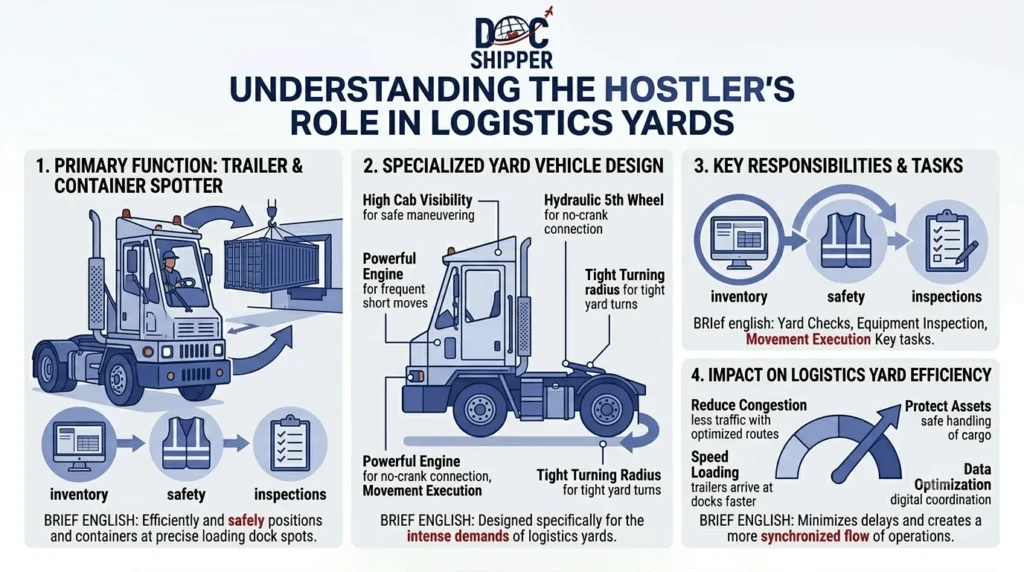
Hostlers typically operate yard trucks—specialized tractors with enhanced visibility, tighter turning radius, and automatic fifth-wheel coupling systems. These vehicles lack the sleeping compartments and long-distance amenities of road tractors, instead prioritizing agility and ease of trailer attachment.
Licensing requirements vary by jurisdiction. In the United States, hostlers generally need a Class A or B Commercial Driver’s License (CDL) if operating on public roads, though some states exempt purely on-site operations. The Federal Motor Carrier Safety Administration (FMCSA) provides guidance on commercial vehicle operator requirements.
Beyond driving skills, successful hostlers master yard logistics systems. Modern facilities employ yard management software (YMS) that assigns trailers to specific locations using barcode scanning or RFID technology. Hostlers interact with these systems through handheld devices, updating trailer positions in real-time.
Safety responsibilities constitute a critical component of the role. Hostlers conduct daily vehicle inspections checking brake systems, coupling mechanisms, lights, and warning devices. They must recognize hazardous conditions like damaged trailers, leaking containers, or unstable loads, escalating issues before creating safety incidents.
At DocShipper, our logistics partners employ trained hostlers who coordinate seamlessly with our warehouse teams, ensuring containers arrive at the correct dock precisely when needed. This synchronization reduces demurrage charges and accelerates cargo processing for our clients.
Practical Examples & Industry Data
To understand hostler impact on logistics efficiency, consider a mid-sized distribution center processing 200 trailers daily. With an average handling time of 12 minutes per trailer movement, hostlers collectively execute 40 operating hours of trailer positioning work each day.
Use Case: Cross-Dock Operation
A regional parcel carrier operates a cross-dock facility where inbound LTL (less-than-truckload) shipments arrive throughout the night for consolidation and outbound dispatch by morning. Hostlers perform the following sequence:
- 22:00-02:00: Position arriving inbound trailers at receiving docks (60 trailers)
- 02:00-05:00: Move emptied inbound trailers to parking areas; stage outbound trailers at shipping docks (80 movements)
- 05:00-06:00: Final positioning of loaded outbound trailers at departure gates (40 trailers)
This operation requires 3-4 hostlers working in coordinated shifts to maintain flow without dock congestion.
Comparative Analysis: Hostler Efficiency Metrics
| Metric | Manual Operation | With YMS Integration |
|---|---|---|
| Avg. Move Time | 15 minutes | 9 minutes |
| Misplacement Rate | 8-12% | 1-2% |
| Daily Trailer Throughput | 180 units | 240 units |
| Incident Rate (per 1000 moves) | 3.2 | 0.8 |
Industry data reveals that facilities employing professional hostlers with modern yard management systems achieve 35-40% higher dock utilization compared to operations where general warehouse staff perform trailer movements ad-hoc.
Economic Impact: For a facility processing 50,000 containers annually, improving hostler efficiency by just 3 minutes per move translates to 2,500 labor hours saved—equivalent to approximately $75,000 in operational cost reduction while simultaneously increasing throughput capacity.
Port terminals present another critical application. Container terminals employ hostlers to shuttle chassis between vessel discharge areas, inspection zones, and outbound truck gates. A large port facility may deploy 20-30 hostlers per shift managing thousands of container movements daily.
Conclusion
Hostlers represent an often-overlooked yet essential component of efficient logistics operations, directly influencing facility throughput, safety standards, and operational costs. Their specialized expertise in yard management separates high-performing logistics facilities from those struggling with congestion and inefficiency.
Need expert support optimizing your warehouse operations or coordinating complex logistics movements? Contact DocShipper for comprehensive supply chain solutions tailored to your requirements.
📚 Quiz
Test Your Knowledge: Hostler
What is the primary operational scope of a hostler?
According to industry data, what efficiency improvement do facilities achieve when employing professional hostlers with modern yard management systems?
A distribution center processes 200 trailers daily with an average handling time of 12 minutes per movement. What does this scenario demonstrate about hostler operations?
🎯 Your Result
📞 Free Personalized QuoteFAQ | Hostler: Definition, Role & Practical Examples in Logistics
A hostler operates exclusively within facility boundaries, moving trailers short distances between docks and staging areas using specialized yard trucks. Truck drivers transport cargo over public roads between different locations, requiring different licensing, equipment, and skillsets focused on long-distance transportation rather than precision yard maneuvering.
Requirements vary by jurisdiction and operation scope. In the US, hostlers typically need a Class A or B CDL if crossing public roads or operating vehicles above certain weight thresholds. Some states exempt purely private-property operations from CDL requirements, though employers often prefer licensed operators for insurance and liability reasons. Always verify local regulations.
Hostlers primarily operate yard trucks (also called yard spotters, yard dogs, or terminal tractors)—specialized tractors designed for frequent trailer coupling/uncoupling with enhanced visibility, tight turning radius, and automatic fifth-wheel systems. They may also operate reach stackers, container handlers, or other material-handling equipment depending on facility type.
Compensation varies by region, experience, and facility type. In the United States, hostlers typically earn $35,000-$55,000 annually, with experienced operators at major ports or distribution centers reaching $60,000-$70,000. Night shift differentials, union representation, and overtime opportunities can significantly increase total compensation. Benefits often include health insurance and retirement plans.
Critical skills include precision vehicle maneuvering in confined spaces, spatial awareness, safety consciousness, basic mechanical knowledge for pre-operation inspections, communication abilities for coordinating with dispatchers and dock workers, and increasingly, familiarity with yard management software and handheld scanning devices used in modern logistics facilities.
Demand remains strong across logistics sectors, particularly as e-commerce drives warehouse expansion and operational intensity. The Bureau of Labor Statistics projects steady growth in material moving occupations through 2030. Facilities struggle to find qualified hostlers due to commercial driving requirements and the specialized nature of yard operations.
Primary hazards include backing incidents (limited visibility despite mirrors/cameras), coupling/uncoupling injuries (pinch points, fifth-wheel malfunctions), slips/trips around trailers, weather exposure, and interaction with pedestrians or forklifts in congested yards. Proper training, equipment maintenance, and adherence to facility safety protocols mitigate these risks significantly.
Absolutely. Hostler positions provide excellent entry into logistics careers, offering pathways to yard supervisor, dispatcher, operations manager, or long-haul truck driver roles. The operational knowledge gained about facility workflows, safety systems, and cargo handling proves invaluable for advancement throughout supply chain management careers.
Yard management systems (YMS) are software platforms tracking trailer locations, contents, and status throughout facility grounds. Hostlers use handheld devices or in-cab tablets to scan trailer IDs, receive movement instructions, update positions, and flag issues. This digitization eliminates paper-based systems, reduces errors, and provides real-time visibility to operations managers.
Yes, port terminals employ significant numbers of hostlers (often called yard jockeys in maritime contexts) to move containers on chassis between vessel operations areas, customs inspection zones, empty container depots, and truck gates. Port hostler work involves higher volumes and more complex coordination than typical warehouse operations.
Training typically includes classroom instruction on safety regulations, equipment operation, and company policies, followed by supervised on-the-job practice. Topics cover pre-operation inspections, coupling/uncoupling procedures, yard navigation, emergency protocols, and facility-specific software systems. Training duration ranges from several days to two weeks depending on employer requirements and candidate experience.
Most hostler positions are full-time, often with shift work covering 24/7 operations at busy facilities. Night and weekend shifts are common, particularly at cross-dock operations, ports, and distribution centers serving retail or e-commerce sectors. Part-time positions exist but are less common, usually at smaller facilities with lower daily volumes.
Need Help with
Logistics or Sourcing ?
First, we secure the right products from the right suppliers at the right price by managing the sourcing process from start to finish. Then, we simplify your shipping experience - from pickup to final delivery - ensuring any product, anywhere, is delivered at highly competitive prices.


Fill the Form
Prefer email? Send us your inquiry, and we’ll get back to you as soon as possible.
Contact us




