


In short ⚡
A dock is a designated loading and unloading area where vehicles (trucks, ships, trains) interface with warehouses or terminals to transfer goods. It serves as the critical connection point between transportation modes and storage facilities, enabling efficient cargo handling in supply chain operations.
Introduction
Many logistics professionals confuse “dock” with simple loading bays, yet modern dock systems represent sophisticated operational hubs that directly impact delivery times and warehouse efficiency. Understanding dock configurations is essential for optimizing freight operations.
In international trade, docks constitute the physical interface where customs clearance, quality inspections, and cross-docking operations occur. Their design determines throughput capacity and operational costs.
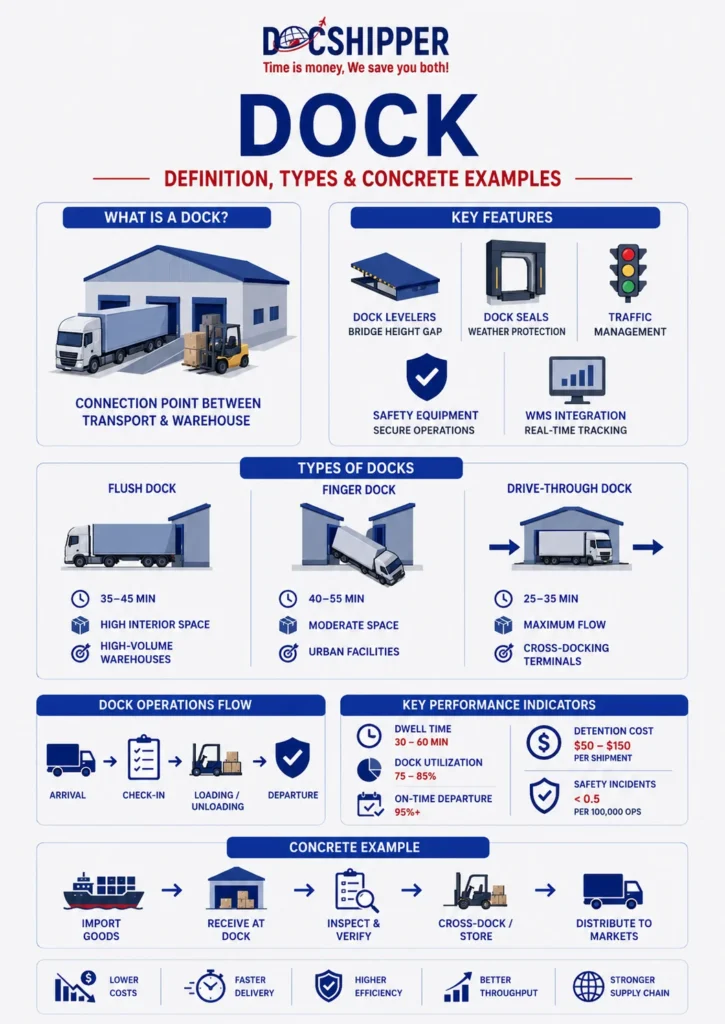
Key characteristics of docks include:
- Adjustable dock levelers compensating height differences between vehicles and warehouse floors
- Dock seals or shelters protecting cargo from weather during transfer
- Traffic management systems coordinating vehicle arrival and departure
- Safety equipment including wheel chocks and restraint systems
- Integration with WMS (Warehouse Management Systems) for real-time inventory tracking
Dock Types & Operational Mechanisms
Dock configurations vary significantly based on facility design, cargo types, and operational requirements. Understanding these distinctions prevents costly errors in warehouse planning and carrier coordination.
The three primary dock types serve distinct functions. Flush docks align trucks perpendicular to the building, maximizing interior space but requiring larger yards. Finger docks position vehicles at 45-degree angles, reducing land requirements while complicating maneuvering. Drive-through docks allow vehicles to enter one side and exit another, ideal for cross-docking operations.
Dock levelers bridge the gap between vehicle beds and warehouse floors. Mechanical levelers use springs or hydraulics, while air-powered systems offer maintenance advantages. The standard adjustment range spans 12 to 18 inches, accommodating most commercial vehicles.
According to OSHA dock safety regulations, facilities must implement vehicle restraint systems to prevent premature departure during loading. Modern systems integrate electronic sensors with warehouse management software.
Dock scheduling systems have become critical in high-volume operations. These platforms coordinate carrier appointments, reducing wait times by up to 40%. Pre-arrival notifications enable warehouse teams to prepare equipment and labor before vehicle arrival.
At DocShipper, we assess dock capacity during facility audits to identify bottlenecks that delay international shipments. Our logistics engineers recommend dock configurations optimized for specific cargo profiles and throughput requirements. Need expertise on warehouse infrastructure? Contact our team.
Concrete Examples & Performance Data
Real-world dock operations demonstrate how configuration choices impact efficiency. Quantifying these differences helps logistics managers justify infrastructure investments.
Use Case: E-commerce Distribution Center
A 500,000 sq ft facility in Ohio operates 48 flush docks with automated scheduling. Peak capacity reaches 120 trucks daily with an average dwell time of 38 minutes. Implementing dock appointment software reduced congestion by 32% and cut detention fees by $180,000 annually.
Comparative Dock Performance:
| Dock Type | Average Turnaround | Space Efficiency | Best Application |
|---|---|---|---|
| Flush Dock | 35-45 minutes | High interior / Low exterior | High-volume warehouses |
| Finger Dock | 40-55 minutes | Moderate both | Urban facilities |
| Drive-Through | 25-35 minutes | Maximum flow | Cross-docking terminals |
Cross-Docking Efficiency Scenario:
A European automotive parts distributor processes 280 shipments daily through 12 drive-through docks. Goods spend less than 4 hours in the facility. This model reduced inventory holding costs by 58% compared to traditional warehousing while maintaining 99.2% on-time delivery.
Key Performance Indicators for Dock Operations:
- Dock utilization rate: Target 75-85% to balance efficiency and flexibility
- Dwell time: Industry standard 30-60 minutes depending on cargo complexity
- On-time departure percentage: Best-in-class facilities achieve 95%+
- Detention cost per shipment: Average $50-150 beyond grace periods
- Safety incidents per 100,000 dock operations: Leading facilities report <0.5
Conclusion
Dock infrastructure directly influences supply chain velocity and cost structure. Selecting appropriate configurations and implementing management systems transforms loading areas from bottlenecks into competitive advantages.
Need guidance on optimizing your dock operations for international shipments? Contact DocShipper for expert facility assessment and logistics solutions.
📚 Quiz
Test Your Knowledge: Dock Operations
1. What is the primary function of a dock in logistics operations?
2. Which dock configuration achieves the fastest turnaround times for cross-docking operations?
3. A warehouse processes 80 shipments daily with 45-minute average turnaround in 12-hour operations. How many docks are minimally required?
🎯 Your Results
📞 Free Quote in 24hFAQ | Dock: Definition, Types & Concrete Examples in Logistics
Standard dock heights range from 48 to 52 inches from ground level, matching typical truck bed heights. Levelers compensate for variations, extending up to 18 inches below and 12 inches above dock level to accommodate different vehicle types from vans to refrigerated trailers.
Dock quantity depends on daily shipment volume and dwell time. The formula is: (Daily shipments × Average dwell hours) ÷ Operating hours. Add 15-20% buffer capacity. A facility handling 80 shipments with 45-minute average turnaround needs approximately 8-10 docks for single-shift operations.
A dock door is the physical overhead door providing building access, while the dock encompasses the entire loading platform, leveler, seal/shelter, and associated equipment. The dock is the operational system; the door is one component enabling vehicle access to that system.
Standard 53-foot domestic containers fit flush docks designed for tractor-trailers. However, 20-foot and 40-foot ISO shipping containers require chassis positioning precision. Some facilities use portable dock plates or ground-level doors for container unloading when dock height mismatches occur.
OSHA mandates vehicle restraint systems, wheel chocks, dock levelers with safety lips, and proper lighting. Additional recommended equipment includes communication systems between drivers and dock workers, high-visibility markings, and edge-of-dock protection. Regular maintenance documentation is legally required in most jurisdictions.
Scheduling systems eliminate congestion by staggering arrivals, allowing warehouses to allocate labor and equipment optimally. Data shows facilities using appointment platforms reduce driver wait times by 35-50% and increase dock utilization rates from typical 60-65% to 80-85%, directly improving throughput capacity.
Cross-docking transfers goods directly from inbound to outbound vehicles with minimal storage time. Drive-through docks excel for this operation, allowing simultaneous loading and unloading from opposite sides. This configuration reduces handling steps and can cut distribution costs by 30-40% for suitable cargo types.
Refrigerated docks feature insulated seals, inflatable shelters, and rapid-close doors to maintain cold chain integrity during loading. They typically include vestibule areas creating airlocks between warehouse and exterior. Energy costs increase 40-60% compared to ambient docks due to climate control requirements.
The top three delay causes are: inadequate appointment scheduling (35% of delays), equipment failures like broken levelers (28%), and driver arrival documentation issues (22%). Implementing dock management software and preventive maintenance programs addresses over 60% of common delay scenarios.
Modern AGV and AMR systems seamlessly integrate with dock operations through WMS connectivity. Automated vehicles transport pallets between docks and storage areas, reducing labor costs by 40-50% in high-volume facilities. Successful integration requires precise dock positioning systems and standardized pallet dimensions.
Finger docks at 45-60 degree angles maximize door quantity within constrained footprints, though they increase maneuvering difficulty. Alternative solutions include ground-level doors with portable ramps or vertical lift systems. Urban facilities often operate extended hours to compensate for lower dock counts.
Insufficient dock capacity creates bottlenecks during customs examinations, potentially incurring demurrage and detention charges. Facilities handling international freight should designate specific docks for customs-hold cargo, maintaining segregation from domestic goods. This separation streamlines inspections and reduces clearance delays by 25-35%.
Need Help with
Logistics or Sourcing ?
First, we secure the right products from the right suppliers at the right price by managing the sourcing process from start to finish. Then, we simplify your shipping experience - from pickup to final delivery - ensuring any product, anywhere, is delivered at highly competitive prices.


Fill the Form
Prefer email? Send us your inquiry, and we’ll get back to you as soon as possible.
Contact us




