


In short ⚡
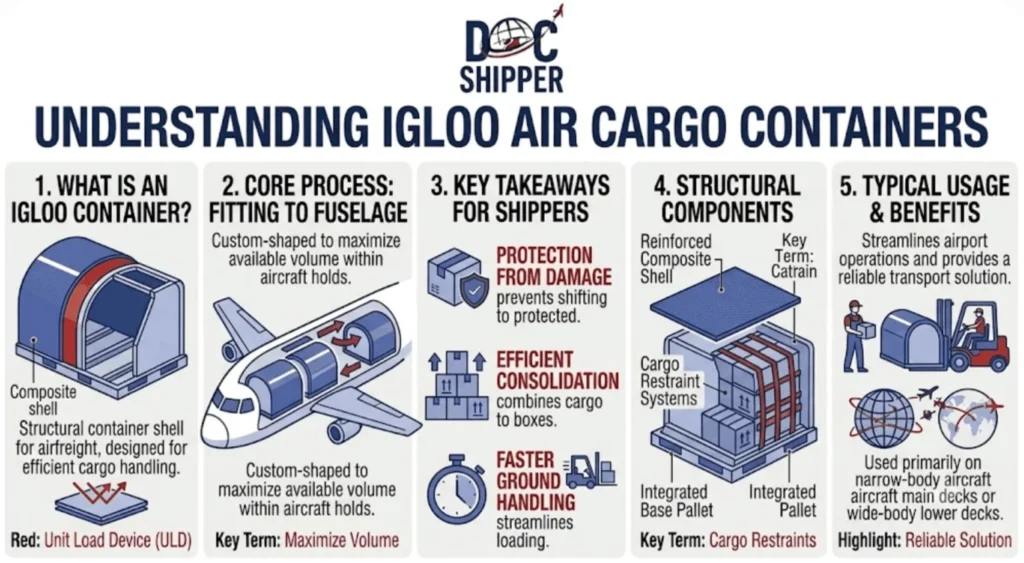
Igloos are specialized, lightweight aluminum containers designed to fit precisely into aircraft cargo holds for air freight operations. These standardized Unit Load Devices (ULDs) optimize space utilization, protect goods during transit, and enable rapid loading/unloading procedures. Igloos feature a contoured shape matching aircraft fuselage profiles, maximizing volumetric efficiency while maintaining strict weight regulations for aviation logistics.
Introduction
International air freight operators frequently face a critical challenge: how to maximize cargo volume within the curved interior of aircraft fuselages while maintaining weight balance and cargo security. Traditional rectangular containers waste valuable space in these contoured environments, creating inefficiency that directly impacts operational costs.
Igloos emerged as the aviation industry’s solution to this geometric problem. These purpose-engineered containers represent a fundamental component of modern air cargo operations, particularly for wide-body aircraft transporting high-value or time-sensitive shipments across intercontinental routes.
Understanding igloo specifications becomes essential for:
- Freight forwarders planning volumetric optimization for air shipments
- Importers/exporters calculating actual transport costs based on ULD configurations
- Logistics managers coordinating temperature-controlled pharmaceutical or perishable cargo
- Customs brokers verifying seal integrity and ULD documentation compliance
- Supply chain planners evaluating modal shift economics between ocean and air freight
Technical Specifications & Aviation Standards
Igloos adhere to strict IATA (International Air Transport Association) standards governing dimensions, materials, and structural integrity. The most common type, the LD-3 container, measures approximately 60.4 inches (length) × 61.5 inches (width) × 64 inches (height), with a maximum gross weight of 3,500 pounds including tare weight.
The distinctive contoured design serves multiple engineering purposes. The angled base and curved profile match the lower deck geometry of aircraft like the Boeing 767 or Airbus A330, eliminating void spaces that would otherwise reduce payload capacity by 15-20%. This geometric efficiency translates directly into revenue optimization for air carriers.
Material construction typically involves aluminum alloy frameworks with reinforced corners and locking mechanisms. Advanced variants incorporate composite materials reducing tare weight by 8-12%, thereby increasing available payload within aviation weight restrictions. Temperature-controlled igloos feature insulated walls with integrated cooling systems for pharmaceutical or perishable cargo requiring GDP (Good Distribution Practice) compliance.
The IATA ULD Regulations establish mandatory certification protocols. Each igloo receives a unique identifier code stamped on its exterior, enabling tracking through global cargo networks. At DocShipper, we verify ULD certification status during pre-shipment inspections to prevent operational delays caused by non-compliant equipment at origin airports.
Operational lifespan typically ranges 10-15 years with proper maintenance cycles. Airlines and ground handling agencies conduct quarterly inspections checking for structural fatigue, locking mechanism integrity, seal functionality, corrosion levels, and RFID tag operability. Damaged units undergo immediate decertification to maintain aviation safety standards.
Operational Applications & Industry Data
Real-world igloo utilization demonstrates significant cost-efficiency advantages in specific trade lanes. Consider a pharmaceutical manufacturer shipping temperature-sensitive vaccines from Frankfurt to Singapore:
| Container Type | Volumetric Capacity | Effective Payload | Cost per Cubic Meter |
|---|---|---|---|
| LD-3 Igloo (Insulated) | 4.2 m³ | 1,400 kg | $285 |
| Standard Rectangular ULD | 3.5 m³ | 1,450 kg | $342 |
| Loose Loading (no container) | Variable | 1,200 kg | $410 |
This comparison reveals that igloo utilization reduces per-cubic-meter transport costs by 17% compared to standard ULDs and 30% versus loose-loaded configurations. The savings compound on high-frequency routes where airlines operate dedicated freighter aircraft optimized for igloo configurations.
Use Case: Electronics Distribution
A consumer electronics brand consolidates shipments from Shenzhen to Dubai during peak retail season. By utilizing 12 LD-3 igloos per flight instead of mixed ULD types, the company achieves:
- Loading time reduction: 42 minutes faster turnaround per aircraft cycle
- Damage rate decrease: From 1.8% to 0.3% due to standardized handling procedures
- Volumetric efficiency gain: Additional 840 kg payload capacity per flight
- Customs clearance acceleration: Pre-sealed igloos enable expedited inspection protocols
- Carbon footprint optimization: Reduced flights needed for equivalent volume (8.5% CO₂ reduction)
Industry data from 2023 air cargo statistics indicates that 68% of wide-body freighter operations on Asia-Europe routes employ igloos for at least 40% of lower deck configurations. The adoption rate increases to 82% for temperature-controlled pharmaceutical shipments requiring validated cold chain integrity.
Emerging markets show growing igloo adoption. African trade lanes experienced a 34% increase in igloo usage between 2021-2023, driven by pharmaceutical vaccine distribution programs and fresh produce exports requiring expedited transit times. Latin American routes similarly demonstrate 27% growth, particularly for high-value automotive components and electronic assemblies.
Conclusion
Igloos represent specialized aviation engineering solutions that directly impact air freight economics through geometric optimization and standardized handling protocols. Understanding their technical specifications and operational applications enables informed decision-making for international shipping strategies.
Need expert guidance on optimizing your air freight operations with appropriate ULD configurations? Contact DocShipper for comprehensive logistics consulting tailored to your supply chain requirements.
📚 Quiz
Test Your Knowledge: Igloos in Air Freight
What is the primary purpose of an igloo's contoured shape in air cargo operations?
An LD-3 igloo has a maximum gross weight of 3,500 pounds. What does this weight include?
A pharmaceutical company needs to ship temperature-sensitive vaccines from Europe to Asia. Which scenario correctly applies igloo usage?
🎯 Your Result
📞 Free Quote in 24hFAQ | Igloos in Logistics: Definition, Applications & Operational Examples
The LD-3 igloo has a maximum gross weight of 3,500 pounds (1,588 kg), which includes both the container's tare weight (approximately 180-220 pounds) and the cargo payload. Actual usable payload capacity typically ranges from 1,400 to 1,500 kg depending on specific aircraft weight distribution requirements and the igloo's construction materials.
Igloos are enclosed containers with rigid aluminum structures and contoured shapes matching aircraft fuselage profiles, while pallets are flat platforms requiring additional netting or shrink-wrapping for cargo securement. Igloos provide superior protection against weather, theft, and handling damage, whereas pallets offer faster loading for uniformly sized cargo. Cost per kilogram typically favors igloos for high-value or environmentally sensitive shipments.
Yes, specialized thermal igloos feature insulated walls with active or passive cooling systems maintaining temperatures between 2°C and 8°C for up to 72 hours. These units comply with WHO and GDP standards for pharmaceutical distribution, incorporating data loggers that record temperature deviations throughout transit. Airlines charge premium rates of 35-60% above standard igloo fees for these temperature-controlled configurations.
Wide-body aircraft including Boeing 747F, 767F, 777F, Airbus A330F, and A350F accommodate igloos in their lower cargo decks. Narrow-body aircraft like Boeing 737 or Airbus A320 families typically cannot utilize igloos due to fuselage diameter limitations. Cargo planners must verify specific aircraft configurations, as passenger variants of wide-body planes may have restricted ULD compatibility compared to dedicated freighter versions.
Igloo shipments generally cost 15-25% more in base freight rates compared to loose-loaded cargo, but deliver significant value through reduced damage rates (0.3% vs 2.1%), faster customs clearance (pre-sealed units), and improved handling efficiency. For high-value electronics or pharmaceuticals, insurance premium reductions of 8-12% often offset the higher freight costs, creating net cost advantages on total landed cost calculations.
Trained ground handling crews load a single LD-3 igloo in approximately 90-120 seconds using powered conveyor systems and roller tracks. A complete wide-body freighter lower deck configuration (10-12 igloos) requires 18-25 minutes for full loading, representing 40% time savings compared to hand-loaded loose cargo. Automated systems at major cargo hubs reduce loading times by an additional 15-20%.
Igloos contribute to environmental efficiency through optimized space utilization, reducing the number of flights needed for equivalent cargo volumes. Their reusable aluminum construction (10-15 year lifespan) minimizes single-use packaging waste. Industry studies indicate that standardized igloo operations reduce fuel consumption by 6-9% per ton-kilometer compared to mixed loading methods, translating to measurable carbon footprint reductions on high-frequency routes.
Standard air waybills (AWB) must reference the specific igloo ULD code, including its unique identifier and seal numbers. Temperature-controlled shipments require additional GDP compliance certificates and continuous temperature monitoring records. Customs authorities may demand physical inspection despite sealed status, particularly for high-risk origin countries or commodity codes requiring veterinary/phytosanitary certification under international trade agreements.
Yes, freight forwarders frequently consolidate multiple shippers' cargo into single igloos on high-traffic routes, provided goods are compatible in handling requirements and destination. Consolidation requires detailed manifesting with separate house air waybills for each shipper nested under a master AWB. This practice reduces per-shipper costs by 30-45% compared to dedicated ULD allocation, though it may extend delivery timelines by 12-24 hours due to deconsolidation procedures at destination.
Airlines maintain liability coverage for cargo damage caused by igloo structural failure, typically limited to SDR 19 per kilogram under Montreal Convention provisions. Shippers should secure supplementary cargo insurance for high-value goods. Damaged igloos undergo immediate removal from service, with replacement units substituted at origin airports. Ground handling agents document damage incidents through standardized IATA property irregularity reports (PIR) for insurance claim processing.
Modern igloos incorporate RFID tags and barcode systems enabling real-time tracking through airport cargo management systems. Each ULD movement generates electronic records including loading time, flight number, and destination facility. Airlines utilize specialized ULD control systems monitoring fleet utilization rates, maintenance schedules, and geographic distribution. Advanced systems provide predictive analytics identifying igloos requiring repositioning to high-demand routes, optimizing network-wide equipment availability.
Cargo insurance providers often offer reduced premium rates (8-15% lower) for igloo shipments versus loose-loaded cargo due to superior protection and lower historical damage rates. Policies should specifically cover "container to container" transit, as standard warehouse-to-warehouse coverage may exclude periods when cargo remains sealed in igloos during intermodal transfers. Temperature-controlled pharmaceutical shipments require specialized endorsements covering thermal excursion events, typically adding 20-35% to base premium costs.
Need Help with
Logistics or Sourcing ?
First, we secure the right products from the right suppliers at the right price by managing the sourcing process from start to finish. Then, we simplify your shipping experience - from pickup to final delivery - ensuring any product, anywhere, is delivered at highly competitive prices.


Fill the Form
Prefer email? Send us your inquiry, and we’ll get back to you as soon as possible.
Contact us




