


In short ⚡
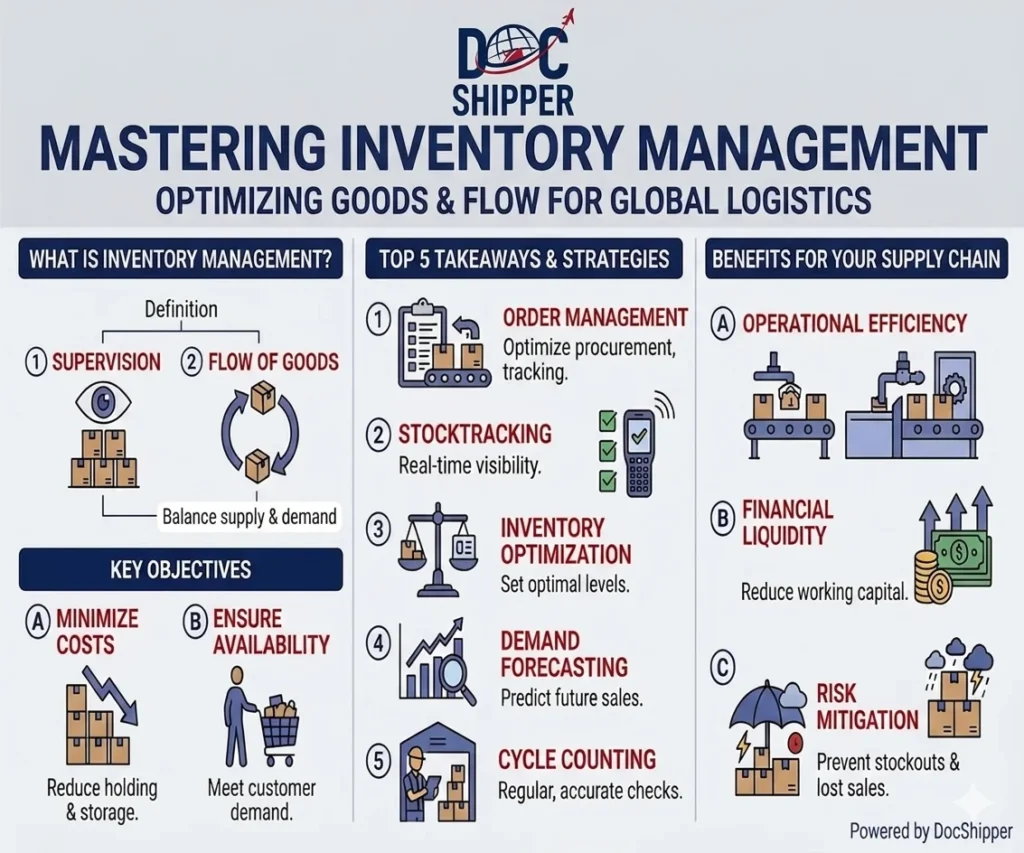
Inventory Management is the systematic process of ordering, storing, using, and tracking goods throughout the supply chain. It encompasses raw materials, work-in-progress, and finished products to optimize stock levels, minimize costs, and ensure product availability while preventing overstocking or stockouts.
Introduction
Many businesses struggle with the same inventory dilemma: too much stock ties up capital, while too little risks lost sales. This balance becomes critical in international trade where lead times extend, customs procedures complicate replenishment, and demand fluctuates across markets.
Effective inventory management directly impacts cash flow, customer satisfaction, and operational efficiency. In import/export operations, poor inventory control can lead to demurrage charges, expired products, or missed market opportunities. Companies that master inventory optimization gain competitive advantages through reduced carrying costs and improved service levels.
Key characteristics of modern inventory management include:
- Real-time visibility across multiple warehouses and transit locations
- Demand forecasting using historical data and market trends
- Automated reordering based on predetermined thresholds
- SKU-level tracking for accurate stock counts and traceability
- Integration with ERP systems for seamless financial and operational data flow
Mechanisms & Technical Expertise
Inventory management systems operate through several complementary methodologies. The perpetual inventory system continuously updates stock levels with each transaction, providing real-time accuracy essential for fast-moving consumer goods. Conversely, the periodic inventory system requires physical counts at regular intervals, suitable for smaller operations with limited SKU diversity.
The Economic Order Quantity (EOQ) model calculates the optimal order size that minimizes total inventory costs. This formula balances ordering costs against holding costs, determining the most cost-effective purchase quantity. For international shipments, EOQ calculations must factor in container optimization and minimum order quantities imposed by manufacturers.
Safety stock levels act as buffers against demand variability and supply chain disruptions. Calculating appropriate safety stock requires analyzing lead time variability, demand volatility, and desired service levels. International logistics adds complexity through customs delays, port congestion, and geopolitical risks that extend lead times unpredictably.
The ABC analysis categorizes inventory based on value contribution. Category A items represent 70-80% of inventory value but only 10-20% of units, requiring tight control and frequent review. Category C items constitute 5-10% of value but 50-70% of units, managed with simpler systems. This prioritization ensures resources focus where financial impact is greatest.
Just-in-Time (JIT) methodology minimizes inventory by synchronizing production with demand. While reducing carrying costs significantly, JIT requires exceptional supplier reliability and supply chain visibility. At DocShipper, we assess whether clients’ supply chains possess the stability necessary for JIT implementation or if strategic buffer stocks better serve their risk profile.
Regulatory compliance adds another layer to inventory management in international trade. According to U.S. Customs and Border Protection, accurate inventory records are mandatory for customs audits and trade program participation. Discrepancies can trigger penalties, duty reassessments, or loss of preferential trade benefits.
Concrete Examples & Data
Industry benchmarks reveal significant variations in inventory turnover ratios across sectors. Retail averages 8-12 turns annually, while electronics manufacturing achieves 15-20 turns due to component obsolescence risks. Conversely, heavy machinery industries may experience only 2-4 turns given longer production cycles and higher unit values.
| Inventory Method | Holding Cost Reduction | Stockout Risk | Best Application |
|---|---|---|---|
| Just-in-Time | 60-80% | High | Stable demand, reliable suppliers |
| Safety Stock Buffer | 15-25% | Low | Variable demand, long lead times |
| Vendor-Managed Inventory | 30-45% | Medium | Strategic partnerships, consignment |
| Economic Order Quantity | 20-30% | Medium | Predictable demand, bulk discounts |
Use Case: Electronics Importer Optimization
A European electronics distributor importing from Asia faced $2.3 million in excess inventory carrying costs annually. Lead times averaged 45 days, with demand varying 30% seasonally. By implementing ABC analysis, the company identified that 18% of SKUs represented 75% of revenue.
The solution involved three-tiered management: A-category products received weekly air shipments with minimal safety stock, B-category items transitioned to bi-weekly sea freight with moderate buffers, and C-category products consolidated into quarterly orders. Results after 12 months showed inventory reduction of 38% while maintaining 97% fill rates.
At DocShipper, we helped this client implement the new system by coordinating mixed-mode shipments and establishing vendor consolidation at origin, reducing both inventory costs and freight expenses simultaneously.
Research from supply chain institutes indicates that companies employing advanced inventory management software achieve 25-35% lower carrying costs compared to manual systems. These platforms integrate demand forecasting algorithms, automatic reorder point calculations, and multi-warehouse optimization to maximize working capital efficiency.
Critical success factors include:
- Accurate demand forecasting reducing safety stock requirements by 15-20%
- Lead time reduction through supplier collaboration and expedited logistics options
- Real-time tracking enabling proactive replenishment decisions
- Cross-functional alignment between procurement, logistics, and sales teams
- Continuous improvement through KPI monitoring and process refinement
Conclusion
Mastering inventory management transforms international trade operations from reactive cost centers into strategic competitive advantages. Balanced stock levels, optimized replenishment cycles, and data-driven decision-making create resilient supply chains capable of adapting to market dynamics.
Need expert guidance optimizing your inventory across global supply chains? Contact DocShipper for customized inventory management solutions tailored to your international logistics needs.
📚 Quiz
Test Your Knowledge: Inventory Management
What is the primary purpose of inventory management in international trade?
In ABC analysis, which category represents the highest inventory value with the fewest SKUs?
A European electronics distributor reduces inventory by 38% while maintaining 97% fill rates. Which strategy best explains this outcome?
🎯 Your Results
📞 Free Personalized QuoteFAQ | Inventory Management: Definition, Methods & Concrete Examples
Inventory management focuses on stock level optimization, purchasing decisions, and demand planning across the entire supply chain. Warehouse management concentrates on physical storage operations, including receiving, putaway, picking, and shipping within specific facilities. While related, inventory management addresses "what and when to order," while warehouse management handles "where and how to store."
Reorder Point = (Average Daily Usage × Lead Time in Days) + Safety Stock. For international logistics, lead time must include production time, inland transport to port, ocean/air transit, customs clearance, and final delivery. Add 20-30% buffer for customs delays and variability. Review quarterly as lead times fluctuate with seasonal port congestion and carrier schedule reliability.
Ideal turnover varies by industry: retail targets 8-12 times annually, manufacturing 6-8 times, and wholesale 10-15 times. Calculate by dividing Cost of Goods Sold by Average Inventory Value. Ratios below industry benchmarks suggest overstocking or obsolescence, while excessively high ratios may indicate insufficient safety stock risking stockouts. Balance must align with service level objectives.
Modern inventory management systems offer API integrations with customs platforms, enabling automatic data exchange for commercial invoices, packing lists, and HS code classification. This integration reduces manual entry errors, accelerates customs clearance, and provides real-time shipment visibility. Systems should support EDI messaging standards like EDIFACT for seamless communication with customs authorities and brokers.
ABC analysis categorizes inventory by value contribution: A-items (high value, 10-20% of SKUs) receive daily monitoring and tight controls; B-items (moderate value, 30-40% of SKUs) use weekly review cycles; C-items (low value, 40-50% of SKUs) employ simple min-max systems. This prioritization allocates management resources where financial impact is greatest, reducing overall carrying costs by 15-25%.
Safety stock buffers against demand variability and supply disruptions inherent in global logistics. Calculate using: Safety Stock = (Maximum Daily Usage × Maximum Lead Time) - (Average Daily Usage × Average Lead Time). International factors requiring higher safety stock include customs delays, port strikes, geopolitical instability, and seasonal demand spikes. Typical safety stock covers 1-2 weeks of average demand.
Cycle counting should audit 5-10% of inventory weekly, completing full coverage quarterly. High-value A-category items warrant monthly physical counts. Annual wall-to-wall inventories remain necessary for financial reporting and customs compliance. Perpetual inventory systems reduce audit frequency but require transaction accuracy above 98%. Discrepancies exceeding 2% trigger investigation into receiving processes or system controls.
Beyond obvious carrying costs (warehousing, insurance, obsolescence), poor inventory management generates expedited freight charges for stockouts, lost sales from unavailability, customer relationship damage, write-offs for expired goods, demurrage fees for delayed container returns, and opportunity costs from capital tied in slow-moving stock. Combined, these hidden costs often equal 25-35% of total inventory value annually.
Free trade zones allow duty-deferred storage, enabling importers to hold inventory without immediate customs duty payment until goods enter domestic commerce. This creates opportunities for postponement strategies, where final configuration occurs after demand clarity. Inventory costs shift from duty-paid to duty-deferred status, improving cash flow. However, zone storage fees and administrative requirements must justify the duty deferral benefit.
Critical metrics include inventory turnover ratio, days sales of inventory (DSI), fill rate percentage, carrying cost percentage, stockout frequency, order accuracy rate, and inventory-to-sales ratio. For international operations, add customs clearance time, in-transit inventory value, and landed cost variance. Dashboard reporting should update daily for A-items, weekly for B-items, enabling proactive management intervention before issues impact service levels.
Seasonal demand requires adjusted safety stock calculations and forward-buying strategies. Analyze 3-5 years of historical data to identify patterns, then adjust reorder points 6-8 weeks before peak seasons accounting for extended international lead times. Pre-season inventory buildup should balance service level targets against carrying cost increases. Post-season markdown strategies must liquidate excess stock before obsolescence crystallizes losses.
E-commerce creates multi-channel complexity with inventory distributed across fulfillment centers, retail locations, and third-party logistics providers. Real-time synchronization prevents overselling when stock is allocated but not yet shipped. Returns management adds reverse logistics inventory that requires inspection, restocking decisions, and condition-based pricing. Drop-shipping arrangements complicate visibility when inventory never enters company custody but impacts customer commitments.
Need Help with
Logistics or Sourcing ?
First, we secure the right products from the right suppliers at the right price by managing the sourcing process from start to finish. Then, we simplify your shipping experience - from pickup to final delivery - ensuring any product, anywhere, is delivered at highly competitive prices.


Fill the Form
Prefer email? Send us your inquiry, and we’ll get back to you as soon as possible.
Contact us




