


In short ⚡
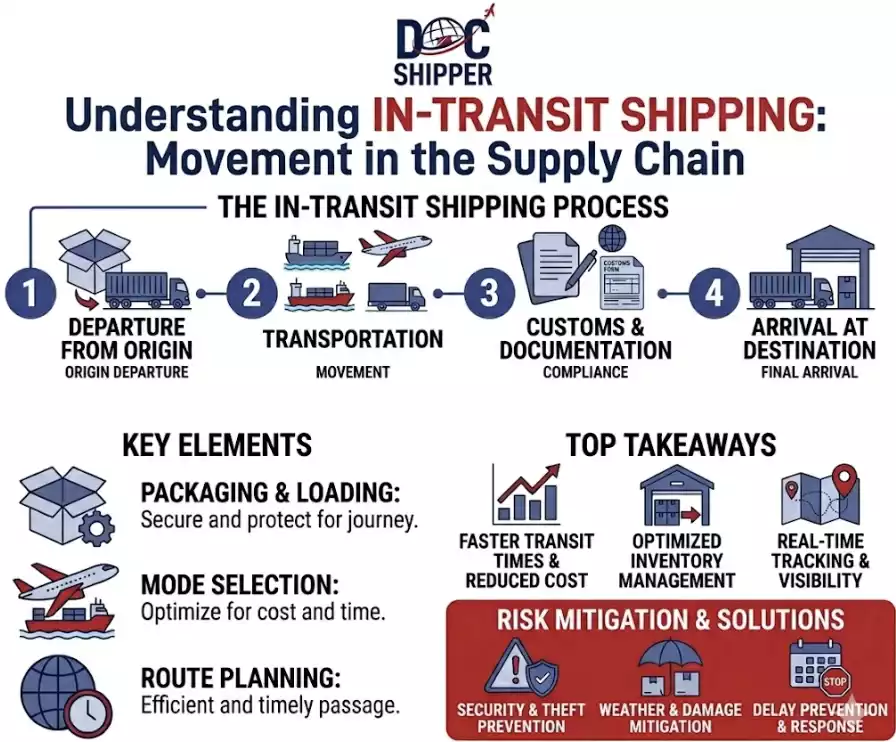
In Transit refers to the status of goods currently being transported from the point of origin to the final destination, during which ownership and responsibility may vary depending on Incoterms and contractual agreements. This phase encompasses all intermediate movements across carriers, borders, and handling facilities until delivery is confirmed.
Introduction
One of the most common sources of confusion in international shipping involves tracking goods labeled as “in transit”. Importers often struggle to determine who bears responsibility for delays, damages, or customs holds during this period.
The in transit phase is critical because it represents the most vulnerable window in the supply chain. Goods can face inspections, transshipments, weather delays, and administrative bottlenecks. Understanding this stage enables businesses to anticipate risks and optimize logistics planning.
- Multi-modal involvement: Goods may pass through sea, air, rail, and road transport sequentially.
- Customs clearance: Often occurs while cargo is technically “in transit” at border points.
- Insurance coverage: Policies must explicitly cover the entire transit period to avoid gaps.
- Tracking visibility: Real-time monitoring systems reduce uncertainty during transit phases.
- Liability transfer: Determined by agreed Incoterms (e.g., FOB, CIF, DAP).
In-Depth Analysis & Expertise
The in transit status encompasses several distinct sub-stages that vary depending on the mode of transport and geographic route. In maritime shipping, this includes the period from when containers leave the port of loading until they arrive at the discharge port. For air freight, transit begins at the origin airport and concludes at the destination airport.
Legal implications during transit are governed by international conventions such as the Hague-Visby Rules for sea transport and the Montreal Convention for air cargo. These frameworks establish carrier liability limits and define what constitutes “in transit” for insurance and claims purposes.
A critical concept is transshipment, where goods are transferred between vessels or vehicles at intermediate hubs. During these transfers, cargo remains “in transit” but faces heightened risk of misrouting, damage, or delay. Major transshipment hubs include Singapore, Dubai, and Rotterdam.
The customs transit procedure allows goods to move across borders without immediate duty payment. The European Union’s Common Transit Convention exemplifies this, enabling sealed cargo to traverse multiple countries under a single transit document.
Force majeure events during transit—such as port strikes, natural disasters, or geopolitical conflicts—can suspend delivery obligations without penalty. However, proving force majeure requires documented evidence that the event was unforeseeable and unavoidable.
At DocShipper, we provide 24/7 tracking visibility throughout the entire transit phase, alerting clients immediately to any deviations or delays. Our team proactively manages customs documentation to prevent transit interruptions at border crossings.
Concrete Examples & Data
Understanding in transit through real-world scenarios clarifies its practical implications for importers and exporters. Consider the following use case:
Use Case: Electronics Shipment from Shenzhen to Hamburg
A French retailer orders 500 smartphones from a Chinese supplier under CIF Hamburg terms. The cargo departs Shenzhen port on March 1st.
- March 1-7: Ocean transit to Singapore (transshipment hub) — status: in transit
- March 8-10: Container transferred to European-bound vessel in Singapore — status: in transit (transshipment)
- March 11-28: Ocean transit through Suez Canal to Hamburg — status: in transit
- March 29: Arrival at Hamburg port — status changes to arrived, awaiting customs clearance
Total transit time: 28 days. During this period, the seller bears risk and insurance costs (CIF terms), but once the goods physically cross the ship’s rail at Shenzhen, ownership technically transfers to the buyer.
Comparative Transit Times by Mode
| Route | Sea Freight | Air Freight | Express Air |
|---|---|---|---|
| China → Europe | 25-35 days | 5-7 days | 2-3 days |
| USA → Europe | 10-14 days | 3-5 days | 1-2 days |
| Asia → USA West Coast | 14-18 days | 4-6 days | 2-3 days |
Key Data Points
- 23% of global cargo delays occur during the in-transit phase due to port congestion.
- Insurance claims related to transit damage account for 12% of all cargo insurance payouts annually.
- Real-time GPS tracking reduces transit-related customer inquiries by 40%.
- Transshipment adds an average of 3-5 days to total transit time.
- Customs holds during transit can extend delivery by 7-14 days without proper documentation.
Conclusion
The in transit phase is the operational backbone of international trade, where goods navigate complex logistics networks under varying legal and practical constraints. Mastering this stage ensures cost control, risk mitigation, and customer satisfaction.
Need expert assistance managing your cargo during transit? Contact DocShipper for comprehensive door-to-door logistics solutions tailored to your supply chain.
📚 Quiz
Test Your Knowledge: In Transit
What does "in transit" status primarily refer to in international shipping?
During transshipment at an intermediate hub, the cargo's status is:
Your electronics shipment from China shows "in transit" for 18 days on a typical 28-day ocean route to Europe. A client asks for immediate delivery. What's the most accurate response?
🎯 Your Result
📞 Free Quote in 24hFAQ | In Transit: Definition, Key Stages & Real-World Examples
In transit refers to the period when goods are actively being transported from origin to destination, passing through carriers, ports, and customs facilities. The cargo remains under the control of logistics providers but has not yet reached the final consignee.
Responsibility depends on the agreed Incoterms. Under FOB terms, the buyer assumes risk once goods cross the ship's rail. Under CIF or CIP terms, the seller covers insurance but risk transfers at the same point. Carriers have limited liability governed by international conventions.
Transit times vary by route: Asia to Europe averages 25-35 days, Asia to US West Coast 14-18 days, and transatlantic routes 10-14 days. Transshipments, port congestion, and customs inspections can add 3-10 days to these baseline estimates.
Yes, but only before the original destination customs clearance begins. You must contact your freight forwarder immediately to issue a diversion order. Additional fees typically apply, and the original Bill of Lading must be amended or surrendered.
Transshipment involves transferring cargo between vessels or vehicles at intermediate hubs due to routing requirements. It adds 3-5 days on average because containers must be unloaded, temporarily stored, and reloaded onto connecting transport.
Most freight forwarders provide online tracking systems using the Bill of Lading number or container ID. Advanced options include GPS-enabled smart containers that report real-time location, temperature, and shock events throughout the journey.
Common causes include customs holds, missing documentation, port strikes, or carrier delays. Immediately contact your freight forwarder to diagnose the issue. They can expedite customs clearance, reroute cargo, or provide proof for insurance claims if applicable.
Standard marine cargo insurance covers warehouse-to-warehouse transit, including loading, ocean voyage, and unloading. However, coverage exclusions exist for improper packaging, inherent vice, or delays unless explicitly added. Always review policy terms before shipment.
Customs transit allows goods to cross borders without immediate duty payment, moving under a sealed bond to an inland customs office. The EU's Common Transit Convention and ATA Carnet system are prime examples enabling simplified cross-border transit.
Weather typically qualifies as force majeure, excusing late delivery without penalty if properly documented. However, carriers must prove the delay was directly caused by the event and not due to poor planning or inadequate vessel maintenance.
"In transit" means cargo is moving through the supply chain between origin and destination. "Out for delivery" indicates the final leg where a local courier has the package and will deliver it to the consignee's address within hours or the same day.
Purchase comprehensive cargo insurance, use reputable carriers with strong track records, ensure complete and accurate documentation, implement real-time tracking, and work with experienced freight forwarders who can proactively manage transit exceptions before they escalate.
Need Help with
Logistics or Sourcing ?
First, we secure the right products from the right suppliers at the right price by managing the sourcing process from start to finish. Then, we simplify your shipping experience - from pickup to final delivery - ensuring any product, anywhere, is delivered at highly competitive prices.


Fill the Form
Prefer email? Send us your inquiry, and we’ll get back to you as soon as possible.
Contact us




