


In short ⚡
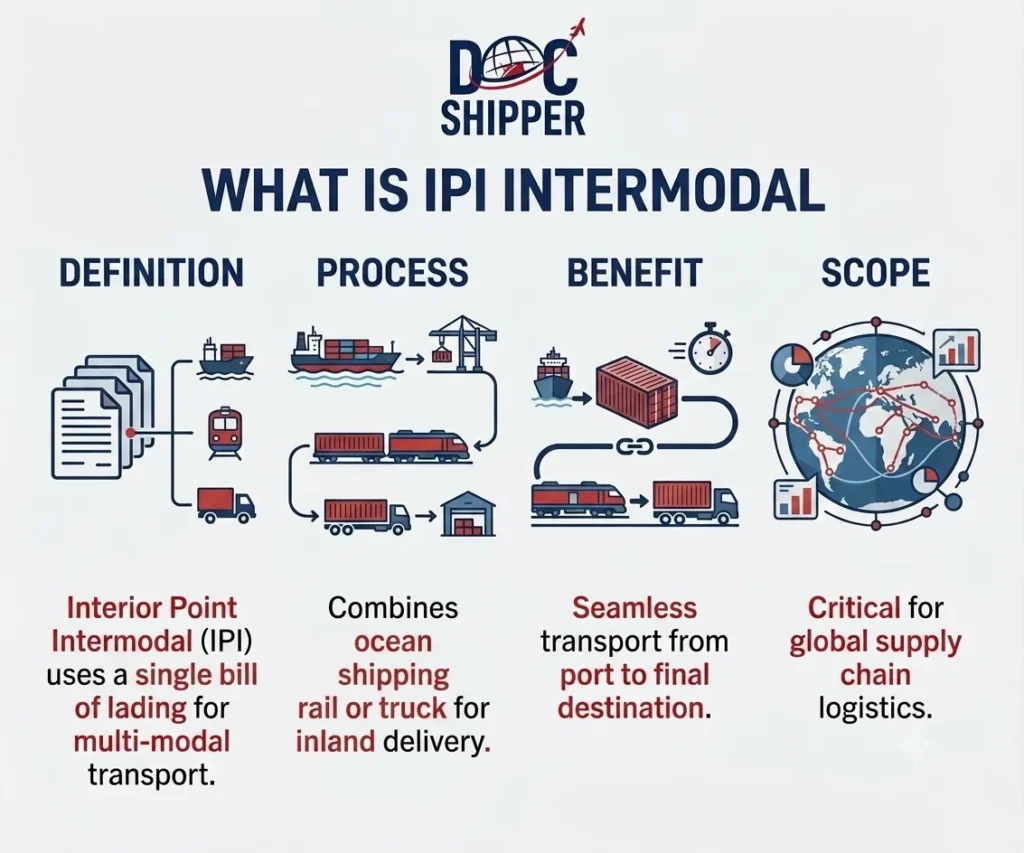
Inland Point Intermodal (IPI) is a shipping service combining ocean and inland transport, allowing cargo to move from a foreign port directly to an interior destination beyond the arrival seaport. This intermodal solution uses a single bill of lading, streamlining customs clearance and reducing handling costs for importers and exporters.Introduction
Shipping containers to inland destinations often involves complex coordination between ocean carriers, rail operators, and trucking companies. Many businesses struggle with fragmented documentation and unpredictable transit times when cargo must travel beyond coastal ports.
IPI addresses this challenge by establishing seamless transport corridors from international ports to interior cities. This service is particularly crucial for businesses located far from seaports, enabling them to compete globally without establishing operations in coastal regions.
The IPI system revolutionizes international logistics by offering:
- Single documentation – One bill of lading covers the entire journey from origin to final inland destination
- Reduced handling – Fewer transshipment points minimize damage risk and delays
- Cost transparency – Consolidated pricing structure eliminates surprise charges
- Customs efficiency – Clearance can occur at inland facilities rather than congested ports
- Multimodal flexibility – Combines ocean, rail, and truck transport based on optimal routing
IPI Mechanism & Logistics Expertise
The IPI framework operates through carrier agreements that extend ocean freight responsibility beyond the port of discharge. When a shipper books IPI service, the ocean carrier coordinates with domestic rail and trucking partners to deliver cargo to the specified inland point.
From a legal perspective, the through bill of lading establishes carrier liability throughout the entire transport chain. This differs from traditional port-to-port shipping where responsibility ends at the discharge port. According to Federal Maritime Commission regulations, carriers offering IPI services must maintain agreements with inland transport providers and clearly define service territories.
The customs clearance process under IPI offers significant advantages. Cargo can remain sealed from origin to the inland destination, where customs examination occurs at an Inland Port or Container Freight Station. This reduces port congestion and allows businesses to leverage bonded warehousing facilities near their operations.
Rate structures for IPI typically include ocean freight, terminal handling, and inland transport as a bundled service. Carriers publish IPI rates to specific inland points, which may offer better pricing than arranging separate domestic transport. The consolidated billing simplifies accounting and eliminates coordination between multiple service providers.
At DocShipper, we evaluate IPI options against traditional port delivery to determine the most cost-effective solution. Our logistics experts analyze transit times, handling requirements, and total landed costs to recommend optimal routing for each shipment. We manage the entire process, ensuring your cargo moves efficiently from factory to final destination.
The infrastructure requirements for IPI service include double-stack rail capabilities, intermodal terminals with container handling equipment, and established trucking networks. Major inland points like Chicago, Dallas, and Memphis have invested heavily in these facilities, creating competitive alternatives to coastal distribution centers.
Concrete Examples & Data Analysis
To illustrate IPI advantages, consider a manufacturer in Columbus, Ohio importing electronics from Shanghai. The company can choose between traditional port delivery or IPI service:
| Service Component | Port Delivery (Los Angeles) | IPI Service (Columbus) |
|---|---|---|
| Ocean Freight (40′ container) | $2,800 | $2,800 |
| Port Terminal Charges | $450 | Included |
| Customs Clearance | $250 (at port) | $200 (inland) |
| Rail Transport | $1,650 (separate booking) | Included in IPI |
| Local Trucking | $380 | $280 |
| Total Cost | $5,530 | $4,950 (IPI bundled rate) |
| Transit Time | 24-26 days | 22-24 days |
This comparison demonstrates a $580 savings (10.5%) and two-day transit improvement with IPI service. The cost advantage derives from negotiated rail rates and elimination of intermediate handling fees at the port.
Case Study: Automotive Parts Distributor
A Midwest automotive supplier shifted from Seattle port delivery to IPI service via Kansas City. Over twelve months, they documented these improvements:
- Cost reduction: 14% average savings across 180 containers annually
- Damage claims: Decreased by 37% due to reduced handling
- Documentation errors: Dropped by 62% with single bill of lading
- Inventory planning: Improved with consistent 21-day transit schedules
- Port congestion immunity: Avoided West Coast delays affecting port-delivery competitors
According to industry data, IPI volumes have grown 23% since 2020 as shippers seek alternatives to congested coastal ports. Major carriers now offer IPI service to over 50 inland points across North America, with rail infrastructure investments expanding this network annually.
DocShipper analyzes your shipping patterns to identify optimal IPI opportunities. We evaluate factors including shipment frequency, cargo value, destination proximity to intermodal terminals, and seasonal volume fluctuations. Our data-driven approach ensures you leverage IPI advantages while maintaining service reliability.
Conclusion
IPI service transforms international logistics by extending carrier responsibility beyond seaports, reducing costs and simplifying inland distribution. Businesses located away from coastal regions gain competitive advantages through streamlined documentation and integrated transport solutions.
Need expert guidance on implementing IPI service for your supply chain? Contact DocShipper today for a customized logistics assessment and routing optimization.
📚 Quiz
Test Your Knowledge: IPI (Inland Point Intermodal)
What is the primary definition of IPI (Inland Point Intermodal) service?
Which statement correctly describes the customs clearance advantage of IPI service?
A Columbus, Ohio manufacturer imports electronics from Shanghai. Based on the article's cost comparison, what is the primary financial advantage of choosing IPI service over traditional port delivery?
🎯 Your Result
📞 Free Quote in 24hFAQ | IPI (Inland Point Intermodal): Definition, Calculation & Concrete Examples
IPI (Inland Point Intermodal) delivers cargo to interior destinations via combined ocean-rail-truck transport under one bill of lading. MLB (Mini Land Bridge) moves cargo across the continent to another coast for ocean shipment. IPI focuses on final inland delivery, while MLB facilitates transcontinental transit before continued ocean transport.
Yes, most carriers offer IPI for LCL cargo, though service availability depends on the inland destination. Your freight is consolidated with other shipments at the port, then transported to an inland Container Freight Station where deconsolidation occurs. Transit times may be slightly longer than full container IPI service due to consolidation processes.
Customs clearance can occur either at the port of entry or at an inland Customs and Border Protection facility. With IPI, cargo often remains sealed until reaching the inland destination, where examination takes place. This reduces port congestion and allows you to leverage bonded warehousing. Your customs broker coordinates with the carrier to determine the optimal clearance location.
IPI rates are typically published by carriers for specific inland points, but volume shippers can negotiate better terms. Annual contracts with minimum volume commitments often secure favorable rates. Working with a freight forwarder like DocShipper provides access to consolidated volume discounts and carrier relationships that individual shippers cannot obtain independently.
The through bill of lading establishes carrier liability for the entire journey, including inland segments. File claims with the issuing ocean carrier, who assumes responsibility for their subcontracted rail and trucking partners. Documentation requirements are simpler than coordinating claims across multiple carriers. Ensure you inspect cargo promptly upon delivery and photograph any damage immediately.
Major IPI hubs include Chicago, Dallas, Kansas City, Memphis, Columbus, and Charlotte. These cities have invested in double-stack rail infrastructure, intermodal terminals, and customs facilities. Coastal proximity, rail network connections, and trucking availability determine service quality. Chicago handles the highest IPI volumes due to its central location and extensive rail connections.
IPI typically saves 2-4 days compared to arranging separate inland transport. The time advantage comes from pre-planned rail movements, priority terminal handling, and elimination of waiting periods between transport modes. Actual savings depend on the inland destination and carrier efficiency. Real-time tracking throughout the journey provides better visibility than coordinating multiple transport providers.
Destination changes are possible but incur fees and may require rebooking. Contact the carrier before cargo departs the origin port for the best chance of accommodation. Once cargo is in transit, changes become more complicated and expensive. Some carriers allow diversion to nearby IPI points within the same service region, while others require complete rebooking.
Standard IPI typically delivers to the inland Container Freight Station or rail terminal. Door delivery to your facility requires additional trucking, which can be arranged through the carrier or separately. Some carriers offer extended IPI service including final mile delivery. Clarify delivery terms when booking to avoid unexpected charges or delays at the inland terminal.
You need standard export documents (commercial invoice, packing list, export declaration) plus specific inland destination details including complete address, contact information, and any special delivery instructions. Ensure your shipper's letter of instruction specifies IPI service and the exact inland point code. Accurate documentation prevents cargo holds and delivery delays at the inland destination.
IPI follows standard containerization limits: 40-foot containers up to 45,000 lbs payload, 20-foot containers up to 38,000 lbs. Overweight cargo requires special arrangements and may not qualify for standard IPI rail service. Oversized cargo or hazardous materials have additional restrictions. Verify your cargo specifications with the carrier before booking to ensure IPI compatibility.
Carriers provide container tracking through their websites using the bill of lading or container number. Tracking shows major milestones: vessel departure, port arrival, rail loading, and inland terminal arrival. Real-time GPS tracking may be available for premium services. Freight forwarders like DocShipper offer consolidated tracking portals that monitor your shipments across multiple carriers and transport modes.
Need Help with
Logistics or Sourcing ?
First, we secure the right products from the right suppliers at the right price by managing the sourcing process from start to finish. Then, we simplify your shipping experience - from pickup to final delivery - ensuring any product, anywhere, is delivered at highly competitive prices.


Fill the Form
Prefer email? Send us your inquiry, and we’ll get back to you as soon as possible.
Contact us




:%20Definition,%20Calculation%20&%20Concrete%20Examples)