


In short ⚡
An Irrevocable Letter of Credit is a binding payment guarantee issued by a bank that cannot be modified or canceled without the explicit consent of all parties involved—importer, exporter, and issuing bank. It ensures that exporters receive payment once they fulfill the agreed contractual terms, eliminating counterparty risk in international trade.
Introduction
In cross-border transactions, payment risk remains the primary concern for exporters. How can a seller in Vietnam trust that a buyer in Germany will honor payment upon shipment? This uncertainty paralyzes countless international deals daily.
The Irrevocable Letter of Credit solves this dilemma by positioning a bank as intermediary guarantor. Unlike open account terms or cash-in-advance arrangements, it balances security for both parties while maintaining transaction fluidity.
Key characteristics include:
- Irrevocability: Cannot be altered unilaterally once issued
- Documentary compliance: Payment triggers only when specified documents are presented correctly
- Bank guarantee: The issuing bank’s creditworthiness replaces buyer risk
- Global standardization: Governed by ICC Uniform Customs and Practice (UCP 600)
- Conditional payment: Exporter must meet exact terms stipulated in the credit
Mechanisms & Legal Framework
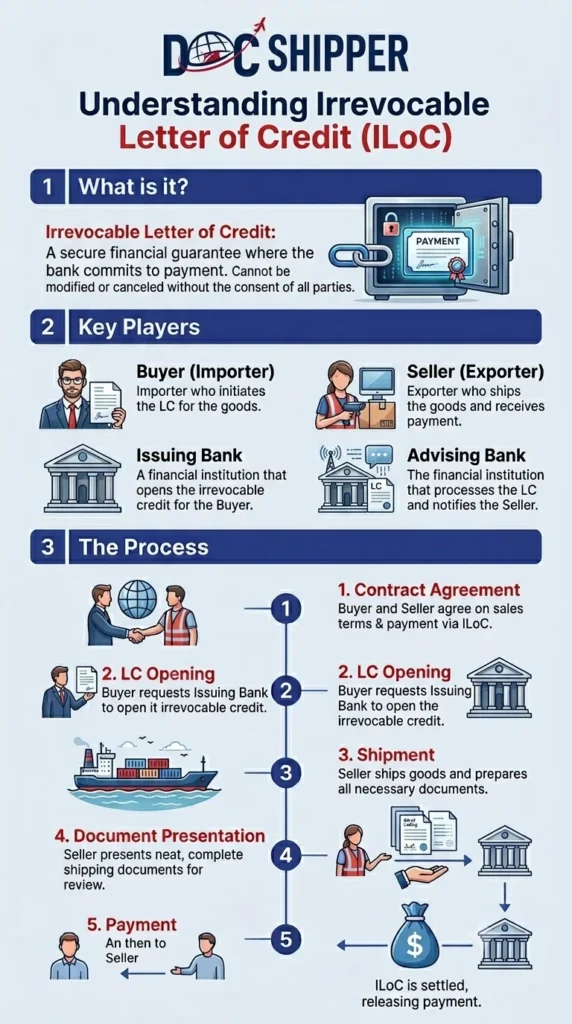
The operational flow involves four principal actors: the applicant (importer), the beneficiary (exporter), the issuing bank, and often an advising or confirming bank. When an importer applies for an irrevocable LC, their bank scrutinizes creditworthiness before issuing the instrument.
Upon issuance, the advising bank in the exporter’s country authenticates the document without assuming payment obligation. If the exporter requests additional security, a confirming bank adds its own guarantee, transforming the LC into a confirmed irrevocable credit.
The documentary compliance principle is absolute. Banks examine documents—not goods. A single discrepancy in the bill of lading, commercial invoice, or certificate of origin can trigger rejection. This strict liability framework is codified in ICC UCP 600, which standardizes examination timelines (five banking days maximum) and discrepancy handling procedures.
Legal enforceability stems from the independence principle: the LC stands separate from the underlying sales contract. Even if the buyer claims defective goods, the bank must honor payment if documents conform. This autonomy makes LCs powerful tools in high-risk jurisdictions.
The amendment process requires unanimous consent. If an importer requests to extend the shipment date, the exporter and all banks must approve. This rigidity protects exporters from opportunistic modifications but can slow transaction adjustments.
At DocShipper, we systematically verify LC terms against shipment capabilities before our clients commit to production. A misaligned expiry date or impossible inspection requirement can derail the entire transaction, making pre-shipment LC audit essential.
Practical Examples & Data
According to ICC Global Survey data, approximately 11-15% of international trade transactions utilize letters of credit, with irrevocable LCs representing over 99% of that volume. The revocable LC—discontinued in UCP 600—has been virtually eliminated from modern trade finance.
Use Case: Electronics Export from Shenzhen to Hamburg
A German retailer orders €250,000 worth of consumer electronics from a Chinese manufacturer with no prior relationship. The buyer’s bank (Deutsche Bank) issues an irrevocable LC valid for 90 days, requiring:
- Full set of clean on-board bills of lading
- Commercial invoice matching LC amount exactly
- Packing list detailing unit quantities
- Certificate of origin (Form A for EU GSP benefits)
- Inspection certificate from SGS
The Chinese exporter ships goods and presents documents to Bank of China (advising bank) on day 60. The bank identifies a discrepancy: the invoice lists “consumer electronics” while the LC specifies “portable audio devices.” Despite goods being correct, payment is refused. The exporter obtains a waiver from the buyer, and payment processes seven days later—demonstrating how documentary precision overrides physical goods quality.
| LC Feature | Irrevocable LC | Revocable LC (Obsolete) |
|---|---|---|
| Amendment Rights | Requires all parties’ consent | Buyer can cancel unilaterally |
| Payment Certainty | Guaranteed if documents comply | No guarantee—can be revoked anytime |
| Exporter Risk | Minimal (bank default only) | High (buyer discretion) |
| Cost | 1.5-3% of LC value | Lower (0.5-1%), now discontinued |
| UCP 600 Status | Standard instrument | Not recognized since 2007 |
Cost Breakdown Example:
For a $100,000 irrevocable LC with 60-day tenor:
- Issuance fee: $300-$500 (flat fee)
- Confirmation fee (if added): 1.5% = $1,500
- Negotiation fee: 0.25% = $250
- Amendment fee: $100-$200 per change
- Total cost: Approximately $2,050-$2,450 (2-2.5% of transaction value)
Exporters to high-risk markets (e.g., certain African or Middle Eastern countries) often require confirmed irrevocable LCs, where a reputable international bank adds its guarantee. This doubles security but increases costs by 1-2 percentage points.
Conclusion
The irrevocable letter of credit remains the gold standard for securing international payments, transforming buyer creditworthiness into bank-backed certainty. Its rigid documentary framework demands precision but delivers unparalleled risk mitigation.
Need expert guidance on LC compliance for your shipments? Contact DocShipper for comprehensive trade finance support and document verification services.
📚 Quiz
Test Your Knowledge: Irrevocable Letter of Credit
1. What is the defining characteristic of an Irrevocable Letter of Credit?
2. When examining documents under an Irrevocable LC, what is the bank's primary focus?
3. A Chinese exporter presents documents for a €250,000 LC, but the commercial invoice lists "consumer electronics" while the LC specifies "portable audio devices." The goods shipped are correct. What happens?
🎯 Your Result
📞 Free Quote in 24hFAQ | Irrevocable Letter of Credit: Definition, Mechanics & Practical Examples
An irrevocable LC cannot be canceled without all parties' consent, but only the issuing bank guarantees payment. A confirmed LC adds a second bank (usually in the exporter's country) that also guarantees payment, providing double security. Confirmed LCs are common when dealing with banks in unstable economies or when exporters want local payment assurance.
No, not unilaterally. Cancellation requires written consent from the beneficiary (exporter), applicant (importer), issuing bank, and any confirming bank. This protection ensures exporters aren't exposed to sudden payment withdrawal after commencing production or shipment. Only expired or fully utilized LCs close automatically.
Under UCP 600 rules, banks have a maximum of five banking days to examine documents after presentation. If documents comply, payment typically processes within 2-3 days for sight LCs (immediate payment) or at the agreed tenor for usance LCs (deferred payment terms). Discrepancies can extend this timeline by 7-14 days pending resolution.
Standard documents include: commercial invoice, bill of lading (B/L), packing list, certificate of origin, and insurance certificate. Specific LCs may require inspection certificates (SGS, Bureau Veritas), phytosanitary certificates for agricultural goods, or beneficiary certifications. The LC text explicitly lists all required documents—missing even one triggers rejection.
Typically, the applicant (buyer) pays issuance, amendment, and confirmation fees, while the beneficiary (exporter) covers negotiation and advising fees. However, LC terms can stipulate "all banking charges outside [country] for beneficiary's account," shifting costs. Always clarify fee allocation during sales negotiations to avoid surprises.
Banks will refuse payment and notify the presenting party of discrepancies. The exporter can either: (1) correct documents and re-present within the LC validity period, (2) request a waiver from the buyer, or (3) accept payment under reserve (buyer's bank seeks approval). Even minor errors like misspelled names or transposed numbers constitute discrepancies.
Yes, irrevocable LCs are particularly beneficial for SMEs lacking credit history with foreign buyers. The bank guarantee eliminates concerns about buyer solvency. However, small exporters must ensure they can meet strict documentary requirements—hiring a freight forwarder or trade finance consultant reduces rejection risk from compliance errors.
Only if the LC is explicitly marked "transferable." Transferable LCs allow beneficiaries (typically middlemen or trading companies) to transfer all or part of the credit to actual suppliers. Non-transferable LCs—the majority—cannot be reassigned. Banks charge additional fees (0.15-0.25%) for transfer processing.
Sight LCs require immediate payment upon compliant document presentation (typically within 5-7 days). Usance LCs (also called time or deferred payment LCs) specify payment at a future date—30, 60, 90, or 180 days after sight or shipment. Usance terms provide importers with working capital flexibility but may require exporters to discount receivables for earlier cash flow.
An irrevocable LC mitigates payment risk but doesn't inherently protect against currency fluctuations or political events. For currency risk, exporters should specify LC denomination (e.g., USD, EUR) or use hedging instruments. For political risk (war, expropriation, currency inconvertibility), confirmed LCs with reputable international banks provide the best protection, as the confirming bank's obligation survives local disruptions.
Yes, if the LC terms explicitly allow partial shipments. Many LCs include clauses like "partial shipments permitted" or specify maximum shipment quantities per period. If the LC is silent or states "partial shipments prohibited," the exporter must ship the entire order in one consignment. Violating this term results in document rejection.
Validity periods vary based on transaction complexity but typically range from 30 to 180 days. The LC specifies both a final shipment date and an expiry date (latest date for document presentation). Exporters must ship goods and present documents within these windows. Extensions require amendments with all parties' consent, often incurring additional fees.
Need Help with
Logistics or Sourcing ?
First, we secure the right products from the right suppliers at the right price by managing the sourcing process from start to finish. Then, we simplify your shipping experience - from pickup to final delivery - ensuring any product, anywhere, is delivered at highly competitive prices.


Fill the Form
Prefer email? Send us your inquiry, and we’ll get back to you as soon as possible.
Contact us




