


In short ⚡
The International Ship and Port Security Code (ISPS) is a comprehensive maritime security framework adopted by the International Maritime Organization (IMO) in 2002. It establishes standardized security measures for ships and port facilities to prevent terrorist acts, safeguard maritime transport, and ensure cargo integrity across international supply chains.
Introduction
Following the September 11 attacks, global maritime transport faced unprecedented security threats. Port authorities and shipping companies struggled with inconsistent security protocols across jurisdictions. The ISPS Code emerged as the maritime industry’s answer to standardizing protection measures worldwide.
This regulatory framework affects every stakeholder in international logistics. Whether you’re shipping consumer goods from Shanghai or receiving industrial equipment in Rotterdam, ISPS compliance directly impacts your operational timelines and costs.
Key components of the ISPS Code include:
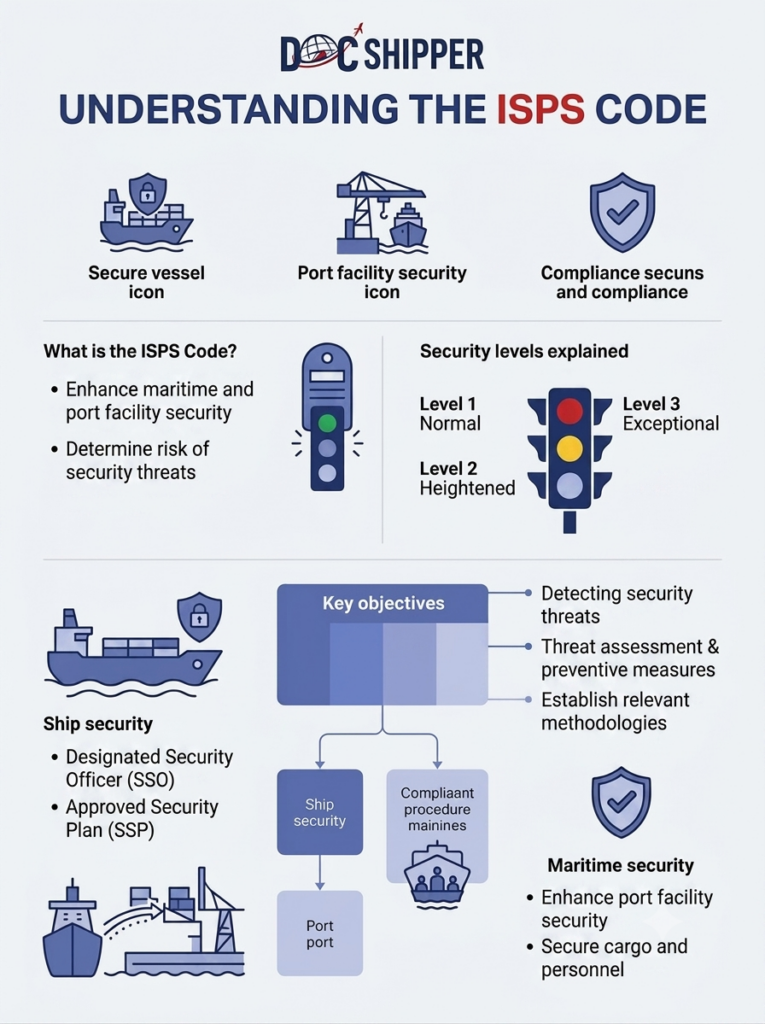
- Three Security Levels: Normal operations (Level 1), heightened risk (Level 2), and imminent threat (Level 3)
- Ship Security Assessment (SSA): Mandatory vulnerability analysis for all covered vessels
- Port Facility Security Assessment (PFSA): Risk evaluation for terminal operations
- Certification Requirements: International Ship Security Certificate (ISSC) for compliant vessels
- Security Officer Designation: Trained personnel responsible for implementation at ship and port levels
ISPS Framework & Implementation Requirements
The ISPS Code divides into two distinct parts. Part A contains mandatory provisions enforceable under SOLAS Chapter XI-2, while Part B provides non-binding recommendations. This structure allows flexibility while maintaining core security standards.
Covered vessels include cargo ships of 500 gross tonnage and above, passenger ships, and mobile offshore drilling units engaged in international voyages. Port facilities serving these vessels must establish security plans approved by national maritime authorities.
The three-level security system operates dynamically. At Security Level 1, minimum protective measures apply during normal operations. Level 2 activates additional measures for elevated risk periods. Level 3 implements specific protective protocols when a security incident is probable or imminent.
Each vessel must appoint a Company Security Officer (CSO) and Ship Security Officer (SSO). Port facilities designate a Port Facility Security Officer (PFSO). These officers undergo specialized training and maintain continuous communication during security incidents.
Documentation requirements include maintaining a Ship Security Plan detailing procedures for all three security levels, access control measures, cargo handling security, and communication protocols. According to the International Maritime Organization, these plans undergo verification during Port State Control inspections.
At DocShipper, we verify ISPS compliance for all carrier partners and terminal operators, ensuring your shipments move through security-certified facilities without delays or unexpected inspection holds.
Practical Compliance Examples & Industry Data
ISPS implementation varies significantly across global trade routes. Understanding these differences helps importers and exporters anticipate documentation requirements and potential delays.
| Security Measure | Level 1 (Normal) | Level 2 (Heightened) | Level 3 (Exceptional) |
|---|---|---|---|
| Access Control | ID verification, visitor logs | Enhanced screening, escort requirements | Access restriction, background checks |
| Cargo Inspection | Standard procedures | Increased frequency, X-ray scanning | 100% physical inspection |
| Vessel Monitoring | Routine surveillance | Continuous CCTV, perimeter patrols | Armed security, underwater checks |
| Communication | Standard protocols | Enhanced reporting intervals | Direct liaison with authorities |
Use Case: Electronics Import from Singapore to Los Angeles
A U.S. importer orders consumer electronics valued at $850,000. The Singapore terminal operates at Security Level 1, requiring standard ISPS documentation. The vessel holds a valid ISSC certificate, verified electronically before cargo acceptance.
During the 14-day transit, intelligence reports elevate the U.S. West Coast to Security Level 2. Upon arrival, Long Beach terminal authorities require additional documentation including a Declaration of Security (DoS) signed between the ship and port facility. Cargo discharge delays extend 18-24 hours due to enhanced screening protocols.
The importer faces storage fees of approximately $120 per container per day during the extended security procedures. Pre-notification and proper ISPS documentation could have reduced this delay to 6-8 hours.
Industry Impact Statistics:
- ISPS compliance costs maritime operators an estimated $1.3 billion annually worldwide
- Port State Control detentions for ISPS deficiencies represent 8-12% of all vessel detentions globally
- Average time lost per ISPS-related inspection: 4.5 hours for compliant vessels, 36+ hours for non-compliant ships
- Container throughput reduction during Level 3 security operations: 40-60% of normal capacity
- Non-compliance penalties range from $25,000 to $250,000 per violation depending on jurisdiction
Conclusion
The ISPS Code fundamentally transformed maritime security, creating standardized protocols that protect global supply chains while enabling efficient trade. Understanding these requirements prevents costly delays and ensures smooth customs clearance.
Need assistance navigating ISPS requirements for your shipments? Contact DocShipper for expert guidance on maritime security compliance and documentation management.
📚 Quiz
Test Your Knowledge: ISPS Code
What is the primary purpose of the ISPS Code?
Which vessels are exempt from ISPS Code compliance requirements?
A vessel arriving at a port operating at Security Level 2 while the ship maintains Level 1. What action is required?
🎯 Your Results
📞 Free Quote in 24hFAQ | International Ship and Port Security Code (ISPS): Definition, Implementation & Practical Examples
All passenger ships engaged in international voyages, cargo ships of 500 gross tonnage or more, and mobile offshore drilling units conducting international operations must comply. Domestic vessels not engaged in international trade are exempt unless national regulations require compliance. The vessel's flag state determines certification requirements.
An ISSC is valid for a maximum of five years, subject to annual verification audits and intermediate surveys. Certificates become invalid if the ship changes flag, the company operating the ship changes, or if significant modifications alter the ship's security arrangements. Renewal requires a complete security assessment by an authorized organization.
National governments set security levels based on intelligence assessments. Level 2 activates when there is heightened risk of a security incident. Level 3 implements when an incident is probable or imminent. Changes typically occur following terrorist threats, geopolitical tensions, or actual security breaches at ports or involving vessels in specific regions.
Yes, port facilities have the authority to deny entry to vessels lacking valid ISPS certification or with significant security deficiencies. The facility must report the vessel to national authorities, and the ship may face detention, fines, or expulsion. Most jurisdictions require corrective actions before allowing port operations.
A Declaration of Security (DoS) is an agreement between a ship and port facility (or between ships) specifying security measures each will maintain during interface operations. It becomes mandatory when the ship operates at a higher security level than the port, when there's a security threat, during ship-to-ship operations, or when one party requests it due to security concerns.
At Security Level 1, cargo inspections follow routine procedures with minimal delays. Level 2 may add 4-8 hours for enhanced screening. Level 3 operations can extend cargo processing by 24-48 hours due to comprehensive physical inspections and documentation verification. Pre-arrival notifications and complete security documentation significantly reduce these timeframes.
Ship Security Officers must complete IMO Model Course 3.19 covering security assessment, security plan development, emergency procedures, and communication protocols. Training includes threat recognition, weapons detection, crowd management, and security equipment operation. Certification requires passing a competency examination and periodic refresher courses every five years.
ISPS Code doesn't mandate specific container-level security, but the Container Security Initiative (CSI) and Customs-Trade Partnership Against Terrorism (C-TPAT) impose additional requirements. Best practices include tamper-evident seals, container inspection before stuffing, and maintaining chain-of-custody documentation. High-security shipments may require specialized sealing and tracking systems.
PSC inspections review the International Ship Security Certificate, verify security officer qualifications, examine the Ship Security Plan, and conduct physical inspections of security equipment and access control measures. Inspectors interview crew members about security procedures and check records of security drills and training. Deficiencies may result in detention until corrected.
Non-compliance costs include vessel detention fees ($15,000-$50,000 per day), regulatory fines ($25,000-$250,000), cargo delays causing storage charges, potential cargo damage claims, and insurance premium increases. Repeat violations may result in blacklisting from certain ports, significantly impacting operational capabilities and business relationships.
Yes, security levels can differ based on regional threat assessments. A country may maintain Level 1 at most ports while elevating specific facilities to Level 2 due to local intelligence. Port authorities coordinate with national security agencies to establish appropriate levels. Vessels must comply with the highest security level applicable during their voyage.
ISPS Code focuses on maritime security during transport and port operations, while AEO and C-TPAT address supply chain security comprehensively. Companies certified under these programs often experience expedited security clearances at ISPS facilities due to pre-vetted security protocols. However, ISPS compliance remains mandatory regardless of other certifications, as these programs serve complementary security objectives.
Need Help with
Logistics or Sourcing ?
First, we secure the right products from the right suppliers at the right price by managing the sourcing process from start to finish. Then, we simplify your shipping experience - from pickup to final delivery - ensuring any product, anywhere, is delivered at highly competitive prices.


Fill the Form
Prefer email? Send us your inquiry, and we’ll get back to you as soon as possible.
Contact us




:%20Definition,%20Implementation%20&%20Practical%20Examples)