


In short ⚡
Line functions in logistics refer to core operational roles directly responsible for creating value through the physical movement, storage, and delivery of goods. These functions include warehousing, transportation, inventory management, and order fulfillment—activities that constitute the primary revenue-generating operations of any supply chain organization.
Introduction
Many organizations struggle to distinguish between essential operational activities and supporting services, leading to misallocated resources and unclear accountability. In logistics, this confusion can result in delayed shipments, inventory discrepancies, and customer dissatisfaction.
Understanding line functions is critical because these departments form the operational backbone of international trade. They directly execute the physical activities that move products from manufacturers to end customers, making them indispensable to supply chain performance.
Key characteristics of line functions in logistics include:
- Direct value creation through tangible goods movement and handling
- Primary revenue responsibility tied to core business operations
- Operational authority over execution and performance metrics
- Customer-facing impact on delivery timelines and service quality
- Hierarchical accountability with clear reporting structures to executive leadership
Organizational Structure & Strategic Importance
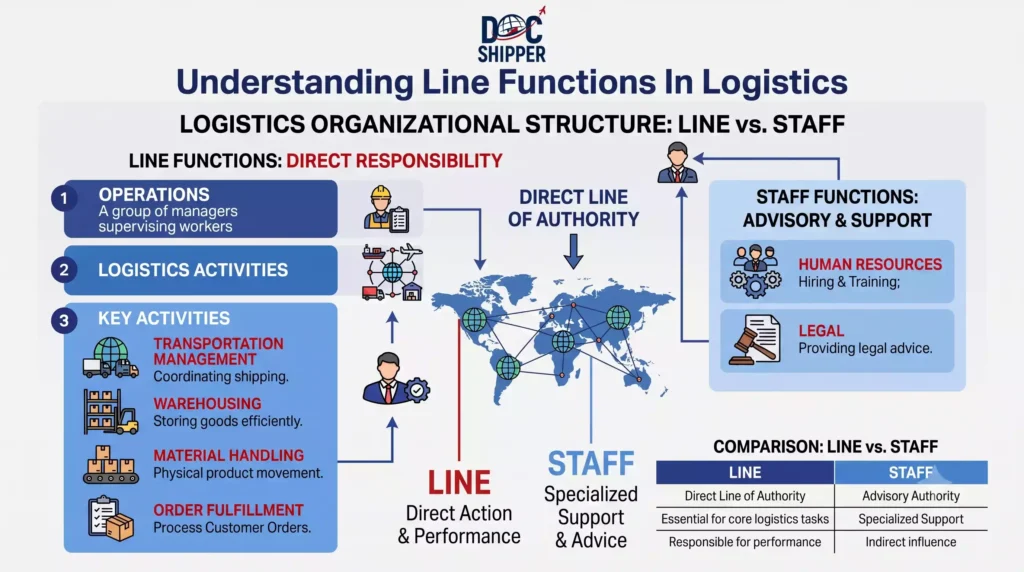
Line functions operate with direct command authority over operational execution. Unlike staff functions (HR, IT, Finance) that provide support, line departments have hierarchical power to make decisions affecting daily logistics operations.
In logistics organizations, typical line functions include:
Warehouse Operations: Physical storage, inventory control, picking, packing, and quality inspection activities that prepare goods for distribution.
Transportation Management: Route planning, carrier selection, freight booking, and shipment tracking that ensure timely delivery to destinations.
Order Fulfillment: Processing customer orders, coordinating inventory allocation, and managing the complete order-to-delivery cycle.
Import/Export Coordination: Managing customs documentation, compliance verification, and cross-border logistics execution.
Inventory Planning: Demand forecasting, stock replenishment, and SKU management to balance availability with carrying costs.
According to the Council of Supply Chain Management Professionals, organizations with clearly defined line functions demonstrate 23% higher operational efficiency compared to those with blurred functional boundaries.
At DocShipper, we structure our operational teams around these core line functions to ensure direct accountability for shipment execution, customs clearance, and delivery performance across all international corridors.
Practical Applications & Performance Metrics
Line functions are measured by output-based performance indicators that directly correlate with customer satisfaction and revenue generation. Understanding these metrics helps organizations optimize resource allocation.
| Line Function | Primary Metrics | Industry Benchmark |
|---|---|---|
| Warehouse Operations | Order accuracy, picking speed, storage utilization | 99.5% accuracy, 150 lines/hour |
| Transportation | On-time delivery, cost per mile, load optimization | 95% on-time, $1.75/mile |
| Order Fulfillment | Order cycle time, perfect order rate | 2-day cycle, 92% perfect orders |
| Customs Clearance | Clearance time, compliance rate, detention costs | 24-48 hours, 98% first-pass rate |
| Inventory Management | Stock turnover, carrying cost, stockout rate | 8-12 turns/year, <2% stockouts |
Case Study: Electronics Importer Optimization
A European electronics distributor restructured its organization to emphasize line function accountability. By separating warehouse operations (line) from IT systems management (staff), the company achieved:
- 34% reduction in order processing time through clearer operational ownership
- $280,000 annual savings by eliminating redundant oversight layers
- 18% improvement in customer satisfaction scores within six months
- Faster decision-making with direct line manager authority over daily operations
- Enhanced employee clarity regarding performance expectations and career progression
This reorganization demonstrated that properly defined line functions create direct accountability chains, eliminating the diffusion of responsibility that often plagues matrix organizations.
Conclusion
Line functions represent the operational core of logistics organizations, directly executing activities that create customer value and generate revenue. Clear functional boundaries improve accountability, streamline decision-making, and enhance overall supply chain performance.
Need assistance optimizing your logistics organizational structure or improving operational performance? Contact DocShipper for expert guidance on structuring efficient line functions across your international supply chain.
📚 Quiz
Test Your Knowledge: Line Functions in Logistics
What is the primary defining characteristic of line functions in logistics?
Which statement correctly describes the relationship between line and staff functions?
A company is restructuring its logistics organization. Which department should be classified as a line function?
🎯 Your Results
📞 Free Personalized QuoteFAQ | Line Functions in Logistics: Definition, Roles & Organizational Impact
Line functions directly execute core operational activities that create value—such as warehousing, transportation, and order fulfillment. Staff functions provide support services like HR, IT, and accounting that enable line operations but don't directly handle goods movement. Line managers have authority over operational decisions, while staff departments offer advisory or technical assistance.
Line functions directly impact customer satisfaction through timely delivery, accurate order fulfillment, and product availability. They control the physical execution of logistics processes, making them responsible for the metrics customers care about most: delivery speed, order accuracy, and product condition. Poor line function performance immediately affects revenue and brand reputation.
Performance is measured through operational KPIs including on-time delivery rates, order accuracy percentages, inventory turnover ratios, warehouse productivity metrics, and cost-per-unit shipped. These quantitative indicators directly correlate with customer satisfaction and profitability, unlike staff function metrics which are typically measured by service levels or project completion rates.
Yes, many organizations outsource line functions to third-party logistics providers (3PLs) while retaining strategic control. Warehouse operations, transportation management, and even customs clearance can be externalized. However, companies must maintain oversight through service level agreements and performance monitoring to ensure outsourced line functions meet quality standards and customer expectations.
Line functions typically report directly to operational executives—such as the Chief Operations Officer or VP of Logistics—who have profit-and-loss responsibility. This hierarchical structure ensures clear accountability and rapid decision-making authority. Staff functions usually report to their functional heads (CIO, CFO, CHRO) who provide expertise across the organization without direct operational command.
Import/export coordination is considered a line function when it directly manages shipment clearance and documentation execution. These teams work closely with customs brokers, regulatory authorities, and carriers to ensure compliant cross-border movements. Their operational decisions directly affect delivery timelines and cost structures for international shipments.
Unclear functional boundaries create accountability gaps, duplicated efforts, and decision-making delays. Organizations experience increased operational costs, slower response times to customer issues, and internal conflicts over resource allocation. Employees face confusion about roles and responsibilities, leading to decreased morale and productivity. Financial performance suffers when no single department owns end-to-end execution accountability.
Automation, warehouse management systems, and transportation management platforms have enhanced line function efficiency without changing their fundamental nature. Technology enables faster execution, better visibility, and data-driven decision-making, but line functions still require human oversight for exception handling, strategic planning, and continuous improvement initiatives. Digital tools augment rather than replace operational expertise.
The core line functions remain similar, but execution priorities differ. B2C operations emphasize rapid order fulfillment, small parcel shipping, and direct consumer delivery. B2B logistics focus on bulk shipments, pallet-level handling, and scheduled deliveries to commercial facilities. Both require the same fundamental capabilities—warehousing, transportation, inventory management—calibrated to different service requirements and volume patterns.
Line functions implement lean principles by eliminating waste in physical operations—reducing excess inventory, optimizing warehouse layouts, streamlining picking processes, and consolidating shipments. Their direct control over execution enables continuous improvement through kaizen events, process standardization, and flow optimization. Lean methodologies originated in operational environments managed by line functions.
Professionals typically progress from operational roles (warehouse associate, dispatcher) to supervisory positions (shift manager, transportation coordinator), then to functional management (warehouse manager, distribution center director), and ultimately to executive leadership (VP Operations, Chief Supply Chain Officer). Line function experience provides comprehensive operational knowledge essential for senior logistics leadership roles.
Line functions require flexible workforce strategies to handle demand variability. Organizations use temporary labor, overtime scheduling, and cross-training to scale capacity during peak seasons. Third-party logistics partnerships provide additional flexibility by offering variable capacity without fixed overhead. Effective seasonal planning ensures line functions maintain service levels while controlling labor costs throughout business cycles.
Need Help with
Logistics or Sourcing ?
First, we secure the right products from the right suppliers at the right price by managing the sourcing process from start to finish. Then, we simplify your shipping experience - from pickup to final delivery - ensuring any product, anywhere, is delivered at highly competitive prices.


Fill the Form
Prefer email? Send us your inquiry, and we’ll get back to you as soon as possible.
Contact us




