


In short ⚡
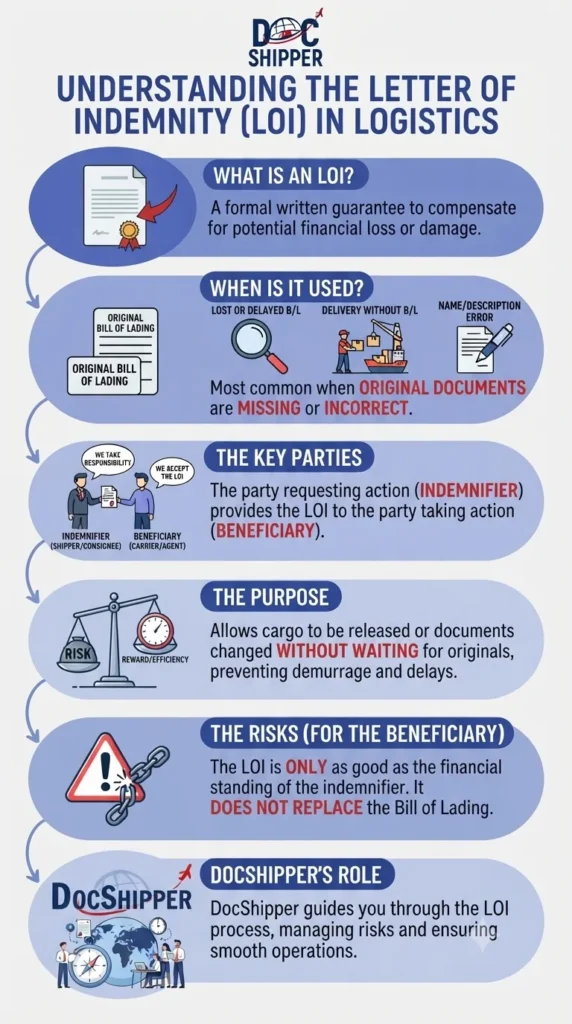
A Letter of Indemnity (LOI) is a contractual document whereby one party agrees to indemnify another against potential losses arising from a specific transaction, typically when original shipping documents are unavailable. In international trade, it enables cargo release without presenting bills of lading, protecting carriers and freight forwarders from legal claims.
Introduction
In international shipping, delays in document transmission can paralyze cargo release, causing storage fees and delivery failures. The Letter of Indemnity emerged as a practical solution to this challenge.
This instrument allows consignees to obtain goods when original bills of lading are delayed in transit. However, it introduces significant legal risks that both shippers and carriers must understand.
Key characteristics include:
- Contractual protection: Shields carriers from third-party claims when releasing cargo without original documents
- Bank guarantee requirement: Often requires counter-indemnity from financial institutions to strengthen security
- Limited enforceability: Not universally recognized in all jurisdictions, creating legal uncertainty
- Fraud vulnerability: Potential tool for fraudulent cargo appropriation if misused
- Time-sensitive nature: Typically used when bills of lading arrive after vessel discharge
Legal Framework & Risk Management
The Letter of Indemnity operates in a complex legal environment where international conventions and national laws intersect. Understanding these frameworks is essential for mitigating exposure.
Under the Hague-Visby Rules, carriers remain liable for cargo delivery to the lawful holder of the bill of lading. An LOI does not eliminate this obligation—it merely transfers financial consequences to the indemnifying party.
Jurisdictional variations significantly impact LOI validity. Common law countries generally recognize these instruments, while civil law jurisdictions may view them as contrary to public policy, particularly when facilitating delivery without proper title documents.
The bank counter-guarantee serves as critical reinforcement. Financial institutions assess creditworthiness before issuing these instruments, typically requiring collateral equivalent to cargo value plus 10-30% contingency. This mechanism provides carriers with recourse beyond the consignee’s assets.
Insurance implications merit careful consideration. P&I Clubs (Protection and Indemnity insurers) often exclude claims arising from LOI arrangements, leaving carriers exposed. Some policies offer limited coverage only when specific conditions are met, including bank guarantees and legal review.
Fraud prevention measures must be implemented rigorously. Verification of signatory authority, cross-checking with known contacts, and requiring original bank guarantees (not faxed copies) are essential safeguards. At DocShipper, we systematically verify all LOI documents through our legal compliance team before authorizing cargo release, ensuring our clients avoid costly disputes.
Practical Applications & Real-World Scenarios
Understanding the Letter of Indemnity through concrete examples reveals both its utility and inherent risks in global supply chain operations.
Scenario 1: Time-Sensitive Electronics Shipment
A consignee in Hamburg receives a container of smartphones from Shenzhen. The vessel arrives on schedule, but original bills of lading are delayed due to courier service disruption. The goods have a retail launch deadline in 72 hours.
Solution: The consignee’s bank issues an LOI with counter-guarantee worth €520,000 (cargo value €400,000 + 30% buffer). The carrier releases cargo against the indemnity, avoiding potential losses exceeding €150,000 in missed sales and demurrage charges.
Scenario 2: Documentary Credit Complications
An Indian textile exporter ships goods to a UK importer under a letter of credit. Bank processing delays prevent timely document presentation. Without an LOI, the importer faces:
- Storage fees: $85 per day after free time expires
- Container demurrage: $120 per day
- Production line stoppage costs: $3,500 daily
By executing a properly structured LOI backed by their UK bank, the importer secures release within 24 hours, preventing total accumulated costs exceeding $18,000 over a projected 5-day delay.
Comparative Risk Assessment
| Factor | With Bank-Guaranteed LOI | Without LOI Protection |
|---|---|---|
| Cargo Release Time | 24-48 hours | 5-10 days (document arrival) |
| Carrier Liability Exposure | Transferred to bank | Full liability retained |
| Fraud Risk | Low (bank verification) | N/A (no release) |
| Cost Impact (10-day delay) | Bank guarantee fee: 0.5-2% of value | Storage + demurrage: $2,000-5,000+ |
| Legal Enforceability | Jurisdiction-dependent | Full compliance with Hague-Visby |
Industry-Specific Considerations
In the automotive sector, just-in-time manufacturing makes LOIs particularly valuable. A 3-day delay in component delivery can halt production lines affecting thousands of vehicles. Manufacturers often pre-arrange LOI frameworks with their banks to enable rapid activation.
Conversely, hazardous materials shipments present heightened complexity. Regulatory authorities may not accept LOIs for dangerous goods release, as safety documentation verification supersedes commercial convenience. DocShipper’s hazmat specialists navigate these constraints by coordinating with customs authorities and ensuring all safety certificates arrive digitally before vessel discharge.
Conclusion
The Letter of Indemnity serves as a pragmatic instrument balancing commercial efficiency against documentary control in international trade. When properly structured with bank guarantees and legal oversight, it mitigates supply chain disruptions without compromising carrier security.
Need expert guidance on implementing LOI procedures or managing documentary compliance? Contact our DocShipper specialists for comprehensive support across your international logistics operations.
📚 Quiz
Test Your Knowledge: Letter of Indemnity
What is the primary function of a Letter of Indemnity in international shipping?
A common misconception is that a Letter of Indemnity can override the legal rights of a bill of lading holder. Is this correct?
In which scenario would a Letter of Indemnity be most appropriately used?
🎯 Your Result
📞 Free Quote in 24hFAQ | Letter of Indemnity: Definition, Legal Framework & Practical Examples
The Letter of Indemnity allows cargo release without presenting original bills of lading, protecting carriers from legal claims while enabling consignees to access goods when documents are delayed. It transfers financial risk from the carrier to the party issuing the indemnity, typically backed by bank guarantees.
No. Enforceability varies significantly by jurisdiction. Common law countries like the UK and Singapore generally recognize LOIs, while some civil law jurisdictions view them skeptically, particularly when they facilitate delivery contrary to bills of lading requirements. Legal advice specific to the relevant jurisdiction is essential.
Banks provide counter-guarantees that strengthen the indemnity's credibility. They assess the consignee's creditworthiness and issue guarantees covering cargo value plus contingency (typically 10-30%). This banking involvement offers carriers financial recourse beyond the consignee's assets and reduces fraud risk through institutional verification.
Not universally. While LOIs work well for general merchandise, hazardous materials, temperature-controlled goods, and certain regulated products face restrictions. Authorities may require original documentation for safety, security, or compliance verification regardless of indemnity arrangements. Perishables present additional complications due to time sensitivity.
The LOI typically requires the consignee to surrender original documents to the carrier once they arrive. This returns the carrier to full compliance with documentary requirements. The indemnity remains active until originals are provided, and any claims arising during the interim period remain covered under the LOI terms.
Bank guarantee fees typically range from 0.5% to 2% of the cargo value annually, depending on creditworthiness, relationship with the bank, and risk assessment. Additional legal fees for drafting the LOI may apply, usually between $500-2,000. These costs must be weighed against potential demurrage and storage charges during document delays.
A comprehensive LOI must contain: precise vessel and voyage details, bill of lading numbers (if known), complete cargo description, consignee and shipper identification, indemnity amount, bank guarantee reference, clear indemnification language, authorized signatures, and explicit agreement to hold the carrier harmless from all claims arising from the documentary deficiency.
Coverage varies significantly. Most Protection and Indemnity Clubs exclude or heavily restrict LOI-related claims due to the inherent risks of releasing cargo without proper title documents. Some offer limited coverage only when strict conditions are met, including bank guarantees, legal review, and specific documentation protocols. Carriers should verify their policy terms explicitly.
Essential verification steps include: confirming signatory authority through independent contact with the company, validating bank guarantees directly with issuing institutions (never accepting faxed copies), cross-referencing consignee details with previous transactions, requiring notarization for high-value shipments, and conducting background checks on unfamiliar parties. Digital authentication platforms are increasingly used for secure verification.
No. An LOI cannot eliminate the legal rights of the lawful bill of lading holder. If the original bill is negotiated to a third party, that party retains superior title to the cargo. The indemnity only protects the carrier financially if claims arise; it does not confer legal ownership or override maritime law principles regarding negotiable instruments.
Alternatives include: electronic bills of lading (eBLs) that eliminate physical document transit delays, express release bills for trusted parties, sea waybills for non-negotiable shipments, telex releases for fast document transmission, and pre-arranged credit terms allowing release upon electronic confirmation. Each option carries distinct legal implications and suitability depending on trade relationships and cargo types.
LOI validity periods vary but typically extend until original bills of lading are surrendered or for a specified period (commonly 6-12 months). Some remain open-ended until the indemnity obligation is formally released. The duration should be explicitly stated in the document, and bank guarantees must cover the entire validity period to maintain protection.
Need Help with
Logistics or Sourcing ?
First, we secure the right products from the right suppliers at the right price by managing the sourcing process from start to finish. Then, we simplify your shipping experience - from pickup to final delivery - ensuring any product, anywhere, is delivered at highly competitive prices.


Fill the Form
Prefer email? Send us your inquiry, and we’ll get back to you as soon as possible.
Contact us




