


In short ⚡
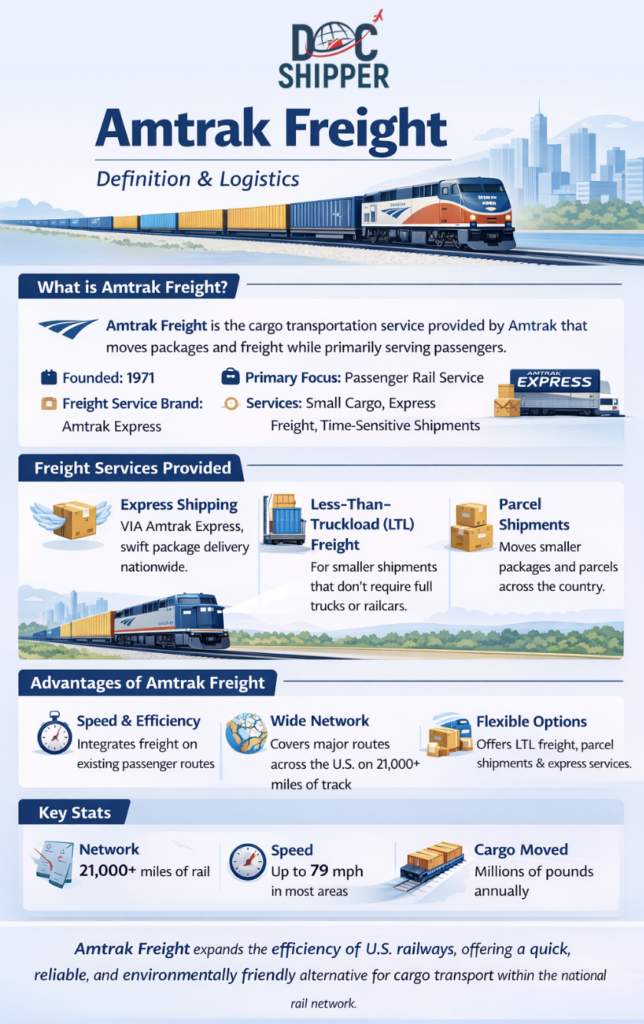
Amtrak is the National Railroad Passenger Corporation, a federally chartered corporation providing intercity passenger rail services across the United States. While primarily known for passenger transport, Amtrak also offers Amtrak Express services for small freight shipments, connecting major urban centers with reliable rail logistics solutions for time-sensitive cargo.Introduction
Many shippers overlook rail as a viable option for time-sensitive freight, assuming trucks dominate the small-parcel market. However, Amtrak’s network spans over 21,000 miles across 46 states, offering a strategic alternative for businesses needing rapid, cost-effective transport between major metropolitan areas.
In international trade and domestic logistics, understanding Amtrak’s freight capabilities becomes crucial when traditional carriers face capacity constraints or when shipping routes align with passenger rail corridors. The service bridges gaps in the supply chain, particularly for express shipments requiring guaranteed delivery windows.
- Network Coverage: Connects 500+ destinations across North America
- Service Type: Amtrak Express for packages up to 500 lbs per piece
- Speed Advantage: Operates on dedicated passenger schedules with priority handling
- Regulatory Framework: Governed by federal rail safety standards and DOT regulations
- Intermodal Compatibility: Integrates with trucking and ocean freight for last-mile delivery
Amtrak Freight Services & Operational Framework
Amtrak Express operates as a specialized division handling small freight shipments alongside passenger operations. Unlike traditional freight rail carriers like Union Pacific or BNSF, Amtrak prioritizes speed over volume, making it ideal for urgent documents, medical supplies, automotive parts, and high-value electronics.
The service accepts shipments weighing up to 500 pounds per piece with dimensional restrictions (maximum 36″ x 36″ x 36″). Packages travel in dedicated baggage cars, ensuring separation from passenger luggage and maintaining chain-of-custody protocols critical for sensitive cargo.
Booking procedures require advance reservation through Amtrak’s freight portal or authorized agents. Shippers must provide detailed manifests, commercial invoices for customs (when applicable), and hazardous materials declarations if shipping restricted goods. At DocShipper, we streamline this process by coordinating documentation and ensuring compliance with both Amtrak’s terms and international trade regulations.
The pricing structure combines base rates determined by weight and distance, plus surcharges for express handling, oversized items, or refrigerated transport. Rates typically range from $0.50 to $2.00 per pound depending on route density and service level. Payment terms accept corporate accounts, credit cards, or prepaid shipping labels.
Legal considerations include liability limits capped at $100 per package unless additional insurance is purchased. The U.S. Department of Transportation regulates carrier liability under 49 CFR Part 370, requiring shippers to declare cargo value at booking. Cross-border shipments to Canada involve coordination with VIA Rail and Canadian customs authorities, necessitating ACI (Advance Commercial Information) filings.
Operational advantages include environmental benefits—rail transport generates 75% fewer emissions than trucking per ton-mile—and reduced road congestion. Amtrak’s fixed schedules eliminate variability common in trucking, though this rigidity requires precise timing for drop-off and pickup at designated stations.
Practical Examples & Shipping Data
Understanding Amtrak’s freight applications requires examining real-world scenarios where rail logistics outperform alternative modes. The following data illustrates cost-benefit analyses and operational timelines.
Comparative Cost Analysis
| Route | Amtrak Express | Air Freight | Expedited Trucking | Transit Time |
|---|---|---|---|---|
| New York – Chicago (200 lbs) | $320 | $580 | $450 | 19 hours |
| Los Angeles – Seattle (350 lbs) | $595 | $890 | $720 | 35 hours |
| Washington DC – Boston (150 lbs) | $240 | $410 | $330 | 8 hours |
Use Case: Medical Equipment Distribution
A pharmaceutical company needed to transport temperature-controlled diagnostic equipment from Philadelphia to Atlanta within 24 hours. The shipment weighed 420 lbs and required continuous monitoring.
- Challenge: Air freight quoted $1,200 with 6-hour transit but lacked temperature tracking
- Solution: Amtrak Express with refrigerated baggage car at $680, 18-hour delivery
- Outcome: 43% cost savings, real-time GPS tracking via Amtrak app, zero temperature excursions
- Documentation: Chain-of-custody forms, FDA compliance certificates, thermal data logs
- Customs Clearance: Not applicable for domestic route, but similar cross-border shipments require Health Canada approvals
DocShipper Platform
Optimize Your Global Logistics with Cutting-Edge Solutions
Enhance efficiency, cut costs, and gain 24/7 visibility 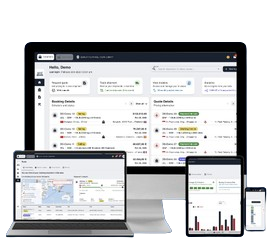 over your entire supply chain.
- Cut your shipping costs and maximize your margins
- Manage sourcing, freight, & customs on one platform
- Get real-time tracking and analytics
Key Performance Metrics
Based on 2023 operational data, Amtrak Express demonstrates:
- On-time delivery rate: 87% (compared to 92% for air, 78% for trucking)
- Damage claims: 0.3% of shipments (industry average: 1.2%)
- Average cost per pound-mile: $0.08 (versus $0.15 for air, $0.11 for truck)
- Carbon footprint: 0.14 kg CO₂ per ton-mile (versus 0.56 kg for trucking)
- Peak capacity utilization: Holiday seasons see 95% baggage car occupancy
At DocShipper, we leverage Amtrak’s network for clients requiring sustainable logistics solutions without compromising speed. Our team coordinates station-to-station transfers, manages customs documentation for international connections, and provides end-to-end tracking through integrated TMS platforms.
Conclusion
Amtrak’s freight services represent an underutilized asset in North American logistics, offering competitive pricing, environmental advantages, and reliable transit times for small-to-medium shipments. Strategic use of rail corridors can optimize supply chain costs while meeting sustainability goals.
Need assistance integrating Amtrak into your shipping strategy? Contact DocShipper for tailored logistics solutions combining rail, ocean, and air freight expertise.
📚 Quiz
Test Your Knowledge: Amtrak Freight
Q1 — What best defines Amtrak Express in the context of freight logistics?
Q2 — A shipper assumes that Amtrak's standard liability automatically covers the full declared value of their $5,000 cargo shipment. Is this correct?
Q3 — A pharmaceutical company needs to ship 420 lbs of temperature-controlled diagnostic equipment from Philadelphia to Atlanta within 24 hours at the lowest cost. Which option best fits?
🎯 Your Result
📞 Free Quote in 24hFAQ | Amtrak: Definition, Services & Practical Examples for Freight Shipping
Amtrak handles packages up to 500 lbs per piece with maximum dimensions of 36" x 36" x 36". Oversized items require special approval and incur additional fees.
Use the tracking number provided at booking through Amtrak's online portal or mobile app. Real-time updates show departure, transit, and arrival status at each station.
Limited hazmat is permitted under DOT regulations (49 CFR 173). Shippers must complete dangerous goods declarations and use approved packaging. Certain classes like explosives are prohibited.
Amtrak provides service guarantees on select routes. Delays due to mechanical issues or weather may qualify for partial refunds. Travel insurance is recommended for high-value cargo.
Amtrak connects with VIA Rail for Canadian destinations. Cross-border shipments require customs brokerage, ACI filings, and compliance with CBSA regulations. DocShipper manages these formalities.
For shipments over 100 lbs traveling 500+ miles, Amtrak typically costs 20-40% less than express couriers. However, station-to-station delivery requires additional local transport arrangements.
Standard liability covers $100 per package. Declared value insurance costs approximately $0.50 per $100 of coverage. Third-party cargo insurance provides broader protection including theft and natural disasters.
Yes, refrigerated baggage cars maintain temperatures between 35-45°F. Shippers must use insulated packaging and provide handling instructions. Service availability varies by route.
Minimum requirements include a commercial invoice, packing list, and shipper's declaration. International shipments need customs invoices, certificates of origin, and potentially import permits.
Reservations open 11 months ahead. Same-day bookings are accepted up to 2 hours before departure, subject to space availability. Peak periods require 48-72 hour advance notice.
Amtrak operates station-to-station. Shippers arrange drop-off and recipients collect cargo at destination stations. Third-party logistics providers like DocShipper offer integrated door-to-door solutions.
Prohibited goods include firearms, live animals (except service animals), flammable liquids over 16 oz, and items exceeding weight/dimension limits. Full restrictions are listed in Amtrak's tariff schedule.
Need Help with
Logistics or Sourcing ?
First, we secure the right products from the right suppliers at the right price by managing the sourcing process from start to finish. Then, we simplify your shipping experience - from pickup to final delivery - ensuring any product, anywhere, is delivered at highly competitive prices.


Fill the Form
Prefer email? Send us your inquiry, and we’ll get back to you as soon as possible.
Contact us




