


In short ⚡
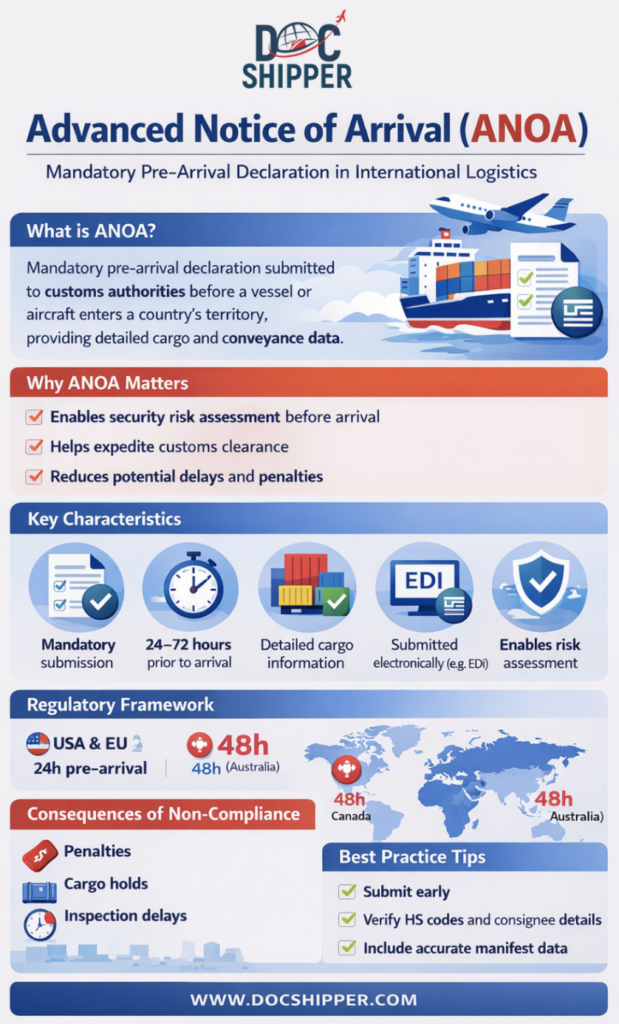
Advanced Notice of Arrival (ANOA) is a mandatory pre-arrival declaration submitted to customs authorities before a vessel or aircraft enters a country's territory. This document provides detailed information about the cargo, crew, passengers, and conveyance, enabling customs to assess security risks and expedite clearance procedures upon arrival.
Introduction
Many importers face unexpected delays and penalties because they underestimate the importance of timely ANOA submission. Missing this critical deadline can result in cargo holds, inspection fees, and disrupted supply chains.
The ANOA serves as the foundation of modern risk-based customs clearance. By providing advance information, customs authorities can identify high-risk shipments before physical arrival, allocating inspection resources efficiently while expediting low-risk cargo.
Key characteristics of ANOA include:
- Mandatory submission: Required by most countries under international security frameworks
- Time-sensitive: Must be filed within specific timeframes before arrival (typically 24-72 hours)
- Comprehensive data: Includes cargo details, conveyance information, and party identifications
- Electronic transmission: Submitted through authorized customs portals or EDI systems
- Risk assessment tool: Enables pre-clearance decisions and targeted inspections
Regulatory Framework & Compliance Requirements
The ANOA requirement emerged from post-9/11 security initiatives, particularly the U.S. 24-Hour Rule and similar regulations worldwide. These frameworks mandate that ocean carriers and NVOCCs transmit cargo information to customs before loading at the foreign port.
The World Customs Organization (WCO) SAFE Framework standardizes ANOA practices globally, establishing minimum data elements and submission protocols. Compliance with these standards ensures seamless cross-border trade while maintaining security integrity.
Critical data elements required in an ANOA include:
- Shipper and consignee details: Full legal names, addresses, and tax identification numbers
- Cargo description: Harmonized System (HS) codes, commodity descriptions, weights, and container numbers
- Conveyance information: Vessel name, voyage number, estimated arrival date/time
- Bill of lading data: Master and house B/L numbers, place of loading and discharge
- Seal numbers: Container seal identifications for security verification
Non-compliance carries significant consequences. The U.S. Customs and Border Protection (CBP) imposes penalties ranging from $5,000 to $10,000 per violation for late or inaccurate ANOA filings. The European Union’s Import Control System (ICS2) similarly enforces strict deadlines with financial penalties and cargo detention.
At DocShipper, we integrate ANOA compliance into our end-to-end logistics services, ensuring all pre-arrival declarations meet destination country requirements. Our customs specialists verify data accuracy and submit filings within regulatory timeframes, eliminating the risk of non-compliance penalties for our clients.
The Authorized Economic Operator (AEO) program offers expedited processing for companies with proven compliance records. AEO-certified importers benefit from reduced ANOA scrutiny and faster cargo release, demonstrating the value of maintaining rigorous documentation standards.
For authoritative guidance, consult the WCO SAFE Framework documentation, which provides international standards for advance cargo information requirements.
Practical Examples & Submission Timelines
Understanding ANOA submission deadlines across different transport modes and jurisdictions is essential for maintaining compliance. Timing requirements vary significantly based on destination country and conveyance type.
| Country/Region | Transport Mode | Submission Deadline | System |
|---|---|---|---|
| United States | Ocean | 24 hours before loading | AMS (Automated Manifest System) |
| United States | Air | 4 hours before arrival | ACAS (Air Cargo Advance Screening) |
| European Union | Ocean | 24 hours before loading | ICS2 (Import Control System 2) |
| Canada | Ocean | 24 hours before loading | ACI (Advance Commercial Information) |
| Australia | Ocean/Air | 48 hours before arrival | ICS (Integrated Cargo System) |
Case Study: Electronics Shipment from Shenzhen to Los Angeles
A technology importer ships 500 laptops (HS Code 8471.30) from Shenzhen, China to Los Angeles, USA. The vessel departs on March 15th with an estimated arrival of March 28th.
ANOA compliance steps:
- March 13th (48 hours before loading): Freight forwarder receives complete commercial invoice and packing list
- March 14th (24 hours before loading): ANOA filed through AMS with accurate HS codes, consignee IRS/EIN number, and container seal numbers
- March 14th evening: CBP reviews filing, assigns risk score, determines no physical inspection required
- March 28th (arrival): Cargo receives immediate release authorization due to compliant pre-filing
- Result: Zero detention time, no examination fees, goods available for pickup within 6 hours of vessel berthing
This scenario demonstrates how proper ANOA submission directly impacts supply chain velocity and cost efficiency. Late or inaccurate filings would have resulted in cargo holds, potential $5,000 penalties, and 3-5 day clearance delays.
Key data accuracy requirements:
- HS Code precision: Use 10-digit HTS codes for U.S. imports (6-digit minimum for ANOA)
- Consignee identification: Exact legal business name matching IRS records
- Container details: Verified seal numbers matching physical container seals
- Weight declarations: Gross weight in kilograms, matching VGM (Verified Gross Mass) documentation
- Value accuracy: Commercial invoice values in transaction currency, convertible to destination currency
DocShipper’s customs team validates all ANOA data against source documents before submission, utilizing automated verification tools that cross-reference HS codes, consignee databases, and regulatory requirements. This proactive approach maintains our 99.7% first-time filing acceptance rate.
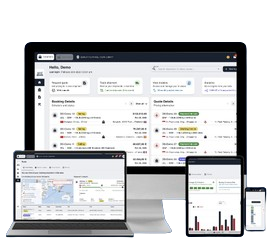
DocShipper Platform
One platform. Your entire supply chain
Sourcing, freight, customs & documents — all centralised, all visible, 24/7.
Conclusion
The Advanced Notice of Arrival represents a critical control point in international logistics, where compliance directly determines cargo velocity and cost efficiency. Mastering ANOA requirements protects your supply chain from preventable delays and penalties.
Need expert assistance with ANOA compliance and customs clearance? Contact DocShipper for comprehensive logistics support across all trade lanes.
📚 Quiz
Test Your Knowledge: Advanced Notice of Arrival (ANOA)
Q1 — What is the primary purpose of an Advanced Notice of Arrival (ANOA)?
Q2 — A common misconception about ANOA is that it replaces the formal customs entry filing. Which statement is correct?
Q3 — A freight forwarder is shipping electronics by ocean from Shenzhen to Los Angeles. The vessel is scheduled to load on March 15th. By when must the ANOA be filed with U.S. CBP?
🎯 Your Result
📞 Free Quote in 24hFAQ | Advanced Notice of Arrival (ANOA): Definition, Requirements & Practical Examples
Missing the ANOA deadline results in cargo holds at the port, potential fines ranging from $5,000-$10,000 per violation, and clearance delays of 3-7 days. Customs may also subject your shipment to mandatory physical inspection, incurring additional examination fees.
The carrier or NVOCC (Non-Vessel Operating Common Carrier) is legally responsible for ANOA submission. However, they require accurate data from the shipper or freight forwarder. Most importers delegate this task to their customs broker or freight forwarder to ensure compliance.
Yes, amendments are permitted before cargo arrival, though some jurisdictions charge amendment fees. Significant changes (consignee, commodity description, HS codes) may trigger additional scrutiny. Submit corrections immediately upon discovering errors to minimize clearance impact.
ANOA requirements apply to all commercial shipments regardless of value, with limited exceptions for personal effects and diplomatic cargo. Even low-value shipments under de minimis thresholds require advance cargo information for security screening purposes.
ANOA is the carrier's manifest submission, while ISF is the importer's security filing. For U.S. imports, both are required: carriers file ANOA 24 hours before loading, and importers file ISF 24 hours before loading. ISF contains additional supply chain data beyond ANOA requirements.
Air cargo ANOA (often called ACAS in the U.S.) has shorter deadlines—typically 4 hours before arrival for passenger aircraft, 4 hours before departure for all-cargo aircraft. Air shipments require master air waybill data and house-level details for consolidations.
Essential documents include commercial invoice, packing list, bill of lading, shipper's letter of instruction, and consignee tax identification. Accurate HS codes, complete party addresses, and container seal numbers are critical data elements.
Very limited exemptions exist for diplomatic pouches, military shipments, and certain emergency relief cargo. Commercial shipments have no value-based exemptions. Even samples and temporary imports require full ANOA compliance.
Carriers and NVOCCs obtain filing credentials directly from customs authorities (CBP, CBSA, etc.). Importers typically work through licensed customs brokers who maintain authorized filing access. Direct importer filing requires customs bond and system registration.
Authorized Economic Operator (AEO) certification demonstrates proven ANOA compliance history. AEO-certified companies receive expedited processing, reduced examination rates, and priority clearance. Consistent ANOA accuracy is a prerequisite for AEO qualification.
Most systems accept ANOA filings up to 30 days before arrival, though practical filing typically occurs 2-5 days before vessel departure. Early filing allows time for corrections but requires accurate voyage and arrival estimates.
No, ANOA is a pre-arrival security screening, not a customs entry. After cargo arrives and ANOA clearance is obtained, importers must still file formal entry documentation (consumption entry, temporary import bond, etc.) to legally import goods and pay duties.
Need Help with
Logistics or Sourcing ?
First, we secure the right products from the right suppliers at the right price by managing the sourcing process from start to finish. Then, we simplify your shipping experience - from pickup to final delivery - ensuring any product, anywhere, is delivered at highly competitive prices.


Fill the Form
Prefer email? Send us your inquiry, and we’ll get back to you as soon as possible.
Contact us




:%20Guide%20for%202026)