


In short ⚡
Business Intelligence (BI) is a technology-driven process that transforms raw data into actionable insights through analytics, reporting, and visualization tools. It enables organizations to make informed strategic decisions by analyzing historical and real-time data across supply chain, logistics, and operational workflows.Introduction
Many logistics companies struggle with fragmented data across warehouses, customs systems, and transportation networks. Without Business Intelligence, critical insights remain buried in spreadsheets and disconnected platforms.
In international trade and freight forwarding, BI transforms operational chaos into strategic clarity. It consolidates shipment tracking, customs clearance timelines, carrier performance, and cost fluctuations into unified dashboards.
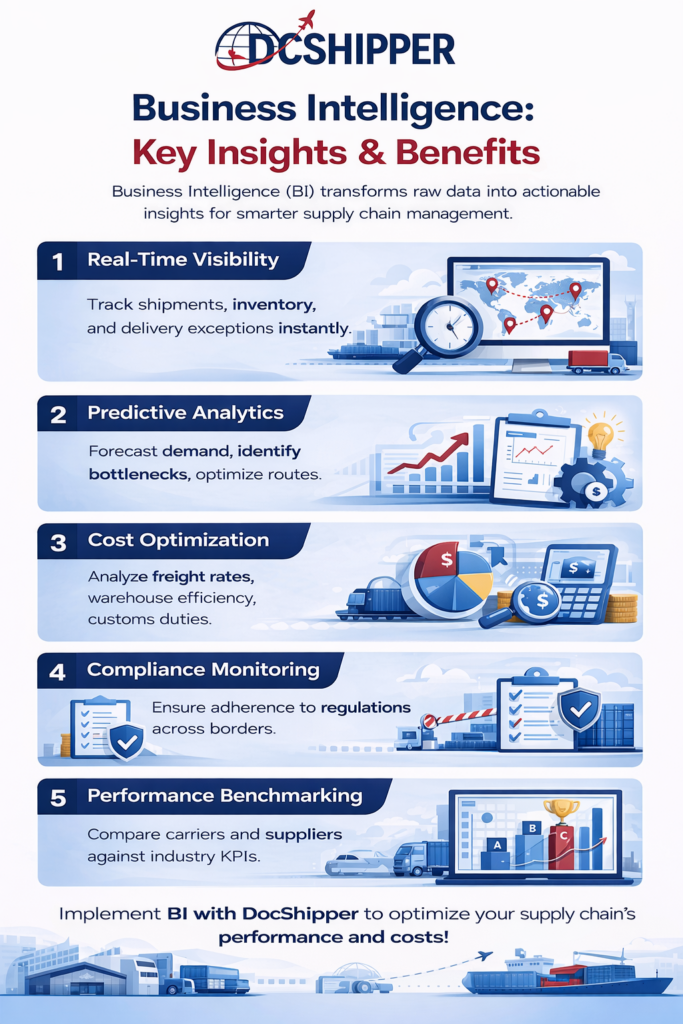
- Real-time visibility: Track shipments, inventory levels, and delivery exceptions instantly.
- Predictive analytics: Forecast demand, identify bottlenecks, and optimize routes.
- Cost optimization: Analyze freight rates, warehouse efficiency, and customs duty patterns.
- Compliance monitoring: Ensure regulatory adherence across multiple jurisdictions.
- Performance benchmarking: Compare carriers, suppliers, and internal KPIs against industry standards.
BI Mechanisms & Strategic Implementation
Business Intelligence operates through four interconnected layers: data collection, storage, analysis, and presentation. In logistics, this begins with integrating ERP systems, WMS platforms, TMS software, and customs databases into a centralized data warehouse.
The ETL process (Extract, Transform, Load) cleanses and standardizes data from disparate sources. For example, shipment dates from one carrier’s API might use DD/MM/YYYY format while another uses YYYY-MM-DD. BI tools normalize these inconsistencies automatically.
OLAP cubes (Online Analytical Processing) enable multidimensional analysis. A freight forwarder can slice data by origin country, destination port, product category, and time period simultaneously. This reveals patterns like seasonal demand spikes or port congestion trends.
Advanced BI platforms incorporate machine learning algorithms to detect anomalies. If container dwell time at a specific terminal suddenly increases by 40%, the system alerts logistics managers before delays cascade through the supply chain.
Regulatory compliance benefits significantly from BI. The European Union Customs Data Model requires detailed transaction records. BI systems automatically flag discrepancies in HS codes, valuation methods, or origin certificates before customs authorities intervene.
At DocShipper, we integrate BI dashboards into client portals, providing real-time visibility into customs clearance status, warehouse inventory, and shipment milestones. This transparency reduces client inquiries by 60% while improving decision-making speed.
Concrete Examples & Performance Data
A European electronics importer implemented BI to analyze 18 months of shipment data. The system identified that 23% of delays originated from a single Asian port during monsoon season. By rerouting shipments through an alternative hub, they reduced transit time by 4.2 days and cut demurrage costs by €47,000 annually.
| Metric | Before BI | After BI | Improvement |
|---|---|---|---|
| Average Customs Clearance Time | 5.8 days | 3.1 days | 46.6% faster |
| Inventory Holding Costs | €280,000/year | €189,000/year | €91,000 saved |
| Carrier On-Time Delivery Rate | 78% | 92% | +14 points |
| Data Entry Errors | 12.3% | 2.1% | 82.9% reduction |
Use Case: A pharmaceutical company exporting temperature-sensitive products used BI to monitor cold chain compliance. Sensors tracked container temperatures every 15 minutes. When a refrigeration unit failed mid-transit, the system triggered an automatic reroute to the nearest port with cold storage facilities. This prevented $320,000 in product loss and maintained FDA compliance.
Key Performance Indicators tracked through BI in logistics include:
- Perfect Order Rate: Percentage of shipments delivered on time, damage-free, with correct documentation.
- Dwell Time: Average hours cargo spends at terminals or customs checkpoints.
- Cost per Shipment: Total logistics expenses divided by number of shipments.
- Forecast Accuracy: Variance between predicted and actual demand or transit times.
- Documentation Error Rate: Percentage of shipments requiring customs document corrections.
A textile importer leveraged BI to compare 14 freight forwarders across 200 shipments. Analysis revealed that the lowest-cost provider had a 19% higher damage rate and 2.3-day longer transit time. Switching to the third-cheapest option reduced total landed costs by 8% when accounting for inventory carrying costs and damage claims.
Conclusion
Business Intelligence transforms logistics from reactive problem-solving to proactive strategy execution. Companies leveraging BI gain competitive advantages through faster decision-making, reduced costs, and superior customer service.
Need expert guidance implementing BI solutions for your supply chain? Contact DocShipper for customized analytics strategies tailored to international trade operations.
📚 Quizz
Test Your Knowledge: Business Intelligence (BI)
1. What is the primary purpose of Business Intelligence (BI) in logistics?
2. A logistics manager claims that Business Intelligence and basic reporting are essentially the same thing. Is this correct?
3. A pharmaceutical company uses BI to monitor cold chain shipments. Mid-transit, a refrigeration unit fails. Which outcome best illustrates BI's applied value in this scenario?
🎯 Your Result
📞 Free Quote in 24hFAQ | Business Intelligence (BI): Definition, Implementation & Concrete Examples
BI integrates multiple data sources, provides predictive analytics, and enables interactive exploration. Basic reporting simply displays historical data without context or actionable insights.
Typical deployments range from 3-9 months depending on system complexity, data quality, and integration requirements. Phased rollouts allow testing with pilot departments first.
Cloud-based BI platforms offer subscription models starting at $50-200/month per user. Many providers offer logistics-specific templates reducing customization costs significantly.
Essential sources include TMS, WMS, ERP, customs platforms, carrier APIs, IoT sensors, and financial systems. Third-party data like port congestion indexes enhances predictive accuracy.
BI identifies documentation patterns causing delays, flags high-risk shipments for pre-clearance review, and tracks duty optimization opportunities across HS code classifications.
Studies show 15-25% reduction in logistics costs within 18 months. Benefits include lower inventory holding, optimized routing, reduced penalties, and improved carrier negotiations.
Modern BI tools feature drag-and-drop interfaces requiring minimal coding. However, dedicated analysts maximize value by designing custom dashboards and interpreting complex trends.
BI platforms connect to carrier APIs, GPS devices, and port systems via webhooks. Data refreshes occur every 5-15 minutes, with critical alerts triggering instant notifications.
While BI cannot forecast policy shifts, it tracks historical duty trends, identifies tariff code vulnerabilities, and models financial impacts of proposed trade agreement changes.
Enterprise BI platforms employ AES-256 encryption, role-based access controls, audit trails, and compliance with GDPR, ISO 27001, and SOC 2 Type II standards.
BI calculates carbon footprints per shipment, tracks emissions across transport modes, and identifies eco-friendly routing options. Data feeds ESG reporting frameworks automatically.
Visibility platforms focus on real-time tracking. BI adds historical analysis, predictive modeling, financial integration, and cross-functional insights beyond shipment status alone.
Need Help with
Logistics or Sourcing ?
First, we secure the right products from the right suppliers at the right price by managing the sourcing process from start to finish. Then, we simplify your shipping experience - from pickup to final delivery - ensuring any product, anywhere, is delivered at highly competitive prices.


Fill the Form
Prefer email? Send us your inquiry, and we’ll get back to you as soon as possible.
Contact us




