


In short ⚡
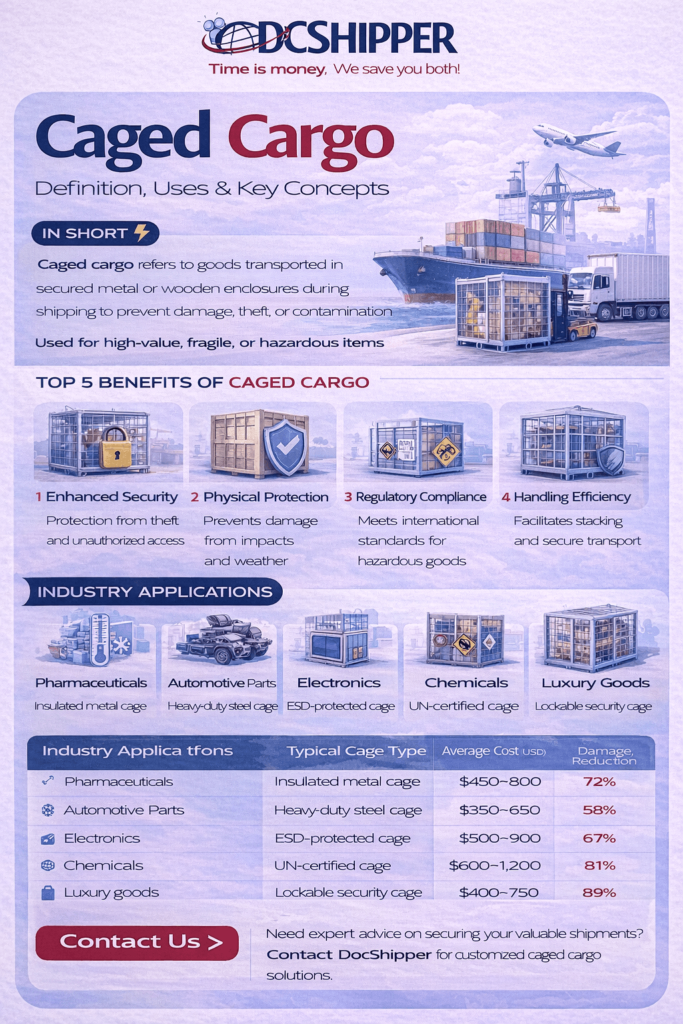
Caged cargo refers to goods transported in secured metal or wooden enclosures during shipping to prevent damage, theft, or contamination. This packaging method ensures product integrity, facilitates handling, and meets regulatory requirements for hazardous or high-value items in international logistics.Introduction
Many importers face cargo damage or theft during transit, especially when shipping valuable or fragile goods. Caged cargo addresses these challenges by providing robust containment systems that protect merchandise throughout the supply chain.
In international freight operations, caged cargo plays a critical role in securing products that require additional protection beyond standard packaging. This method is essential for air freight, sea shipping, and multimodal transport where goods face multiple handling points.
- Enhanced security against theft and unauthorized access during transit
- Physical protection from impacts, moisture, and environmental factors
- Regulatory compliance for dangerous goods and controlled substances
- Improved handling efficiency through standardized dimensions and stackability
- Traceability with integrated labeling and tracking systems
Technical Requirements & Regulatory Framework
Caged cargo systems must comply with international standards governing construction materials, dimensions, and load capacity. The International Air Transport Association (IATA) and International Maritime Organization (IMO) establish specific requirements for different cargo categories.
Construction specifications vary based on cargo type. Metal cages typically use galvanized steel or aluminum alloy with mesh sizes between 25mm and 50mm. Wooden cages must meet ISPM-15 phytosanitary standards, requiring heat treatment or fumigation to prevent pest transmission across borders.
Load-bearing capacity represents a critical factor. Standard aviation cages support 150-500 kg per cubic meter, while maritime containers can handle heavier loads up to 1,000 kg per cubic meter. Structural integrity testing ensures cages withstand stacking pressures and dynamic forces during transport.
For hazardous materials, caged cargo must incorporate UN-certified containment features. This includes leak-proof liners, ventilation systems, and compatibility with dangerous goods classifications. The UN Model Regulations provide detailed specifications for each hazard class.
At DocShipper, we verify cage specifications against carrier requirements before shipment, preventing rejections and delays. Our teams conduct pre-shipment inspections to ensure compliance with both origin and destination country regulations.
Labeling requirements include cargo identification numbers, handling instructions, weight declarations, and hazard symbols. Electronic tracking devices can be integrated into cage structures for real-time monitoring throughout the journey.
Practical Applications & Industry Data
Caged cargo finds widespread application across multiple industries. Pharmaceutical companies transport temperature-sensitive vaccines in climate-controlled cages with monitoring systems. Automotive manufacturers ship high-value components like engines and transmissions in reinforced cages to prevent theft and damage.
The electronics sector extensively uses caged systems for semiconductors and precision instruments. Industry data shows that proper caging reduces damage claims by 67% compared to standard packaging for fragile electronics.
| Industry Sector | Typical Cage Type | Average Cost (USD) | Damage Reduction |
|---|---|---|---|
| Pharmaceuticals | Insulated metal cage | $450-800 | 72% |
| Automotive parts | Heavy-duty steel cage | $350-650 | 58% |
| Electronics | ESD-protected cage | $500-900 | 67% |
| Chemicals | UN-certified containment | $600-1,200 | 81% |
| Luxury goods | Lockable security cage | $400-750 | 89% |
Cost-benefit analysis demonstrates significant ROI for high-value shipments. A practical case: an electronics manufacturer shipping $500,000 worth of components faced average damage claims of $15,000 per shipment using standard packaging. After implementing caged cargo systems at $2,800 per shipment, claims dropped to $3,500—generating net savings of $8,700 per shipment.
Handling efficiency improves measurably with standardized cage dimensions. Airports report 23% faster processing times for caged cargo compared to irregularly packaged freight. Warehouse operations benefit from stackability, reducing storage footprint by up to 40%.
Environmental considerations increasingly influence cage selection. Reusable cage programs reduce packaging waste by 85% compared to single-use solutions. Major logistics providers now offer cage pooling systems where customers rent standardized units, promoting circular economy principles.
DocShipper coordinates cage procurement, certification, and return logistics for clients requiring specialized containment solutions. Our global network ensures cage availability at origin points and proper disposal or return at destination facilities.
Conclusion
Caged cargo represents a critical protective measure for high-value, fragile, or regulated goods in international shipping. Proper implementation reduces damage, ensures compliance, and optimizes handling efficiency across the supply chain.
Need expert guidance on caged cargo solutions for your shipments? Contact DocShipper for customized logistics support.
📚 Quiz
Test Your Knowledge: Caged Cargo
Q1 — What is the primary definition of "caged cargo" in international logistics?
Q2 — A shipper uses wooden cages for an international shipment. Which regulatory requirement must those wooden cages comply with?
Q3 — An electronics manufacturer is deciding between standard packaging and caged cargo for a $500,000 shipment of semiconductors. Based on industry data, which statement best justifies choosing caged cargo?
🎯 Your Result
📞 Free Quote in 24hFAQ | Caged Cargo: Definition, Requirements & Practical Examples
Galvanized steel, aluminum alloy, and ISPM-15 certified wood are standard materials. Selection depends on cargo weight, transport mode, and environmental exposure during transit.
Most carriers apply dimensional weight pricing rather than specific cage surcharges. However, oversized cages may incur additional handling fees depending on airline policies.
Yes, insulated cages with active or passive cooling systems maintain required temperatures for pharmaceuticals, biologics, and perishable goods throughout transit.
Standard requirements include commercial invoice, packing list, cage certification, and dangerous goods declaration if applicable. Specific countries may require additional permits.
Quality metal cages withstand 50-100 shipment cycles with proper maintenance. Wooden cages typically handle 10-20 cycles before requiring replacement.
Aircraft cargo door dimensions limit maximum cage sizes. Standard restrictions range from 96x125 inches for narrow-body aircraft to 125x240 inches for wide-body freighters.
Tamper-evident seals, numbered locks, GPS tracking devices, and surveillance integration provide multiple security layers. High-security cages use welded construction rather than bolted assemblies.
Properly documented caged cargo typically clears customs faster due to enhanced security features and clear product visibility during inspections.
Compatibility depends on regulatory restrictions. Dangerous goods cannot mix with food products, and incompatible chemicals require separate containment per UN regulations.
Options include return logistics to origin, local resale, recycling programs, or retention for future shipments. Many companies participate in cage pooling networks.
Standard forklifts and pallet jacks handle most cages. Heavy-duty or oversized units may require specialized lifting equipment available at major freight terminals.
Calculate total product volume, add 15-20% for internal cushioning, then select the nearest standard cage size that accommodates weight limits and transport mode restrictions.
Need Help with
Logistics or Sourcing ?
First, we secure the right products from the right suppliers at the right price by managing the sourcing process from start to finish. Then, we simplify your shipping experience - from pickup to final delivery - ensuring any product, anywhere, is delivered at highly competitive prices.


Fill the Form
Prefer email? Send us your inquiry, and we’ll get back to you as soon as possible.
Contact us




