


In short ⚡
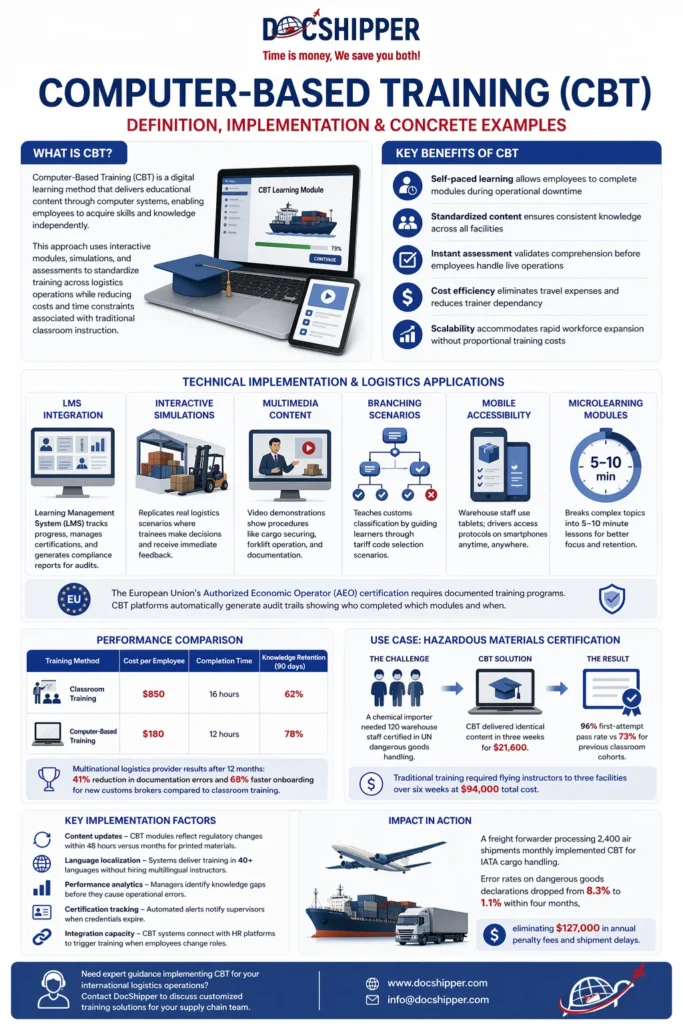
Computer-Based Training (CBT) is a digital learning method that delivers educational content through computer systems, enabling employees to acquire skills and knowledge independently. This approach uses interactive modules, simulations, and assessments to standardize training across logistics operations while reducing costs and time constraints associated with traditional classroom instruction.Introduction
Training logistics personnel across multiple locations creates operational bottlenecks. Traditional methods require coordinating schedules, booking venues, and pulling staff from critical tasks. Computer-Based Training eliminates these friction points.
In international freight forwarding, regulatory compliance and procedural accuracy directly impact shipment success. CBT ensures every team member receives identical, up-to-date training on customs protocols, hazardous materials handling, and documentation requirements.
- Self-paced learning allows employees to complete modules during operational downtime
- Standardized content ensures consistent knowledge across all facilities
- Instant assessment validates comprehension before employees handle live operations
- Cost efficiency eliminates travel expenses and reduces trainer dependency
- Scalability accommodates rapid workforce expansion without proportional training costs
Technical Implementation & Logistics Applications
Effective CBT systems integrate with existing logistics management software. The architecture typically includes a Learning Management System (LMS) that tracks progress, manages certifications, and generates compliance reports for regulatory audits.
Content delivery mechanisms vary by training objective. Interactive simulations replicate warehouse management scenarios where trainees make decisions with immediate feedback. Video demonstrations show proper cargo securing techniques or forklift operation protocols. Branching scenarios teach customs classification by presenting product descriptions and guiding learners through tariff code selection.
The European Union’s Authorized Economic Operator (AEO) certification requires documented training programs. CBT platforms automatically generate audit trails showing who completed which modules and when, satisfying compliance requirements.
Mobile compatibility extends training accessibility. Warehouse staff can complete safety refreshers on tablets during shift changes. Drivers access hazardous materials protocols on smartphones before loading cargo.
Microlearning modules break complex topics into 5-10 minute segments. An employee learning INCOTERMS doesn’t face a four-hour session but completes focused lessons on EXW, FOB, and DDP across multiple days.
At DocShipper, we implement CBT for client teams managing their first international shipments, ensuring they understand documentation requirements and customs procedures before goods leave origin ports.
Concrete Examples & Performance Data
A multinational logistics provider deployed CBT for customs compliance training across 23 countries. Results after 12 months showed a 41% reduction in documentation errors and 68% faster onboarding for new customs brokers compared to classroom training.
| Training Method | Cost per Employee | Completion Time | Knowledge Retention (90 days) |
|---|---|---|---|
| Classroom Training | $850 | 16 hours | 62% |
| Computer-Based Training | $180 | 12 hours | 78% |
Use Case: Hazardous Materials Certification
A chemical importer needed 120 warehouse staff certified in UN dangerous goods handling. Traditional training required flying instructors to three facilities over six weeks at $94,000 total cost. CBT delivered identical content in three weeks for $21,600, with 96% first-attempt pass rate versus 73% for previous classroom cohorts.
Key implementation factors:
- Content updates – CBT modules reflect regulatory changes within 48 hours versus months for printed materials
- Language localization – Systems deliver training in 40+ languages without hiring multilingual instructors
- Performance analytics – Managers identify knowledge gaps before they cause operational errors
- Certification tracking – Automated alerts notify supervisors when credentials expire
- Integration capacity – CBT systems connect with HR platforms to trigger training when employees change roles
A freight forwarder processing 2,400 air shipments monthly implemented CBT for IATA cargo handling. Error rates on dangerous goods declarations dropped from 8.3% to 1.1% within four months, eliminating $127,000 in annual penalty fees and shipment delays.
Conclusion
Computer-Based Training transforms logistics workforce development from a resource-intensive bottleneck into a scalable competitive advantage. Organizations achieve regulatory compliance, operational consistency, and cost efficiency simultaneously.
Need expert guidance implementing CBT for your international logistics operations? Contact DocShipper to discuss customized training solutions for your supply chain team.
📚 Quiz
Test Your Knowledge: Computer-Based Training (CBT)
Q1 — What is the primary purpose of Computer-Based Training (CBT) in a logistics context?
Q2 — A logistics manager claims that CBT can fully replace hands-on forklift operation training. Is this correct?
Q3 — A chemical importer needs to certify 120 warehouse staff in UN dangerous goods handling across three facilities. Which approach best illustrates the advantage of CBT?
🎯 Your Result
📞 Free Quote in 24hFAQ | Computer-Based Training (CBT): Definition, Implementation & Concrete Examples
Standard computers, tablets, or smartphones with internet connectivity suffice. Most platforms require 2GB RAM and modern web browsers. No specialized equipment needed beyond existing office infrastructure.
CBT covers theoretical knowledge and safety protocols. Physical skills still require hands-on training, but CBT reduces classroom time by 60-70% before practical assessments begin.
Yes. Learning Management Systems generate audit reports showing training completion dates, test scores, and certification expiration dates. These satisfy ISO 9001 and industry-specific quality standards.
Simple modules take 4-6 weeks. Complex simulations with branching scenarios require 12-16 weeks. Off-the-shelf content for standard topics like customs procedures is immediately deployable.
Professional systems support 40+ languages with automatic content switching based on user profiles. Translations maintain technical accuracy for regulatory terminology across all versions.
Video-heavy modules need 5 Mbps minimum. Text-based content functions on 1 Mbps connections. Most platforms cache content locally, allowing offline completion with periodic syncing.
Modern LMS platforms use APIs to connect with WMS, ERP, and HR systems. This enables automatic training triggers when employees access new system functions or change responsibilities.
Regulatory content requires updates within 30 days of law changes. Procedural training should refresh quarterly. Technology training updates align with software version releases.
Scenario-based questions testing decision-making outperform multiple-choice tests. Drag-and-drop exercises for cargo loading sequences and interactive customs forms provide practical validation.
Documented training completion strengthens legal defense by proving employees received proper instruction. Timestamped records show when safety protocols were taught and comprehension verified.
Track error reduction rates, compliance penalty avoidance, training cost per employee, and time-to-competency metrics. Most organizations achieve positive ROI within 8-14 months.
Yes. Self-paced modules allow rapid onboarding without waiting for scheduled training sessions. Temporary staff complete essential safety and compliance training before first shift, reducing supervision requirements.
Need Help with
Logistics or Sourcing ?
First, we secure the right products from the right suppliers at the right price by managing the sourcing process from start to finish. Then, we simplify your shipping experience - from pickup to final delivery - ensuring any product, anywhere, is delivered at highly competitive prices.


Fill the Form
Prefer email? Send us your inquiry, and we’ll get back to you as soon as possible.
Contact us




:%20Definition%20&%20Guide%20for%202026)