


In short ⚡
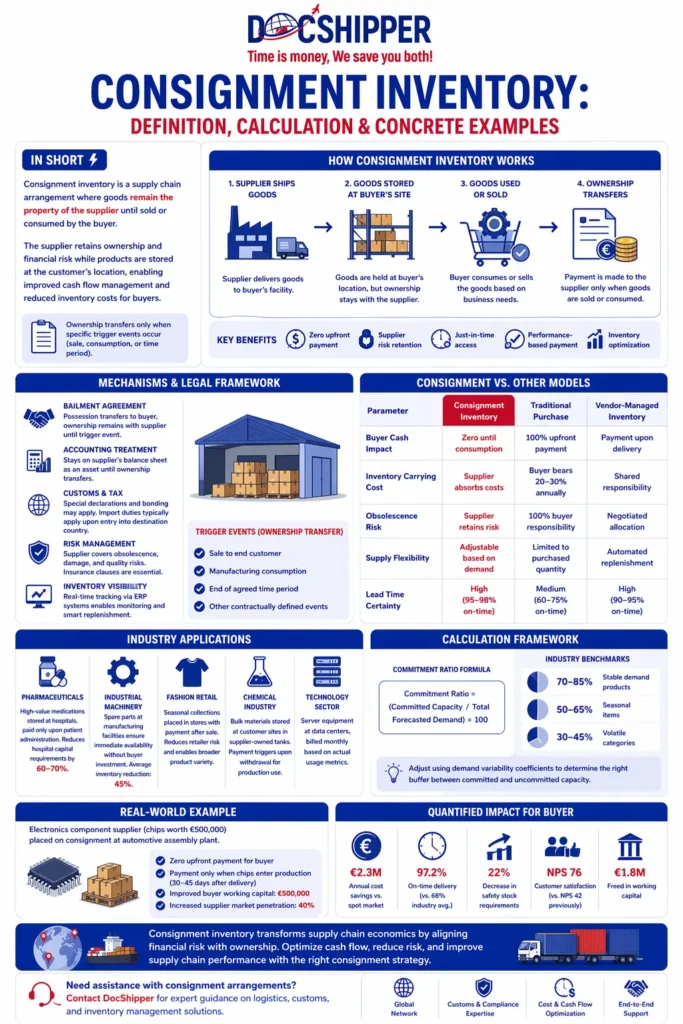
Consignment inventory is a supply chain arrangement where goods remain the property of the supplier until sold or consumed by the buyer. The supplier retains ownership and financial risk while products are stored at the customer's location, enabling improved cash flow management and reduced inventory costs for buyers.
Introduction
Many businesses struggle with inventory management—tying up capital in stock that may sit unsold for months. This creates cash flow problems and storage challenges.
Consignment inventory solves this by shifting ownership responsibility. The supplier maintains title to goods stored at the buyer’s facility until the moment of sale or use. This model has become essential in international trade, particularly for high-value or slow-moving products.
- Zero upfront payment: Buyers avoid immediate capital expenditure on inventory.
- Supplier risk retention: The consignor bears obsolescence and damage risks.
- Just-in-time access: Products are immediately available without procurement delays.
- Performance-based payment: Payment triggers only upon actual consumption or sale.
- Inventory optimization: Reduces warehousing needs for both parties when managed effectively.
Understanding Mechanisms & Legal Framework
The consignment model operates through a bailment agreement where the consignor (supplier) transfers possession but not ownership to the consignee (buyer). Legal title remains with the supplier until specific trigger events occur.
Ownership transfer mechanisms vary by contract but typically include sale to end customer, manufacturing consumption, or agreed time periods. The consignment agreement must clearly define these triggers to prevent disputes.
From an accounting perspective, consignment inventory stays on the supplier’s balance sheet as an asset. The buyer records no inventory liability until ownership transfers. This creates significant financial reporting implications under IFRS and GAAP standards.
Customs and tax considerations add complexity to international consignment. According to EU customs regulations, goods under consignment may require special declarations and bonding arrangements. Import duties typically apply when goods enter the destination country, regardless of ownership status.
The risk management framework must address insurance coverage, quality deterioration, and market obsolescence. At DocShipper, we ensure consignment agreements include comprehensive insurance clauses and regular stock audits to protect both parties throughout the supply chain.
Inventory tracking systems become critical for consignment success. Real-time visibility through ERP integration allows suppliers to monitor stock levels, rotation rates, and consumption patterns. This data drives replenishment decisions and prevents stockouts or overstocking situations.
Practical Examples & Financial Data
Understanding consignment through real-world applications reveals its strategic value. Consider these comparative scenarios and financial implications.
Use Case: Electronics Component Supplier
A semiconductor manufacturer places €500,000 worth of specialized chips at an automotive assembly plant. Under traditional purchasing, the buyer would pay upfront and carry inventory costs of approximately 25% annually (€125,000).
With consignment inventory, the buyer eliminates this cost burden. The supplier maintains ownership but gains guaranteed shelf space and reduced sales cycle time. Payment occurs only when chips enter production, typically 30-45 days after delivery. This arrangement improved the buyer’s working capital by €500,000 while increasing the supplier’s market penetration by 40%.
Comparative Financial Analysis
| Model | Buyer Cash Impact | Inventory Carrying Cost | Obsolescence Risk | Supply Flexibility |
|---|---|---|---|---|
| Traditional Purchase | 100% upfront payment | Buyer bears 20-30% annually | 100% buyer responsibility | Limited to purchased quantity |
| Consignment Inventory | Zero until consumption | Supplier absorbs costs | Supplier retains risk | Adjustable based on demand |
| Vendor-Managed Inventory | Payment upon delivery | Shared responsibility | Negotiated allocation | Automated replenishment |
Industry-Specific Applications
- Pharmaceutical sector: High-value medications stored at hospitals, paid only upon patient administration. Reduces hospital capital requirements by 60-70%.
- Industrial machinery: Spare parts consignment at manufacturing facilities ensures immediate availability without buyer investment. Average inventory reduction: 45%.
- Fashion retail: Seasonal collections placed in stores with payment after sale. Reduces retailer risk and enables broader product variety without capital constraints.
- Chemical industry: Bulk materials stored at customer sites in supplier-owned tanks. Payment triggers upon withdrawal for production use.
- Technology sector: Server equipment and network infrastructure placed at data centers, billed monthly based on actual usage metrics.
At DocShipper, we facilitate consignment arrangements by managing customs compliance, warehouse coordination, and inventory tracking systems. Our clients typically achieve 30-50% working capital improvement while maintaining supply chain reliability.
Conclusion
Consignment inventory transforms traditional supply chain economics by aligning financial risk with ownership. This model enables buyers to optimize working capital while suppliers gain market access and customer proximity.
Need assistance structuring consignment arrangements for international trade? Contact DocShipper for expert guidance on logistics, customs, and inventory management solutions.
📚 Quiz
Test Your Knowledge: Consignment Inventory
Q1 — What is the defining characteristic of consignment inventory?
Q2 — Under a consignment inventory arrangement, who is responsible for import duties when goods cross an international border?
Q3 — A hospital stores high-value medications supplied by a pharmaceutical company. The hospital only pays when a medication is administered to a patient. Which model does this best illustrate?
🎯 Your Result
📞 Free Quote in 24hFAQ | Consignment Inventory: Definition, Calculation & Concrete Examples
The importer of record (typically the consignee/buyer) pays import duties when goods enter the destination country, even though the supplier retains ownership. Customs bonds may be required to defer duty payment until final sale.
Duration varies by agreement, typically ranging from 90 days to 12 months. Customs regulations may impose time limits on duty-deferred goods. After the agreed period, ownership may automatically transfer or goods must be returned.
The supplier bears loss risk until ownership transfers. Consignment agreements should specify insurance requirements, damage reporting procedures, and liability allocation. Buyers typically have duty of care obligations for proper storage.
Yes, unsold or unused consignment goods can typically be returned to the supplier without payment. Return logistics costs and restocking fees should be clearly defined in the consignment agreement to avoid disputes.
Suppliers record consignment inventory as an asset on their balance sheet. Buyers do not record inventory until ownership transfers. This treatment impacts working capital ratios, inventory turnover metrics, and financial health indicators.
Tax obligations typically arise at the point of sale or consumption. VAT/GST treatment varies by jurisdiction—some require tax payment upon import, others at final sale. Professional tax advice is essential for cross-border consignment arrangements.
Consignment works best for high-value, predictable-demand products with stable shelf life. It's less suitable for perishable goods, extremely low-margin items, or products with rapid technological obsolescence requiring frequent updates.
Effective tracking requires integrated inventory management systems with real-time visibility. Regular physical audits (monthly or quarterly) verify quantities and condition. Barcode scanning, RFID technology, and automated reporting ensure accuracy.
Consignment involves supplier ownership until sale; vendor-managed inventory (VMI) typically transfers ownership at delivery but the supplier manages replenishment. VMI focuses on supply chain efficiency, while consignment emphasizes financial risk transfer.
Yes, consignment agreements often include review clauses allowing term adjustments based on consumption patterns, market conditions, or performance metrics. Changes require mutual consent and formal contract amendments to maintain legal clarity.
Consignment improves resilience by maintaining buffer stock at customer locations without buyer capital commitment. This reduces lead time variability and enables rapid response to demand fluctuations, particularly valuable during supply chain disruptions.
Suppliers should maintain cargo insurance covering goods in transit and at consignee locations. Coverage should include theft, damage, natural disasters, and obsolescence. Buyers may require separate liability insurance for goods in their custody.
Need Help with
Logistics or Sourcing ?
First, we secure the right products from the right suppliers at the right price by managing the sourcing process from start to finish. Then, we simplify your shipping experience - from pickup to final delivery - ensuring any product, anywhere, is delivered at highly competitive prices.


Fill the Form
Prefer email? Send us your inquiry, and we’ll get back to you as soon as possible.
Contact us




