


In short ⚡
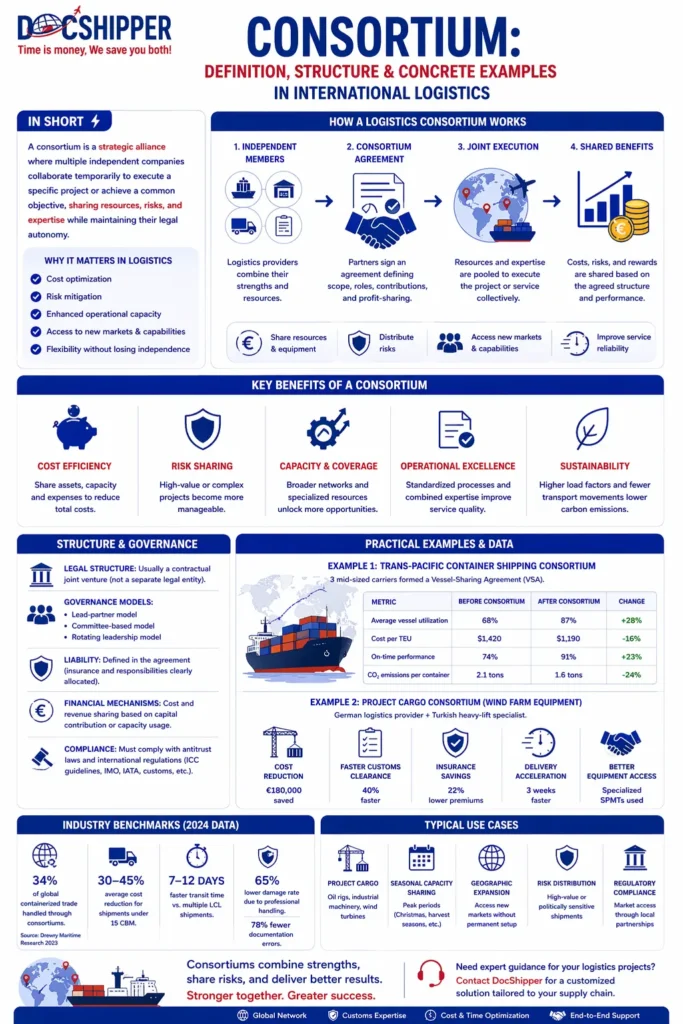
A consortium is a strategic alliance where multiple independent companies collaborate temporarily to execute a specific project or achieve a common objective, sharing resources, risks, and expertise while maintaining their legal autonomy. In international logistics, consortiums enable cost optimization, risk mitigation, and enhanced operational capacity for complex shipments.
Introduction
Many importers and exporters face a critical dilemma: how to handle oversized cargo, manage fluctuating demand, or access specialized equipment without bearing prohibitive capital investments. This is where the consortium model becomes essential.
In global trade, a consortium allows freight forwarders, shipping lines, or logistics providers to pool their capabilities. This collaboration model is particularly relevant for:
- Project cargo requiring specialized handling (oil rigs, industrial machinery, wind turbines)
- Seasonal capacity sharing during peak periods (pre-Christmas retail surges, harvest seasons)
- Geographic coverage expansion without establishing permanent infrastructure
- Risk distribution on high-value or politically sensitive shipments
- Regulatory compliance in markets requiring local partnerships
Unlike permanent mergers or joint ventures, consortiums maintain operational flexibility. Each member retains independence while contributing specific strengths—whether warehouse networks, customs expertise, or carrier contracts.
In-Depth Analysis & Expert Mechanisms
Understanding how consortiums function requires examining their legal framework, operational governance, and liability structures. These alliances operate under contractual agreements defining contribution levels, profit-sharing formulas, and exit conditions.
Legal structure: Most logistics consortiums form as contractual joint ventures rather than separate legal entities. Partners sign a consortium agreement outlining scope, duration, and decision-making authority. According to the International Chamber of Commerce, this structure minimizes regulatory complexity while preserving each member’s corporate identity.
Governance models: Consortiums typically adopt one of three management approaches. In the lead-partner model, one member coordinates operations while others provide resources. The committee-based model requires unanimous decisions on major issues. The rotating leadership model assigns coordination duties cyclically.
Liability distribution: Consortium agreements must clearly define liability allocation. In maritime shipping, vessel-sharing agreements (VSAs) specify which carrier assumes responsibility for cargo damage during specific voyage legs. This prevents disputes and ensures insurance coverage remains valid.
Financial mechanisms: Revenue and cost-sharing formulas vary by consortium type. Space-charter agreements allocate container slots proportionally to capital contributions. In project cargo consortiums, members invoice clients independently but share procurement costs for specialized equipment like heavy-lift cranes.
Competitive compliance: Antitrust regulations scrutinize consortiums to prevent market manipulation. The European Commission monitors vessel-sharing agreements to ensure they don’t restrict competition. Members must demonstrate that collaboration improves service quality rather than fixing prices.
At DocShipper, we regularly coordinate with consortium partners to secure competitive rates and guaranteed space during capacity crunches, ensuring our clients benefit from collective bargaining power without sacrificing service flexibility.
Concrete Examples & Industry Data
Real-world applications demonstrate how consortiums solve complex logistics challenges. The following scenarios illustrate typical use cases and measurable outcomes.
Scenario 1: Trans-Pacific Container Shipping Consortium
Three mid-sized carriers formed a vessel-sharing agreement (VSA) on the Asia-Europe route. Each contributed 2 vessels weekly, creating a combined service with 6 weekly departures. Results after 12 months:
| Metric | Before Consortium | After Consortium | Change |
|---|---|---|---|
| Average vessel utilization | 68% | 87% | +28% |
| Cost per TEU | $1,420 | $1,190 | -16% |
| On-time performance | 74% | 91% | +23% |
| CO₂ emissions per container | 2.1 tons | 1.6 tons | -24% |
Scenario 2: Project Cargo Consortium for Wind Farm Equipment
A German logistics provider partnered with a Turkish heavy-lift specialist to transport 45 wind turbine components from Hamburg to Istanbul. The consortium structure enabled:
- Specialized equipment access: The Turkish partner provided self-propelled modular transporters (SPMTs) unavailable in Germany
- Regulatory navigation: Local expertise accelerated customs clearance by 40% compared to standard procedures
- Cost reduction: Shared mobilization expenses decreased project costs by €180,000
- Risk mitigation: Joint insurance coverage reduced premiums by 22% versus individual policies
- Timeline compression: Parallel operations shortened delivery by 3 weeks
Industry Benchmarks
According to Drewry Maritime Research (2023), consortiums handle approximately 34% of global containerized trade. The 2M Alliance (Maersk + MSC) alone operates over 200 vessels, demonstrating scale advantages unavailable to independent operators.
In air freight, cargo consortiums like WOW Alliance combine capacity from multiple carriers, achieving load factors averaging 72% versus 58% for non-consortium flights on comparable routes.
Conclusion
The consortium model represents a strategic solution for logistics challenges requiring scale, specialization, or risk-sharing beyond individual company capabilities. By combining strengths while preserving independence, partners access markets and execute projects otherwise unattainable.
Need guidance on consortium partnerships or complex international shipments? Contact DocShipper for expert consultation tailored to your supply chain requirements.
📚 Quiz
Test Your Knowledge: Consortium
Q1 — Which of the following best defines a consortium in international logistics?
Q2 — A common misconception about consortiums is that members lose their independence. What is the correct interpretation?
Q3 — A German logistics company needs to transport oversized wind turbine components to Turkey and lacks local heavy-lift equipment. Which approach best illustrates the consortium model in action?
🎯 Your Result
📞 Free Quote in 24hFAQ | Consortium: Definition, Structure & Concrete Examples in International Logistics
A consortium is typically project-based and temporary, with members retaining full legal independence. Joint ventures create new legal entities with shared ownership and long-term commitments.
Distribution formulas vary but commonly allocate revenue proportional to capacity contributions (vessel slots, container volumes) or capital investment percentages defined in the consortium agreement.
Direct participation is rare, but forwarders access consortium services through booking contracts. Some regional alliances specifically target small-to-medium logistics providers seeking collective bargaining power.
Well-structured agreements include exit clauses and contingency plans. Remaining members may absorb capacity, recruit replacements, or redistribute obligations based on predefined terms.
Yes, when they enhance efficiency without restricting competition. Regulatory bodies like the EU Commission and US FMC monitor agreements to ensure compliance with competition laws.
Duration varies widely. Vessel-sharing agreements often span 3-5 years with renewal options. Project cargo consortiums dissolve upon completion, sometimes within 6-18 months.
Key risks include partner reliability issues, conflicting operational priorities, liability disputes, and reduced strategic flexibility. Thorough due diligence and clear contractual terms mitigate these concerns.
Yes, through optimized capacity utilization. Higher load factors reduce empty miles and per-unit emissions. Shared infrastructure investments also enable adoption of cleaner technologies.
Generally yes, unless exclusivity clauses exist. Members typically compete for customers while collaborating on operational execution, maintaining market competition.
Customs treat consortium cargo identically to standard shipments. However, clear documentation identifying the responsible party for each leg prevents clearance delays and liability confusion.
Policies must clearly define coverage boundaries between members. Cargo insurance, liability coverage, and equipment protection require coordination to avoid gaps or overlapping premiums.
Emerging platforms facilitate dynamic, short-term consortiums by matching capacity and demand in real-time. This trend particularly impacts less-than-container-load (LCL) and air freight consolidation.
Need Help with
Logistics or Sourcing ?
First, we secure the right products from the right suppliers at the right price by managing the sourcing process from start to finish. Then, we simplify your shipping experience - from pickup to final delivery - ensuring any product, anywhere, is delivered at highly competitive prices.


Fill the Form
Prefer email? Send us your inquiry, and we’ll get back to you as soon as possible.
Contact us




