


In short ⚡
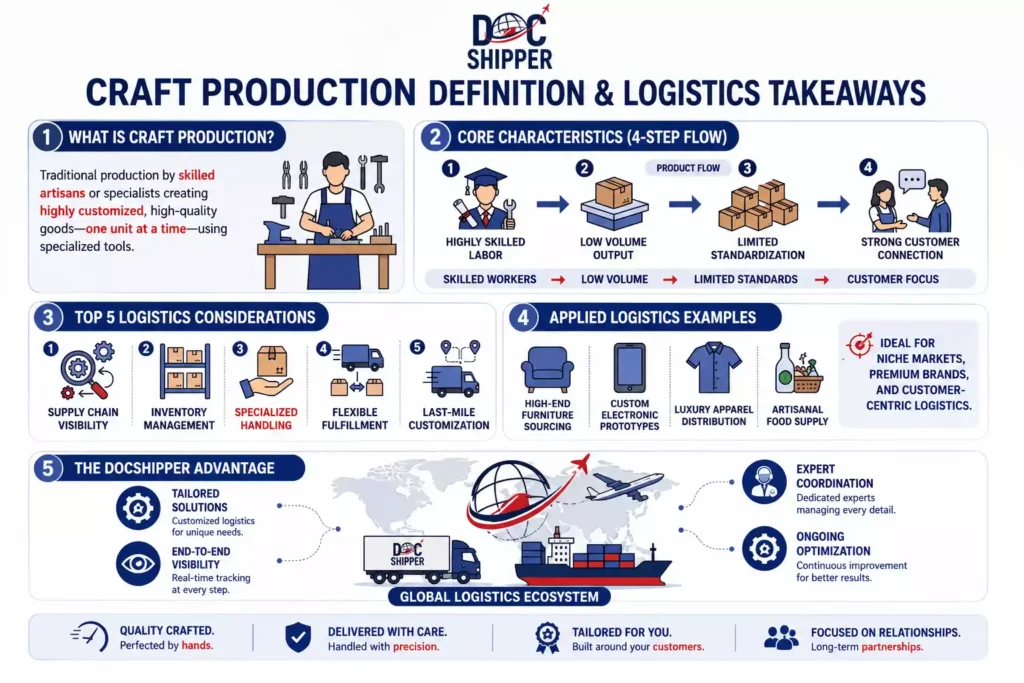
Craft production is a manufacturing method where skilled artisans create goods individually or in small batches using traditional techniques and manual skills. This approach emphasizes quality, customization, and human expertise over mass production efficiency, resulting in unique, high-value products with distinctive characteristics and cultural significance.Introduction
In today’s globalized supply chain, many businesses struggle to differentiate their products in saturated markets. Craft production offers a compelling alternative to standardized manufacturing, enabling brands to deliver authenticity, traceability, and premium positioning.
This production model plays a strategic role in international trade, particularly for luxury goods, artisanal foods, and heritage products where origin and craftsmanship directly impact market value and consumer perception.
- Small-scale production: Limited quantities ensuring exclusivity and quality control
- Artisan expertise: Skilled craftspeople with years of specialized training
- Traditional methods: Techniques passed through generations, often region-specific
- Customization capacity: Flexibility to adapt products to individual client specifications
- Higher unit costs: Labor-intensive processes resulting in premium pricing structures
Core Mechanisms & Industry Implications
Craft production operates on fundamentally different economic principles than industrial manufacturing. The value creation stems from human capital rather than capital equipment, with production speed deliberately sacrificed for quality consistency.
From a supply chain perspective, craft producers face unique challenges in scalability constraints. Unlike factories that increase output through machinery duplication, craft operations require recruiting and training additional artisans—a process measured in years, not months.
The intellectual property dimension becomes critical in international logistics. Many craft techniques qualify for geographical indication (GI) protection under WTO agreements, creating legal frameworks that restrict production to specific regions. Examples include Champagne, Parmigiano-Reggiano, and Scottish Tweed.
Quality verification in craft production relies on human assessment rather than automated testing. This requires specialized customs documentation and certification processes. At DocShipper, we systematically coordinate with certification bodies to ensure artisanal products meet both origin requirements and destination market standards, preventing costly delays at border controls.
The sustainability profile of craft production often surpasses industrial alternatives. Lower energy consumption, minimal waste, and local sourcing create favorable carbon footprints. However, international shipping logistics must carefully balance these environmental benefits against transportation emissions when exporting craft goods globally.
For authoritative guidance on geographical indications and craft product classification, consult the World Intellectual Property Organization’s GI Portal.
Concrete Examples & Comparative Data
Understanding craft production becomes clearer through quantitative comparison with alternative manufacturing approaches. The following analysis demonstrates how production method selection impacts cost structure, lead times, and market positioning.
| Production Method | Unit Cost Range | Lead Time | Minimum Order | Customization |
|---|---|---|---|---|
| Craft Production | $50-500+ | 2-12 weeks | 1-10 units | High flexibility |
| Batch Production | $10-50 | 3-6 weeks | 50-500 units | Limited options |
| Mass Production | $1-10 | 6-16 weeks | 1,000+ units | Standardized only |
Use Case: Italian Leather Goods Export
A Florentine leather workshop produces handcrafted bags using vegetable-tanned leather and traditional stitching techniques. Production capacity: 15 bags monthly. Average retail price: €850 per unit. Total production cost: €320 (materials €180, labor €140).
When exporting to the United States, the craft origin enables premium positioning but requires specific documentation. The artisan must provide proof of Italian origin, material sourcing certificates, and craftsmanship authentication. Shipping costs represent 8-12% of product value due to small batch sizes preventing consolidated freight optimization.
Comparative scenario: A mass-produced synthetic leather bag with similar aesthetics costs €45 to manufacture in volume (10,000 units), retails at €120, but lacks authenticity markers and GI protection. The craft alternative captures 7x higher margins despite 20x lower production volume.
Key operational metrics for craft production logistics:
- Average defect rate: 2-5% (vs. 0.5-2% in automated production)
- Artisan productivity: 5-20 units per month depending on complexity
- Price premium over industrial equivalents: 300-800%
- Customer return rate: 1-3% (higher satisfaction from customization)
- Export documentation time: 3-7 days (authenticity verification requirements)
Conclusion
Craft production represents a strategic manufacturing approach where human expertise and traditional methods create defensible competitive advantages in global markets. The model demands specialized logistics coordination to preserve product authenticity throughout international supply chains.
Need support navigating craft product certification, customs clearance, or international shipping logistics? Contact DocShipper for expert guidance tailored to artisanal goods.
📚 Quiz
Test Your Knowledge: Craft Production
Q1 — Which of the following best defines craft production?
Q2 — A craft producer receives a large order and wants to double output quickly. What is the most accurate statement about scaling craft production?
Q3 — A Florentine leather workshop exports handcrafted bags to the US. Which competitive advantage does craft production provide in this scenario that mass production cannot replicate?
🎯 Your Result
📞 Free Quote in 24hFAQ | Craft Production: Definition, Characteristics & Real-World Examples
The terms overlap significantly. Craft production emphasizes manual skills and small-scale output, while artisanal production specifically highlights traditional techniques and cultural heritage. Both contrast with industrial manufacturing methods.
Scaling requires hiring and training additional artisans, which takes months or years. Some craft producers maintain quality by capping production volumes rather than expanding capacity, preserving exclusivity and craftsmanship standards.
Handcrafted goods may qualify for preferential tariff treatment under cultural heritage provisions or free trade agreements. Proper classification requires detailed origin documentation and craftsmanship certification to claim reduced duty rates.
Higher unit values require specialized cargo insurance with agreed value coverage. Standard policies may undervalue handcrafted items. Insurers often request authentication certificates and detailed product descriptions for adequate coverage.
Yes, platforms like Etsy, Not On The High Street, and Amazon Handmade specifically cater to craft producers. However, sellers must verify handmade status and comply with platform-specific authenticity requirements.
Extended production cycles (2-12 weeks) require advance planning and customer expectation management. Many craft businesses operate on pre-order models rather than maintaining finished goods inventory, reducing working capital requirements.
Visual inspection, functional testing, and artisan self-assessment dominate. Unlike automated QC systems, craft quality relies on maker expertise and reputation. Third-party certification bodies verify adherence to traditional methods for protected designations.
No, craft products cost 3-8x more due to labor intensity. Competitive advantage comes from differentiation—uniqueness, customization, storytelling, and premium positioning—rather than cost leadership strategies.
Small parcel carriers (DHL, FedEx, UPS) suit low-volume craft shipments. For fragile items, specialized art shippers provide custom crating and white-glove handling. Consolidation services rarely benefit craft producers due to irregular production schedules.
GI registrations legally restrict product names to specific regions where traditional methods exist. This prevents imitation and preserves market premiums. Examples include Murano glass, Harris Tweed, and Cognac—all protected under international treaties.
Certificates of origin, artisan declarations, photographic production evidence, and third-party authentication from trade guilds or certification bodies. Some markets require notarized statements detailing materials, techniques, and production location.
Yes, certifications like Fair Trade, B Corp, and Cradle to Cradle apply to craft producers meeting environmental and social standards. These labels enhance market positioning and appeal to conscious consumers willing to pay premiums.
Need Help with
Logistics or Sourcing ?
First, we secure the right products from the right suppliers at the right price by managing the sourcing process from start to finish. Then, we simplify your shipping experience - from pickup to final delivery - ensuring any product, anywhere, is delivered at highly competitive prices.


Fill the Form
Prefer email? Send us your inquiry, and we’ll get back to you as soon as possible.
Contact us




