


In short ⚡
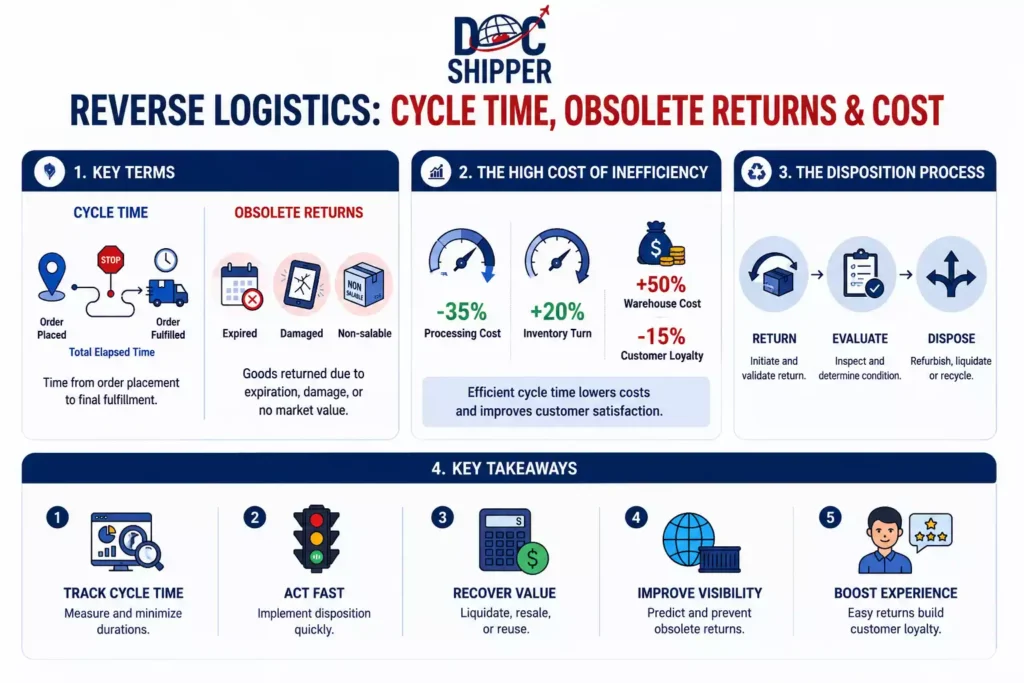
Cycle Time to Process Obsolete and End-of-Life Product Returns for Disposal is the total duration required to receive, assess, dismantle, and dispose of returned products that have reached obsolescence or end-of-life status. This metric encompasses inspection, environmental compliance verification, material recovery, and final waste disposal or recycling operations.
Introduction
Managing obsolete and end-of-life product returns represents a critical challenge for international supply chains. Companies frequently underestimate the complexity and duration required to properly dispose of returned goods while maintaining regulatory compliance.
In reverse logistics, this cycle time directly impacts environmental sustainability, regulatory adherence, and cost management. Extended processing periods increase storage costs, environmental risks, and potential legal liabilities.
- Regulatory compliance: Adherence to WEEE, RoHS, and Basel Convention requirements
- Environmental impact: Proper handling of hazardous materials and recyclable components
- Cost efficiency: Minimizing storage and processing expenses
- Material recovery: Maximizing value extraction from recyclable materials
- Documentation requirements: Complete audit trails for disposal certification
In-Depth Analysis & Expertise
The cycle time encompasses multiple sequential and parallel processes. Understanding each phase enables organizations to identify bottlenecks and optimization opportunities.
Reception and initial assessment form the first stage. Returns arrive at designated facilities where teams verify product condition, categorize obsolescence level, and determine appropriate disposal pathways. This phase typically requires 2-5 business days depending on volume and complexity.
Environmental compliance verification follows initial assessment. Specialized personnel identify hazardous components, battery systems, and regulated materials. According to EU WEEE Directive requirements, this assessment must document all potentially harmful substances before proceeding to dismantling.
Dismantling and material separation represent the most labor-intensive phase. Trained technicians separate components into distinct categories: recyclable metals, plastics, electronic components, and hazardous waste. This process duration varies significantly based on product complexity, ranging from 15 minutes for simple items to several hours for industrial equipment.
Material recovery and recycling coordination involve partnering with certified recyclers and waste management facilities. Organizations must maintain relationships with specialized processors for different material streams. At DocShipper, we coordinate with certified partners across 25 countries to ensure compliant disposal pathways for all material categories.
Final disposal certification and documentation complete the cycle. Comprehensive records proving proper disposal are essential for regulatory audits and corporate sustainability reporting. This documentation phase typically adds 3-7 days to overall cycle time but remains non-negotiable for compliance.
Concrete Examples & Data
Real-world data reveals significant variations in cycle times across industries and product categories. Understanding these benchmarks helps organizations set realistic targets.
| Product Category | Average Cycle Time | Primary Bottleneck | Optimization Potential |
|---|---|---|---|
| Consumer Electronics | 12-18 days | Battery removal and disposal | 25-30% reduction |
| Industrial Equipment | 25-45 days | Hazardous fluid drainage | 15-20% reduction |
| Medical Devices | 30-60 days | Regulatory documentation | 10-15% reduction |
| Automotive Components | 18-28 days | Material separation complexity | 20-25% reduction |
| Household Appliances | 10-15 days | Refrigerant recovery | 30-35% reduction |
Use Case: Electronics Manufacturer Optimization
A European electronics manufacturer processed 45,000 obsolete units annually with an average cycle time of 21 days. Analysis revealed three critical delays:
- Initial sorting delays: 6 days average due to mixed product categories arriving simultaneously
- Battery disposal coordination: 8 days waiting for certified hazardous waste collection
- Documentation completion: 5 days for final certification processing
Implementation of pre-sorting protocols, standing agreements with disposal partners, and automated documentation systems reduced cycle time to 13 days—a 38% improvement. Annual cost savings exceeded €340,000 through reduced storage fees and improved material recovery rates.
At DocShipper, we’ve observed that companies implementing dedicated end-of-life processing workflows achieve 25-40% cycle time reductions compared to those handling obsolete returns through standard reverse logistics channels. Specialized facilities with trained personnel and established disposal partnerships consistently outperform generalized operations.
Conclusion
Effective management of cycle time to process obsolete and end-of-life product returns for disposal requires specialized knowledge, established partnerships, and systematic processes. Organizations that invest in optimizing this metric achieve significant cost reductions while ensuring environmental compliance and regulatory adherence.
Need expert assistance managing your end-of-life product disposal processes? Contact DocShipper for specialized reverse logistics solutions tailored to your industry requirements.
📚 Quizz
Cycle Time to Process Obsolete & End-of-Life Returns
Q1 — What does "Cycle Time to Process Obsolete and End-of-Life Product Returns for Disposal" measure?
Q2 — Which product category typically has the LONGEST average disposal cycle time, and why?
Q3 — A European electronics manufacturer reduced its disposal cycle time from 21 days to 13 days. Which combination of actions drove this 38% improvement?
🎯 Your Result
📞 Free Quote in 24hFAQ | Cycle Time to Process Obsolete and End-of-Life Product Returns for Disposal: Definition, Calculation & Concrete Examples
Primary frameworks include the EU WEEE Directive, Basel Convention on hazardous waste, US EPA regulations, and China's Extended Producer Responsibility laws. Compliance requirements vary by jurisdiction and product category, necessitating country-specific disposal protocols.
Refurbishment pathways typically require 40-60% longer cycle times due to additional testing, repair assessment, and quality verification steps. Disposal-only pathways focus exclusively on material recovery and environmental compliance, streamlining the overall process.
Essential documentation includes waste transfer notes, hazardous material declarations, recycling certificates, disposal facility permits, and chain-of-custody records. Complete audit trails must demonstrate proper handling from receipt through final disposal.
Yes, through pre-established disposal partnerships, standardized assessment protocols, dedicated processing facilities, and automated documentation systems. These investments maintain full compliance while significantly reducing processing duration.
Design for disassembly principles dramatically reduce processing time. Products with modular construction, clearly marked materials, and accessible fasteners enable 50-70% faster dismantling compared to complex integrated designs requiring specialized tools.
Return volumes typically spike 30-50% post-holiday periods and following major product launches. Facilities must maintain flexible capacity or implement appointment-based intake systems to manage these fluctuations without extending cycle times.
Each additional day in the disposal cycle typically costs €2-8 per unit in storage fees, plus opportunity costs from delayed material recovery revenue. Extended cycles also increase environmental liability exposure and regulatory non-compliance risks.
Higher material recovery targets require more intensive separation processes, potentially extending cycle time by 20-35%. However, improved recovery rates generate revenue that often justifies the additional processing duration.
Automated dismantling systems, AI-powered material identification, robotic sorting equipment, and blockchain-based documentation platforms reduce manual labor requirements and accelerate processing by 25-45% for high-volume operations.
Benchmark against industry-specific standards, considering product complexity, regulatory environment, and processing volume. Leading performers achieve cycle times 30-40% below industry averages through specialized facilities and optimized workflows.
Extended storage increases risks of hazardous material leakage, battery degradation, and refrigerant escape. Delayed processing also prevents timely material recovery, reducing overall circular economy effectiveness and increasing environmental footprint.
International returns add 7-21 days for customs clearance, regulatory verification, and transport coordination. Basel Convention requirements for hazardous waste movements introduce additional documentation and approval processes that significantly extend overall cycle time.
Need Help with
Logistics or Sourcing ?
First, we secure the right products from the right suppliers at the right price by managing the sourcing process from start to finish. Then, we simplify your shipping experience - from pickup to final delivery - ensuring any product, anywhere, is delivered at highly competitive prices.


Fill the Form
Prefer email? Send us your inquiry, and we’ll get back to you as soon as possible.
Contact us




