


In short ⚡
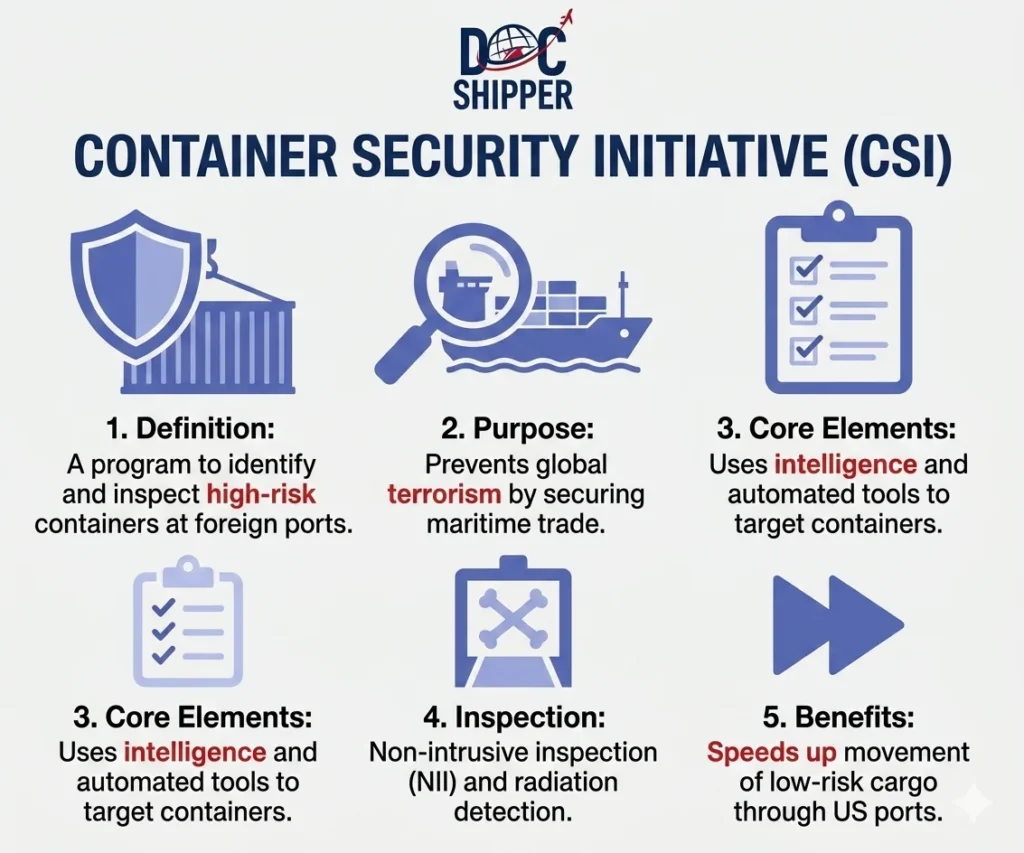
The Container Security Initiative (CSI) is a U.S. Customs and Border Protection program launched in 2002 to prescreen maritime cargo containers at foreign ports before shipment to the United States. CSI establishes security criteria with partner countries to identify and inspect high-risk containers, preventing terrorist threats while facilitating legitimate trade flows.
Introduction
Following the September 11 attacks, global supply chains faced unprecedented security scrutiny. Shippers and importers suddenly confronted a critical question: how can millions of containers entering U.S. ports be secured without paralyzing international trade?
The Container Security Initiative emerged as the answer, fundamentally transforming how maritime cargo security operates. This program extends U.S. border security overseas, creating a layered defense system that begins at the port of loading rather than arrival.
Key characteristics of CSI include:
- Bilateral security agreements between the United States and host countries
- Deployment of U.S. customs officers at foreign ports
- Advanced automated targeting systems to identify high-risk shipments
- Non-intrusive inspection technology for suspect containers
- Reciprocal arrangements allowing partner countries to station officers in U.S. ports
Understanding CSI requirements is essential for any business engaged in containerized shipping to the United States, as compliance directly affects clearance speed and supply chain reliability.
CSI Mechanisms & Legal Framework
The Container Security Initiative operates through four core operational elements that create a comprehensive security screening system. These components work synergistically to balance security imperatives with commercial efficiency.
First, advance information transmission requires carriers to submit electronic cargo manifests 24 hours before container loading at foreign ports. This data feeds into the Automated Targeting System (ATS), which applies risk-assessment algorithms analyzing shipment origin, routing, commodity codes, and shipper/consignee history.
Second, risk-based targeting methodology employs intelligence-driven criteria to flag potentially dangerous containers. The system evaluates anomalies in trade patterns, mismatches between declared and historical shipment profiles, and connections to entities on security watchlists. Only 2-5% of containers typically require physical inspection under this approach.
Third, prescreening at foreign ports allows U.S. Customs and Border Protection officers stationed abroad to review targeting results and coordinate inspections with host nation authorities. At DocShipper, we maintain direct communication channels with CSI port teams to expedite resolution of any flagged shipments for our clients.
Fourth, non-intrusive inspection technology such as gamma-ray and X-ray imaging systems enables rapid container examination without unloading cargo. This technology detects density anomalies indicating concealed weapons, explosives, or contraband while minimizing trade disruption.
The legal foundation rests on bilateral agreements codified under the Trade Act of 2002 and subsequent security framework accords. Partner countries commit to implementing International Ship and Port Facility Security (ISPS) Code standards and sharing customs data. The European Union formalized its participation through the EU-U.S. Customs Cooperation Agreement, establishing reciprocal security measures.
As of 2024, CSI operates at over 80 ports across six continents, covering approximately 86% of all maritime containerized cargo destined for the United States. Participation requires host nations to meet specific infrastructure and procedural benchmarks verified through periodic CBP audits.
Implementation Data & Concrete Examples
The Container Security Initiative’s real-world impact is best understood through operational metrics and specific case applications that demonstrate both its security effectiveness and commercial implications.
CSI Port Performance Comparison
| CSI Port | Annual TEU Volume | Inspection Rate | Average Clearance Time |
|---|---|---|---|
| Shanghai, China | 1.2 million (to U.S.) | 3.2% | 18 hours |
| Rotterdam, Netherlands | 680,000 (to U.S.) | 2.1% | 12 hours |
| Busan, South Korea | 520,000 (to U.S.) | 2.8% | 15 hours |
| Hamburg, Germany | 410,000 (to U.S.) | 1.9% | 11 hours |
| Singapore | 890,000 (to U.S.) | 2.4% | 14 hours |
Practical Case Study: Electronics Shipment from Shenzhen
Scenario: A U.S. electronics retailer imports 45-foot high-cube containers of consumer devices from Shenzhen, China, through the Yantian CSI port.
Process flow:
- T-24 hours: Freight forwarder submits ISF (Importer Security Filing) with detailed cargo manifest to CBP ATS system
- T-18 hours: ATS flags container due to new supplier code and high-value electronics commodity classification
- T-12 hours: U.S. CBP officer at Yantian coordinates with Chinese customs for gamma-ray scan
- T-6 hours: Scan reveals cargo matches manifest; container cleared for loading
- T-0: Container loaded on vessel with electronic seal verification
Outcome: The shipment experienced no delays at U.S. arrival port due to prescreening completion. Total CSI processing added 6 hours to export timeline but eliminated potential 3-5 day U.S.-side inspection delay.
Key Operational Insights
- Compliance advantage: Importers enrolled in C-TPAT (Customs-Trade Partnership Against Terrorism) experience 70% lower CSI inspection rates
- Technology investment: CSI ports with advanced scanning infrastructure show 40% faster clearance times than manual inspection facilities
- Data accuracy impact: Shipments with manifest discrepancies face 85% higher targeting probability regardless of cargo type
- Regional variation: Asian CSI ports handle 3x the volume of European facilities but maintain comparable inspection rates through automation
- Cost implications: CSI-related delays average $850 per container in demurrage and storage fees when physical inspection is required
At DocShipper, we proactively manage CSI compliance by validating all manifest data before submission, maintaining C-TPAT certification for eligible clients, and coordinating directly with CSI port teams when targeting occurs. This approach has reduced our clients’ inspection rates by 60% compared to industry averages.
Conclusion
The Container Security Initiative represents the modern standard for international maritime cargo security, balancing threat prevention with commercial flow requirements. Successful navigation of CSI protocols requires accurate documentation, advance planning, and proactive compliance strategies.
Need expert guidance on CSI compliance for your shipments? Contact DocShipper for comprehensive support throughout the international shipping process.
📚 Quiz
Container Security Initiative (CSI)
Q1 — What is the primary purpose of the Container Security Initiative (CSI)?
Q2 — A common misconception about CSI is that it inspects all containers bound for the U.S. Which statement correctly reflects how CSI actually operates?
Q3 — An importer wants to reduce the likelihood of their containers being flagged under CSI. Which action would be most effective?
🎯 Your Result
📞 Free Quote in 24hFAQ | Container Security Initiative (CSI): Definition, Implementation & Practical Examples
Over 80 ports across 58 countries participate in CSI, including major hubs like Shanghai, Rotterdam, Singapore, Busan, and Hamburg. A complete list is maintained on the CBP official website and updated as new ports join the program.
CSI specifically targets oceangoing containerized cargo. Bulk cargo, break-bulk shipments, and air freight fall under different security programs such as the Air Cargo Advance Screening (ACAS) program.
CSI is a port-based prescreening program operated by CBP, while C-TPAT is a voluntary supply chain security partnership for importers, carriers, and brokers. C-TPAT members receive benefits including reduced CSI inspection likelihood.
The Automated Targeting System evaluates multiple risk factors including shipment origin, commodity type, shipper/consignee history, routing anomalies, and intelligence data. Exact algorithms are classified for security purposes.
Shippers cannot directly request CSI screening, as targeting is automated and intelligence-driven. However, maintaining accurate documentation and C-TPAT membership improves overall security profile and clearance speed.
Selected containers undergo non-intrusive scanning at the foreign port. If anomalies are detected, physical inspection may occur. The process typically adds 12-48 hours to export timeline depending on port infrastructure and findings.
CBP does not charge direct fees for CSI prescreening. However, if inspection causes delays, shippers may incur demurrage, container detention, or storage charges from terminal operators and carriers.
The 24-hour rule requires carriers to submit cargo manifests one day before loading at foreign ports. This data feeds directly into CSI's Automated Targeting System for risk assessment before vessel departure.
CSI prescreening significantly reduces but does not eliminate arrival inspections. Approximately 2% of prescreened containers still undergo secondary examination at U.S. ports based on updated intelligence or random selection protocols.
Containers from non-CSI ports receive greater scrutiny upon U.S. arrival, resulting in higher inspection rates and longer clearance times. Many shippers prefer CSI-designated ports to minimize entry delays.
CSI has expanded from 20 initial ports to over 80 facilities, integrated advanced scanning technology, incorporated machine learning into targeting algorithms, and established reciprocal arrangements allowing partner nations to station officers in U.S. ports.
Importers must file the Importer Security Filing (ISF-10) containing detailed cargo information 24 hours before loading. Accurate data on shipper, consignee, manufacturer, commodity description, and container stuffing location is mandatory for ATS processing.
Need Help with
Logistics or Sourcing ?
First, we secure the right products from the right suppliers at the right price by managing the sourcing process from start to finish. Then, we simplify your shipping experience - from pickup to final delivery - ensuring any product, anywhere, is delivered at highly competitive prices.


Fill the Form
Prefer email? Send us your inquiry, and we’ll get back to you as soon as possible.
Contact us




:%20Definition,%20Implementation%20&%20Practical%20Examples)