


In short ⚡
Delivery Instructions are detailed directives provided by shippers, consignees, or freight forwarders that specify how, when, and where goods should be delivered. These instructions ensure proper handling, timely arrival, and compliance with recipient requirements throughout the international supply chain.
Introduction
Misunderstood or incomplete delivery instructions cause 23% of shipment delays in international logistics. A missing dock appointment, unclear unloading requirements, or incorrect contact information can stall containers at terminals for days.
In global trade, delivery instructions bridge the gap between transportation and final handover. They transform generic shipping documents into actionable plans for carriers, warehouse operators, and customs brokers.
Key characteristics of effective delivery instructions include:
- Recipient details: Full company name, delivery address, contact person with phone/email
- Timing requirements: Preferred delivery windows, appointment scheduling protocols
- Handling specifications: Unloading equipment needed, special handling for fragile/hazardous goods
- Documentation needs: Proof of delivery format, signature authority, customs clearance papers
- Contingency plans: Alternative contacts, rejection procedures, redelivery instructions
Mechanisms & Expertise in Delivery Instructions
Delivery instructions operate within a complex regulatory and operational framework. The Incoterms® 2020 rules define when delivery responsibility transfers between parties, but instructions fill the practical gaps these rules don’t address.
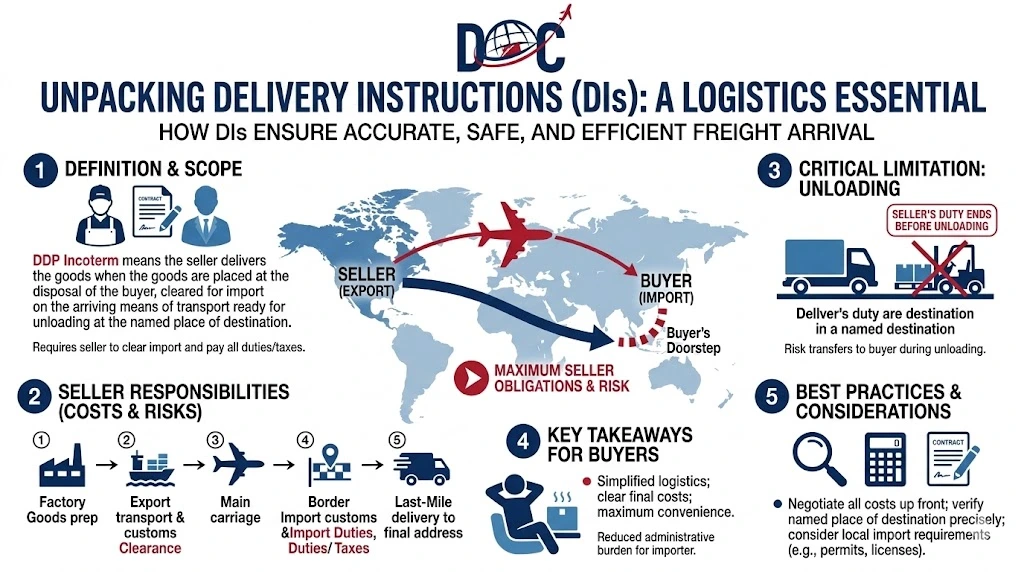
Under DDP (Delivered Duty Paid) terms, the seller must provide comprehensive instructions covering customs clearance, final mile delivery, and unloading. For FOB (Free On Board) shipments, the buyer typically issues instructions to their nominated carrier after goods leave the origin port.
The CMR Convention (for road transport in Europe) requires carriers to follow reasonable delivery instructions, but they can refuse if instructions create safety risks or violate traffic regulations. According to UNECE guidelines, carriers must document any instruction deviations in the consignment note.
Electronic data interchange (EDI) standards like EDIFACT DESADV messages automate delivery instruction transmission between shippers and logistics providers. These standardized formats reduce manual errors and enable real-time tracking updates.
At DocShipper, we validate delivery instructions against destination country requirements before shipment departure. Our teams verify that warehouse operating hours match delivery windows and that all required equipment (forklifts, liftgates) will be available at the delivery site.
The liability framework for delivery instructions varies by transport mode. Ocean carriers following the Hague-Visby Rules can limit liability if they reasonably interpret ambiguous instructions. Air carriers under the Montreal Convention face stricter interpretation standards, particularly for time-sensitive deliveries.
Practical Examples & Data
Industry data reveals that clear delivery instructions reduce failed delivery attempts by 67% and cut dwell time at distribution centers by an average of 2.3 days. The following scenarios demonstrate best practices:
Use Case: Electronics Import to Germany
A U.S. electronics manufacturer ships 15 pallets of laptops to a Munich distributor. Effective delivery instructions specify:
- Delivery window: Tuesday-Thursday, 08:00-16:00 (avoiding Friday when warehouse closes early)
- Appointment required: 48-hour advance notice via email to logistics@recipient.de
- Unloading: Tail-lift truck required (no loading dock available)
- Documentation: Signed CMR + photo proof of delivery required within 2 hours
- Contact escalation: Primary contact mobile +49-xxx, backup warehouse manager +49-yyy
Result: Zero delays, successful first-attempt delivery, immediate POD transmission to shipper’s ERP system.
Comparative Analysis: Instruction Detail Impact
| Instruction Level | Average Delivery Time | Failed Attempts | Additional Costs |
|---|---|---|---|
| Minimal (address only) | 7.2 days | 34% | $180 per shipment |
| Standard (address + contact + hours) | 4.6 days | 12% | $65 per shipment |
| Comprehensive (all elements) | 2.8 days | 3% | $15 per shipment |
The data shows that investing 15 minutes in detailed delivery instructions saves an average of $165 per shipment in redelivery fees, storage charges, and expedited handling costs.
Critical Elements by Industry
- Pharmaceuticals: Temperature logging requirements, cold chain handover protocols, licensed receiver verification
- Automotive parts: Just-in-time delivery slots (±30 minutes), sequenced unloading for assembly lines
- Fashion/retail: Hanger delivery specifications, carton labeling for direct-to-store distribution
- Hazardous materials: ADR/IMDG compliance certificates, emergency response contact numbers
- High-value goods: Security escort requirements, signature authority limits, photo documentation
Conclusion
Delivery instructions transform logistics from transactional shipping to strategic supply chain execution. Precise, comprehensive instructions prevent costly delays and ensure goods reach their destination exactly as intended.
Need expert guidance on optimizing your delivery instructions for international shipments? Contact DocShipper for tailored logistics solutions.
📚 Quiz
Test Your Knowledge: Delivery Instructions
Q1 — What is the primary purpose of delivery instructions in international logistics?
Q2 — Under FOB (Free On Board) Incoterms, who is typically responsible for issuing delivery instructions to the carrier?
Q3 — A shipment of pharmaceuticals is arriving at a distribution center. Which of the following best reflects comprehensive delivery instructions for this cargo?
🎯 Your Result
📞 Free Quote in 24hFAQ | Delivery Instructions: Definition, Types & Practical Examples
Essential elements are complete delivery address, recipient contact details (name, phone, email), preferred delivery timeframe, and any special handling requirements. Without these, carriers cannot execute delivery efficiently.
Responsibility depends on Incoterms. Under DDP, the seller provides instructions. For EXW or FOB, the buyer typically issues instructions to their carrier. Freight forwarders often coordinate instructions between parties.
Yes, but changes may incur fees and delays. Most carriers allow instruction amendments via their online portals or customer service, but changes affecting customs clearance or destination port may require formal documentation.
Shipping instructions guide the carrier on pickup and transport (origin to port). Delivery instructions focus on final destination handling (port to consignee). Both are critical but address different supply chain stages.
Carriers typically place shipments on hold and request clarification, causing delays. Goods may be stored at the carrier's facility, accruing demurrage or storage fees until proper instructions are provided.
Instructions become contractually binding when incorporated into the bill of lading or air waybill. Carriers must follow reasonable instructions, but they can refuse directives that violate regulations or create undue risk.
Specify if appointments are mandatory, the required advance notice period (typically 24-72 hours), booking method (phone/email/portal), and consequences of missed appointments. Include backup contact information.
Indicate if it's a residential delivery (affects carrier routing), note any access restrictions (gated community codes), specify if liftgate service is needed, and provide cell phone contact for real-time coordination.
Provide separate instruction sets for each delivery location, including stop sequence priorities, time windows per stop, partial unloading quantities, and individual contact persons. Clearly label which goods go to which location.
Yes, for international shipments. Include broker name, contact details, reference numbers, and any specific customs clearance instructions. This prevents delays at border crossings and ensures smooth handoff between transport and clearance.
Include ADR/IMDG class, UN number, emergency contact details, special handling placards needed, and receiver's dangerous goods license verification. Carriers require this information before accepting hazardous cargo.
Transportation Management Systems (TMS) automate instruction transmission, validate completeness, and integrate with carrier systems. EDI standards eliminate manual data entry, while APIs enable real-time instruction updates and delivery tracking.
Need Help with
Logistics or Sourcing ?
First, we secure the right products from the right suppliers at the right price by managing the sourcing process from start to finish. Then, we simplify your shipping experience - from pickup to final delivery - ensuring any product, anywhere, is delivered at highly competitive prices.


Fill the Form
Prefer email? Send us your inquiry, and we’ll get back to you as soon as possible.
Contact us




