


In short ⚡
Demand Pull is a supply chain management strategy where production and inventory replenishment are triggered directly by actual customer demand rather than forecasts. This approach minimizes overstock, reduces waste, and ensures products move through the logistics chain only when needed, creating a responsive and efficient distribution system aligned with real market consumption.Introduction
Many importers struggle with inventory management: order too much, and warehousing costs skyrocket; order too little, and stockouts damage customer relationships. Demand Pull eliminates this guessing game by synchronizing production and distribution with verified sales data.
In international logistics, this concept transforms how goods flow from origin to destination. Instead of pushing inventory into markets based on predictions, companies respond dynamically to consumption patterns. This shift is critical for businesses managing complex import/export operations across multiple markets.
Key characteristics of Demand Pull systems include:
- Real-time responsiveness to actual consumption signals
- Reduced inventory holding costs throughout the supply chain
- Lower obsolescence risk for seasonal or perishable goods
- Enhanced cash flow through just-in-time replenishment
- Data-driven decision-making replacing forecast-based planning
In-Depth Analysis & Expert Insights
Demand Pull operates on a fundamental inversion of traditional supply chain logic. Rather than manufacturing products and distributing them to warehouses hoping for sales, the system waits for confirmed orders before triggering replenishment. This creates a pull signal that cascades backward through the entire logistics network.
The mechanism relies on three core components. First, point-of-sale data integration captures real-time consumption. Second, automated replenishment triggers activate when inventory reaches predetermined thresholds. Third, supplier collaboration platforms ensure upstream partners receive immediate notification of demand changes.
Legal and operational implications differ significantly from push-based models. Under Incoterms® 2020 rules published by the International Chamber of Commerce, Demand Pull systems often favor DDP (Delivered Duty Paid) arrangements where suppliers maintain ownership until final delivery, aligning risk with actual demand realization.
Customs procedures require adaptation. Traditional pre-shipment documentation assumes fixed quantities. Demand Pull necessitates flexible customs declarations and bonded warehouse arrangements allowing rapid release of small batches. At DocShipper, we implement customized clearance protocols that accommodate variable shipment volumes triggered by client sales patterns, ensuring compliance without sacrificing responsiveness.
The approach fundamentally changes working capital requirements. Companies shift from financing large inventory purchases to managing smaller, more frequent transactions. This improves inventory turnover ratios and reduces the financial burden of unsold stock, particularly critical for SMEs managing international procurement with limited credit lines.
Concrete Examples & Data
Consider a European electronics retailer importing smartphones from Asia. Under traditional push systems, they might order 10,000 units quarterly based on sales forecasts. With Demand Pull, they maintain a base stock of 2,000 units and trigger weekly shipments of 500-800 units based on actual weekly sales.
| Metric | Push System | Demand Pull System | Improvement |
|---|---|---|---|
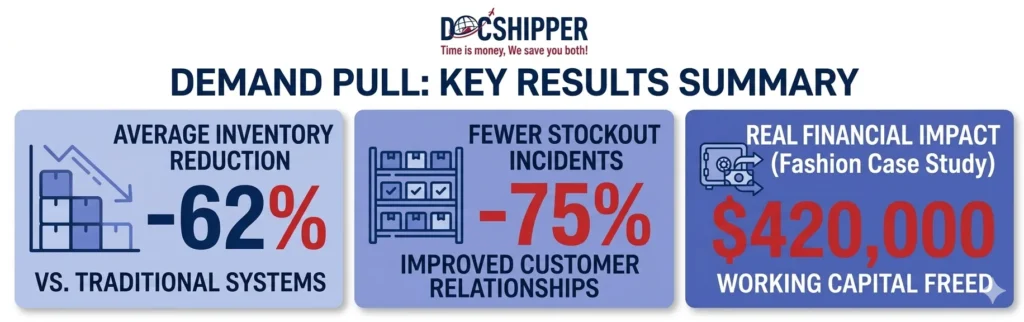
| Average Inventory | 8,500 units | 3,200 units | -62% |
| Inventory Holding Cost | €127,500/year | €48,000/year | -62% |
| Stockout Incidents | 4 per year | 1 per year | -75% |
| Obsolescence Write-offs | €35,000/year | €8,000/year | -77% |
| Cash Conversion Cycle | 87 days | 34 days | -61% |
A practical case study involves a U.S. fashion importer sourcing from Bangladesh. By implementing Demand Pull with weekly replenishment cycles, they reduced their safety stock requirement from 12 weeks to 4 weeks of coverage. This freed up $420,000 in working capital while improving product freshness and reducing end-of-season markdowns by 34%.
Key performance indicators for Demand Pull systems include:
- Inventory Turnover: Typically increases from 4-6x to 12-18x annually
- Order Frequency: Shifts from monthly/quarterly to weekly/bi-weekly cycles
- Forecast Accuracy Dependency: Reduces reliance from 85% to 40% of decision-making
- Lead Time Sensitivity: Requires 30-50% reduction in supplier response times
- Technology Investment: Initial setup costs range $15,000-$75,000 for SMEs
The automotive industry provides advanced examples. Toyota’s legendary Kanban system represents pure Demand Pull, where each assembly station signals upstream suppliers only when parts are consumed. This approach reduced Toyota’s inventory-to-sales ratio to 0.8 compared to industry averages of 2.3, generating billions in competitive advantage.
Conclusion
Demand Pull represents the future of responsive international logistics, aligning inventory investment with verified market demand. Companies adopting this approach gain financial flexibility, reduce waste, and respond faster to market changes.
Need expert guidance implementing Demand Pull strategies in your import/export operations? Contact DocShipper for customized supply chain solutions that match your business rhythm.
📚 Quiz
Test Your Knowledge: Demand Pull
Q1 — What is the core principle of a Demand Pull system in supply chain management?
Q2 — A common misconception about Demand Pull is that it eliminates the need for any inventory buffer. What does it actually require?
Q3 — A U.S. fashion importer sources goods from Bangladesh. Which scenario best describes a Demand Pull approach?
🎯 Your Result
📞 Free Quote in 24hFAQ | Demand Pull: Definition, Calculation & Concrete Examples
Demand Pull triggers production and shipments based on actual sales, while Push systems rely on forecasts to pre-position inventory. Pull minimizes overstock; Push aims for immediate availability.
Yes, but requires strategic buffer stock and supplier collaboration. Companies maintain minimal safety inventory while using air freight for emergency replenishment when ocean transit is too slow.
Essential systems include real-time POS data integration, inventory management software with automated reorder triggers, and supplier portals for instant communication. Cloud-based solutions start around $200/month.
Frequent smaller shipments require streamlined customs processes. Companies often use bonded warehouses, AEO (Authorized Economic Operator) status, or periodic declarations to manage multiple entries efficiently.
It works best for products with predictable consumption patterns and reliable suppliers. Less suitable for highly seasonal items, long-shelf-life commodities, or products with extreme demand volatility.
Companies report 40-65% reductions in inventory holding costs, 20-35% decreases in obsolescence, and 15-25% improvements in cash flow. Results vary by industry and implementation quality.
Pilot programs typically launch in 8-12 weeks. Full implementation across multiple SKUs and suppliers takes 6-9 months, including supplier onboarding, system integration, and process refinement.
Main risks include stockouts if suppliers fail to respond quickly, increased per-unit shipping costs from smaller batches, and technology dependency. Mitigation requires supplier vetting and contingency planning.
Potentially yes, by eliminating waste from unsold inventory and optimizing shipment consolidation. However, frequent small shipments may increase transport emissions unless carefully managed through route optimization.
It requires deeper collaboration and transparency. Suppliers need visibility into your sales data and must commit to faster response times. Successful partnerships often involve shared forecasting platforms and performance incentives.
Monitor inventory turnover ratio, stockout frequency, order cycle time, supplier on-time delivery rate, and total logistics cost per unit. Compare these against baseline push-system performance quarterly.
Both benefit, but implementation differs. B2C typically uses automated triggers from e-commerce platforms, while B2B often relies on EDI integration with client ERP systems and negotiated replenishment agreements.
Need Help with
Logistics or Sourcing ?
First, we secure the right products from the right suppliers at the right price by managing the sourcing process from start to finish. Then, we simplify your shipping experience - from pickup to final delivery - ensuring any product, anywhere, is delivered at highly competitive prices.


Fill the Form
Prefer email? Send us your inquiry, and we’ll get back to you as soon as possible.
Contact us




