


In short ⚡
Drop shipping is a retail fulfillment method where the seller does not keep products in stock. Instead, when a customer places an order, the seller purchases the item from a third-party supplier who ships it directly to the customer. This model eliminates inventory management and warehousing costs for the retailer.
Introduction
Many entrepreneurs struggle with the capital-intensive nature of traditional retail—buying inventory upfront creates financial risk and storage challenges. Drop shipping emerged as a solution, enabling businesses to sell products without physical inventory.
In international trade and e-commerce logistics, this model has transformed how retailers operate. It reduces barriers to entry while introducing unique compliance and quality control considerations.
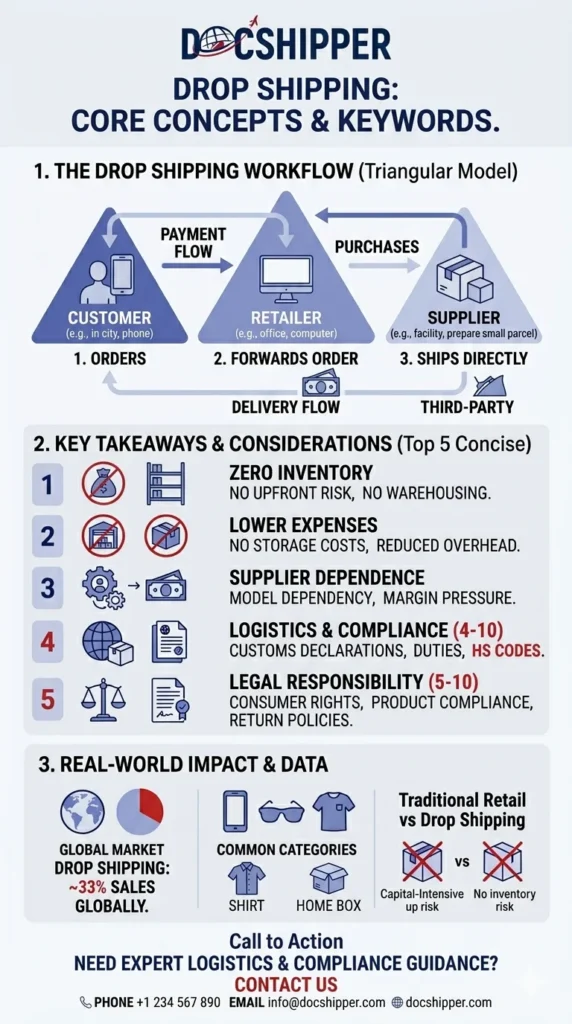
- Zero inventory investment: No need to purchase stock before making sales
- Lower operational costs: Eliminates warehousing and inventory management expenses
- Supplier dependency: Relies entirely on third-party fulfillment accuracy
- Customs complexity: International drop shipping requires understanding import regulations
- Margin pressure: Competitive pricing often reduces profit per transaction
Drop Shipping Mechanisms & Expertise
The drop shipping workflow follows a triangular transaction model. The customer orders from the retailer’s platform, the retailer forwards the order to the supplier, and the supplier ships directly to the customer. Payment flows from customer to retailer, then retailer to supplier.
Legal considerations vary by jurisdiction. In the EU, the retailer remains legally responsible for product compliance, warranty obligations, and consumer rights—even though they never handle the goods. The European Consumer Protection Law mandates clear return policies and accurate product descriptions.
Customs implications arise when suppliers ship internationally. The retailer must ensure proper HS code classification, accurate customs declarations, and compliance with import duties. Misclassification can result in shipment delays or penalties.
Quality control challenges represent a critical vulnerability. Since retailers never inspect products, they depend entirely on supplier standards. Establishing quality agreements and conducting periodic audits mitigates this risk.
At DocShipper, we assist drop shipping businesses with customs compliance verification, ensuring all international shipments meet destination country requirements and preventing costly clearance issues.
Concrete Examples & Data
Understanding drop shipping economics requires examining real-world scenarios and comparative data. Below is a cost comparison between traditional retail and drop shipping models:
| Cost Factor | Traditional Retail | Drop Shipping |
|---|---|---|
| Initial Inventory Investment | $10,000–$50,000 | $0 |
| Warehousing Costs (monthly) | $500–$2,000 | $0 |
| Product Cost per Unit | Lower (bulk pricing) | Higher (single-unit pricing) |
| Shipping Control | Full control | Dependent on supplier |
| Profit Margin (typical) | 30–50% | 10–30% |
Use Case: An online electronics retailer based in France partners with suppliers in China. A customer orders a smartphone case for €25. The retailer pays the supplier €12 (including shipping). The supplier ships directly from Shenzhen to Paris. The retailer earns €13 gross profit but must account for platform fees (€2), payment processing (€0.75), and marketing costs (€5), yielding a net profit of €5.25 per transaction.
International considerations: When shipping from China to the EU, orders below €150 benefit from the VAT e-commerce package regulations. However, the retailer must register for IOSS (Import One-Stop Shop) to collect and remit VAT, or the customer faces unexpected charges upon delivery.
Market data shows drop shipping accounts for approximately 33% of online sales globally. The model is particularly prevalent in consumer electronics, fashion accessories, and home goods categories where product turnover is high and customization is minimal.
Conclusion
Drop shipping offers low-barrier entry to e-commerce but demands rigorous supplier vetting, compliance management, and customer service excellence. Success hinges on selecting reliable partners and understanding international trade regulations.
Need assistance navigating drop shipping logistics or customs compliance? Contact DocShipper for expert guidance tailored to your business model.
📚 Quiz
Test Your Knowledge: Drop Shipping
Q1 — Which of the following best defines drop shipping?
Q2 — In the EU, who is legally responsible for product compliance, warranties, and consumer rights in a drop shipping arrangement?
Q3 — A French online retailer drop ships goods valued under €150 from a Chinese supplier directly to EU customers. What must the retailer register for to handle VAT correctly?
🎯 Your Result
📞 Free Quote in 24hFAQ | Drop Shipping: Definition, Process & Real-World Examples
The primary advantage is eliminating upfront inventory investment. Retailers avoid warehousing costs and reduce financial risk since products are purchased only after customer orders are confirmed.
The retailer remains legally responsible for returns and customer service. However, operational arrangements vary—some suppliers accept returns directly, while others require retailers to manage the process and coordinate replacements.
Customs duties depend on the product's HS code, origin country, and destination regulations. The retailer must ensure accurate declarations. In many cases, the customer pays duties upon delivery unless the retailer uses DDP (Delivered Duty Paid) shipping terms.
Yes, diversifying suppliers reduces dependency risk and enables broader product catalogs. However, managing multiple suppliers increases complexity in order tracking, quality consistency, and shipping time coordination.
Typical net profit margins range from 10% to 30% after accounting for product costs, shipping, platform fees, payment processing, and marketing expenses. Margins vary significantly by product category and competition level.
Drop shipping itself is legal worldwide, but retailers must comply with local consumer protection laws, tax regulations, and import/export restrictions. Some countries require business registration or specific licenses for e-commerce operations.
Delivery times vary from 7 to 30 days depending on origin, destination, and shipping method. Express options reduce transit to 3–7 days but significantly increase costs, impacting profit margins.
Key challenges include supplier reliability, product quality inconsistency, shipping delays, customs complications, intense price competition, and limited control over customer experience. Successful drop shippers invest heavily in supplier vetting and customer communication.
If you ship goods valued under €150 from outside the EU directly to EU consumers, you must register for IOSS (Import One-Stop Shop) to collect and remit VAT. Orders above €150 require standard import VAT procedures.
Research platforms like Alibaba, Global Sources, or industry-specific directories. Verify suppliers through factory audits, sample orders, reference checks, and certifications. Establishing direct communication and clear quality agreements is essential before scaling operations.
Yes, hybrid models are common. Retailers stock fast-moving or high-margin items while using drop shipping for niche products or test markets. This approach balances control with flexibility and capital efficiency.
Retailers should consider general liability insurance, product liability coverage, and cyber liability insurance. While suppliers typically insure shipments in transit, retailers remain liable for product defects, misrepresentation claims, and data breaches affecting customer information.
Need Help with
Logistics or Sourcing ?
First, we secure the right products from the right suppliers at the right price by managing the sourcing process from start to finish. Then, we simplify your shipping experience - from pickup to final delivery - ensuring any product, anywhere, is delivered at highly competitive prices.


Fill the Form
Prefer email? Send us your inquiry, and we’ll get back to you as soon as possible.
Contact us




