


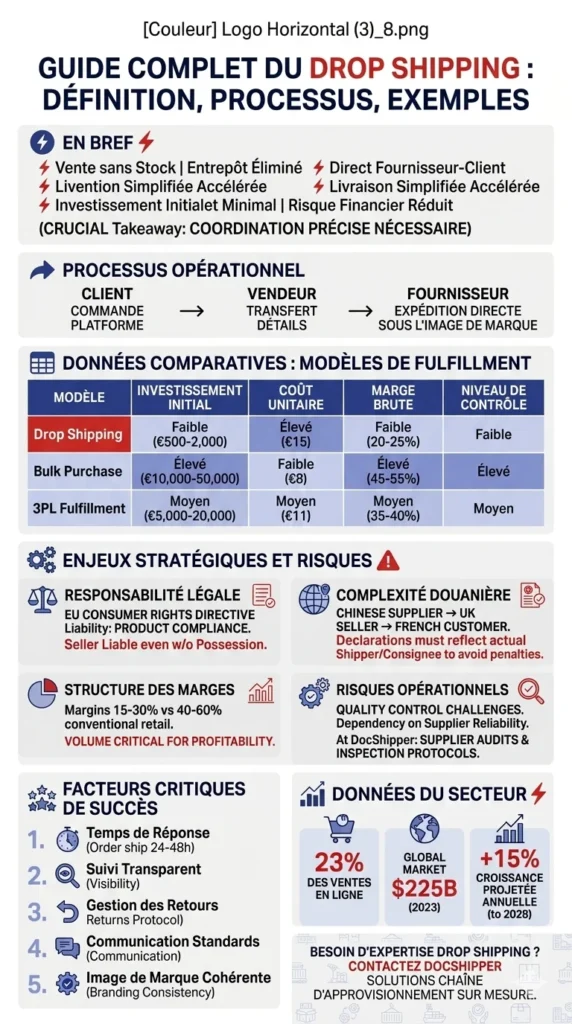
In short ⚡
Drop shipping is a logistics model where a seller accepts customer orders without holding inventory. The supplier ships products directly to the end customer, eliminating warehousing costs. This method reduces capital requirements but requires precise coordination between seller, supplier, and customer.
Introduction
Many e-commerce entrepreneurs struggle with inventory management costs, storage limitations, and cash flow constraints. Drop shipping eliminates these barriers by decoupling sales from physical inventory ownership.
In international trade, this model has transformed how businesses approach cross-border commerce. It enables rapid market entry without significant upfront investment in stock.
Key characteristics of drop shipping include:
- Zero inventory holding – No warehouse or storage costs
- Direct supplier-to-customer fulfillment – Streamlined delivery chain
- Lower capital requirements – Reduced financial risk for sellers
- Flexible product range – Easy to add or remove items
- Dependency on supplier reliability – Quality and timing controlled externally
Drop Shipping Mechanisms & Strategic Implications
The operational workflow follows a precise sequence. The customer places an order on the seller’s platform. The seller forwards order details to the supplier. The supplier packages and ships directly to the customer under the seller’s branding.
Legal considerations vary by jurisdiction. In the EU, sellers remain liable for product compliance under the Consumer Rights Directive. The seller must ensure products meet safety standards, even without physical possession.
Customs implications become complex in international drop shipping. When a Chinese supplier ships directly to a French customer for a UK-based seller, customs declarations must reflect the actual shipper and consignee. Misrepresentation can trigger penalties.
The margin structure differs fundamentally from traditional retail. Sellers typically achieve 15-30% margins compared to 40-60% in conventional models. Volume becomes critical to profitability.
Quality control challenges represent the primary operational risk. At DocShipper, we conduct supplier audits and implement inspection protocols before products reach end customers, mitigating defect-related returns.
Practical Examples & Comparative Data
Understanding drop shipping economics requires concrete scenarios. The following comparison illustrates cost structures across different fulfillment models.
| Model | Initial Investment | Unit Cost | Gross Margin | Control Level |
|---|---|---|---|---|
| Drop Shipping | €500-2,000 | €15 | 20-25% | Low |
| Bulk Purchase | €10,000-50,000 | €8 | 45-55% | High |
| 3PL Fulfillment | €5,000-20,000 | €11 | 35-40% | Medium |
Use Case: Electronics Retailer
A UK-based online store sells smartphone accessories. Monthly sales: 800 units at €25 retail price. Drop shipping supplier charges €18 per unit including shipping. Monthly revenue: €20,000. Cost of goods: €14,400. Gross profit: €5,600 (28% margin). No inventory investment required.
Critical success factors for drop shipping operations:
- Supplier response time – Orders must ship within 24-48 hours
- Transparent tracking systems – Real-time shipment visibility for customers
- Return management protocols – Clear procedures for defective products
- Communication standards – Supplier must provide accurate stock levels
- Branding consistency – Packaging should not reveal third-party involvement
Industry data shows 23% of online sales now use drop shipping models. The global market reached $225 billion in 2023, with 15% annual growth projected through 2028.
Conclusion
Drop shipping transforms e-commerce by eliminating inventory barriers while introducing supplier dependency risks. Success requires rigorous partner vetting and operational discipline.
Need expert guidance on implementing drop shipping logistics? Contact DocShipper for customized supply chain solutions.
📚 Quiz
Test Your Knowledge: Drop Shipping
Q1 — What best defines the drop shipping model?
Q2 — A common misconception about drop shipping is that the seller has no legal responsibility for the products sold. Is this correct?
Q3 — A UK-based online retailer sells 800 units/month at €25 each. The drop shipping supplier charges €18 per unit including shipping. What is the approximate gross margin?
🎯 Your Result
📞 Free Quote in 24hFAQ | Drop Ship: Definition, Process & Practical Examples
Traditional retail requires purchasing and storing inventory before selling. Drop shipping eliminates inventory ownership—products ship directly from suppliers to customers after orders are placed.
Initial investment ranges from €500-€2,000, covering website setup, marketing, and initial supplier agreements. No inventory purchase is required, significantly reducing capital requirements.
The supplier typically manages export procedures. Import customs clearance responsibility depends on Incoterms used. DDP (Delivered Duty Paid) places all obligations on the seller/supplier.
Yes, diversifying suppliers reduces dependency risk. However, managing multiple partners increases complexity in order routing, quality control, and customer communication.
Margins generally range between 15-30%, lower than traditional retail's 40-60%. Competitive pricing and supplier costs limit markup potential, requiring higher sales volumes for profitability.
Establish clear return policies with suppliers beforehand. Most arrangements require customers to return items to the supplier's address, with the seller coordinating refunds or replacements.
Drop shipping itself is legal worldwide. However, sellers must comply with consumer protection laws, tax regulations, and product safety standards in their operating jurisdictions.
Primary risks include supplier reliability issues, quality inconsistencies, shipping delays, inventory miscommunication, and thin profit margins. Thorough supplier vetting mitigates these concerns.
Domestic drop shipping usually takes 3-7 days. International shipments range from 10-30 days depending on origin, destination, and shipping method chosen by the supplier.
Standard business registration and sales tax permits apply. No special drop shipping licenses exist, but compliance with e-commerce regulations and consumer protection laws is mandatory.
Yes, B2B drop shipping is common in wholesale and distribution. Businesses appreciate reduced inventory costs, though they often demand higher service levels and customized ordering systems.
Use verified supplier directories, attend trade shows, request samples, check references, and conduct factory audits. Third-party logistics partners like DocShipper can facilitate supplier verification processes.
Need Help with
Logistics or Sourcing ?
First, we secure the right products from the right suppliers at the right price by managing the sourcing process from start to finish. Then, we simplify your shipping experience - from pickup to final delivery - ensuring any product, anywhere, is delivered at highly competitive prices.


Fill the Form
Prefer email? Send us your inquiry, and we’ll get back to you as soon as possible.
Contact us




