


In short ⚡
Dual Operation refers to a logistics strategy where a single transport unit or facility performs two complementary functions simultaneously—such as loading and unloading at the same stop, or combining inbound and outbound flows. This approach maximizes asset utilization, reduces empty miles, and optimizes operational costs in international supply chains.
Introduction
In international freight forwarding, empty container repositioning costs the industry over $20 billion annually. Dual operation addresses this inefficiency by designing logistics flows where vehicles, containers, or warehouses serve multiple purposes within a single trip or operational cycle.
This concept is critical for importers and exporters seeking to reduce dwell times, lower transportation costs, and improve carbon footprints. By synchronizing pickup and delivery activities, businesses transform potential waste into value-generating operations.
Key characteristics of dual operation include:
- Backhaul optimization: Utilizing return trips for revenue-generating cargo instead of running empty
- Cross-docking integration: Combining inbound receipt with immediate outbound dispatch
- Container triangulation: Routing empty equipment through strategic reload points
- Warehouse dual-purpose zones: Spaces designed for both storage and value-added services
- Intermodal synchronization: Coordinating rail, road, and maritime legs for seamless transitions
Mechanisms & Strategic Expertise
Dual operation functions through precise coordination of timing, routing, and cargo compatibility. The fundamental principle involves identifying complementary freight flows that share geographic proximity or temporal windows.
In container shipping, depot triangulation represents a classic dual operation model. Rather than returning an empty container directly to the port, carriers route it through an inland depot where export cargo awaits loading. This eliminates one empty leg while serving two customers with a single asset movement.
Road freight applies dual operation through milk-run logistics, where a single truck performs sequential pickups and deliveries along an optimized route. This method reduces total vehicle kilometers by 30-40% compared to dedicated single-stop trips, according to European logistics benchmarks.
Warehousing dual operations manifest in flow-through distribution centers. These facilities receive inbound shipments while simultaneously preparing outbound orders, often without traditional storage. Products move directly from receiving docks to shipping docks within 24-48 hours, minimizing handling costs and inventory holding expenses.
At DocShipper, we design dual operation strategies by analyzing client shipment patterns across multiple trade lanes. Our network coordination identifies backhaul opportunities that reduce per-unit transport costs by 15-25% while maintaining service reliability.
Regulatory compliance remains essential in dual operations. The International Convention on Harmonization of Frontier Controls of Goods (UN/ECE) provides frameworks for synchronized customs clearance when combining import and export activities at the same facility. For authoritative guidance, consult UN/CEFACT trade facilitation standards.
Technology enablers include Transport Management Systems (TMS) with dynamic route optimization, real-time cargo matching algorithms, and predictive analytics that forecast complementary load availability. These systems evaluate thousands of variables—weight, volume, destination, timing—to identify dual operation opportunities that human planners might overlook.
Concrete Examples & Operational Data
A European automotive parts supplier implemented dual operation by coordinating container movements between Germany and Poland. Outbound finished goods to Poland used the same containers that returned with raw materials, achieving 92% container utilization versus the industry average of 68%.
| Operation Type | Empty Miles Reduction | Cost Savings | CO₂ Reduction |
|---|---|---|---|
| Container Triangulation | 35-45% | 18-22% | 28-32% |
| Milk-Run Distribution | 30-40% | 15-20% | 25-30% |
| Cross-Dock Operations | 20-25% | 12-16% | 18-22% |
| Warehouse Dual-Zone | N/A | 10-14% | 8-12% |
Case Study: A US-Asia electronics importer faced $180,000 annual empty container repositioning fees. By partnering with an agricultural exporter in the same region, they established a dual operation loop. Import containers carrying electronics were immediately reloaded with soybeans for export. This eliminated 85% of repositioning costs while generating additional revenue through container leasing agreements.
In pharmaceutical cold chain logistics, dual operation requires specialized execution. Temperature-controlled containers returning from Europe to Asia often carry high-value biotech products outbound, then reload with fresh produce or seafood for the return leg—maintaining the -18°C to +2°C range throughout both journeys.
Key performance indicators for dual operation success:
- Asset utilization rate: Target 85%+ loaded capacity in both directions
- Dwell time reduction: Decrease terminal waiting periods by 40-60%
- Cost per ton-kilometer: Achieve 20-30% lower rates versus single-direction operations
- Carbon intensity: Reduce grams CO₂ per ton-kilometer by 25-35%
- Service reliability: Maintain 95%+ on-time performance despite increased coordination complexity
DocShipper’s dual operation networks span 15 countries, with real-time cargo matching across 2,400+ active trade lanes. Our clients typically see payback periods of 4-6 months when implementing structured dual operation programs.
Conclusion
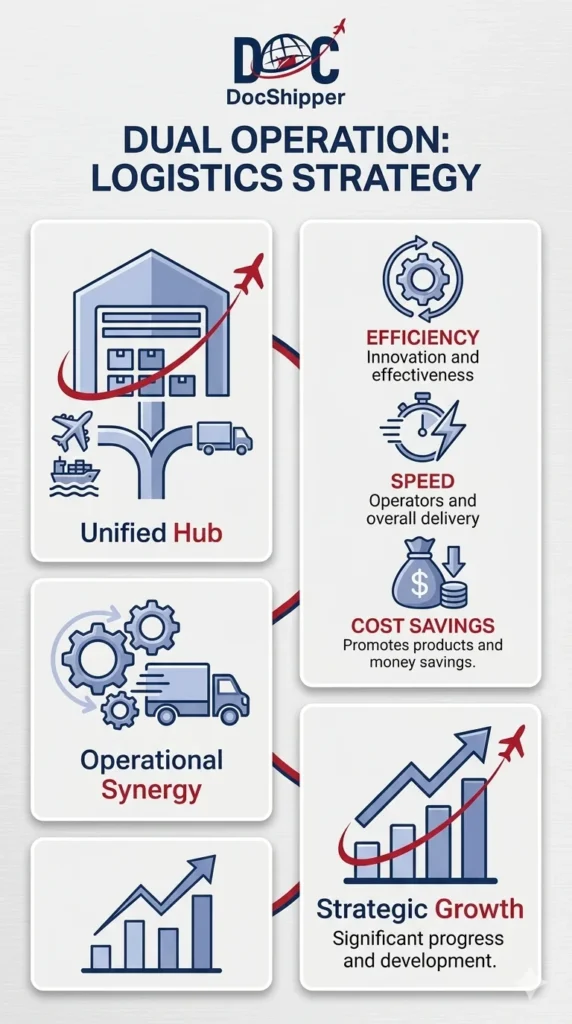
Dual operation transforms logistics from a cost center into a strategic advantage by eliminating waste and maximizing every transport movement. Whether through container triangulation, milk-run distribution, or cross-docking, this approach delivers measurable improvements in cost, speed, and sustainability.
Need expert guidance on implementing dual operation strategies for your supply chain? Contact DocShipper for a customized network analysis and optimization roadmap.
📚 Quiz
Test Your Knowledge: Dual Operation
Q1 — What best defines "Dual Operation" in international logistics?
Q2 — A common misconception is that "Dual Operation" and "Backhaul" are the same concept. Which statement is correct?
Q3 — A US electronics importer pays $180,000/year in empty container repositioning fees. Which dual operation approach best solves this problem?
🎯 Your Result
📞 Free Quote in 24hFAQ | Dual Operation: Definition, Mechanisms & Practical Examples
Backhaul refers specifically to return trips with cargo, while dual operation encompasses broader strategies including simultaneous loading/unloading, cross-docking, and multi-function facility use. Dual operation is the comprehensive framework; backhaul is one application within it.
Yes, through consolidation centers that combine multiple LCL shipments into full containers for outbound transport, then deconsolidate inbound cargo at the same facility. This requires sophisticated warehouse management systems to track individual consignments accurately.
When properly coordinated, dual operation can reduce clearance times by 20-30% through pre-clearance arrangements and authorized economic operator (AEO) programs. However, poor coordination can create delays if import and export documentation isn't synchronized.
Key risks include cargo compatibility issues (hazardous goods restrictions), timing mismatches causing delays, increased coordination complexity, and dependency on multiple parties. Mitigation requires robust contingency planning and real-time visibility systems.
Yes, when designed with priority lanes and buffer times. Express dual operations use dedicated equipment and guaranteed capacity, though cost savings are typically 10-15% lower than standard dual operation due to reduced flexibility.
Seasonal imbalances (e.g., holiday import peaks) require dynamic network adjustments. Advanced planning systems forecast these patterns 90-120 days ahead, repositioning assets and adjusting cargo matching algorithms to maintain 70%+ utilization during off-peak periods.
Modern dual operations rely on TMS with AI-powered load matching, IoT sensors for real-time cargo tracking, blockchain for multi-party documentation, and predictive analytics for demand forecasting. Integration across these systems is critical for success.
Absolutely. By eliminating empty miles and optimizing routes, dual operation typically reduces CO₂ emissions by 25-35% per shipment. This aligns with EU Green Deal targets and helps companies meet Scope 3 emissions reduction commitments.
Pricing models vary: some carriers offer 10-20% discounts for guaranteed backhaul cargo, while others use dynamic pricing that adjusts based on real-time supply-demand balance. Transparent cost-sharing agreements between shippers are essential for equitable pricing.
Automotive (parts and finished vehicles), FMCG (fast-moving consumer goods), agriculture (seasonal produce), chemicals (tank container optimization), and retail (omnichannel distribution) see the highest ROI from dual operation implementations.
Initial pilot programs launch in 6-8 weeks, with full network optimization taking 4-6 months. This includes partner onboarding, system integration, route optimization, and staff training. Continuous improvement cycles refine performance over 12-18 months.
Some jurisdictions restrict foreign carriers from domestic backhaul (cabotage laws), while others require separate customs bonding for combined import-export facilities. Always consult local trade regulations and work with licensed customs brokers for compliance.
Need Help with
Logistics or Sourcing ?
First, we secure the right products from the right suppliers at the right price by managing the sourcing process from start to finish. Then, we simplify your shipping experience - from pickup to final delivery - ensuring any product, anywhere, is delivered at highly competitive prices.


Fill the Form
Prefer email? Send us your inquiry, and we’ll get back to you as soon as possible.
Contact us




