The 2026 US tariff reset: Why the Supreme Court forced a new trade era
To understand why the current 15% surcharge matters, you first need to grasp the legal earthquake that preceded it. For the past several years, the Trump administration built its entire trade-war architecture on the International Emergency Economic Powers Act (IEEPA), a broad national security statute that granted near-unlimited executive authority to impose tariffs by decree. Critics called it a constitutional overreach; importers called it a financial crisis. Both were right.
In early 2026, the Supreme Court agreed to hear an emergency appeal brought by Learning Resources Inc., a US-based educational toy manufacturer, arguing that open-ended IEEPA tariffs of 25% and above, particularly those targeting Chinese-made goods, exceeded the statute’s scope and violated the non-delegation doctrine. The ripple effect was immediate.
Analyzing the Learning Resources Inc. v. Trump impact on global logistics
 The Learning Resources Inc. v. Trump case is not merely a legal technicality. It has triggered one of the most significant pivots in US trade policy in a generation. With the IEEPA tariff framework facing potential invalidation, the White House needed a legally defensible alternative, and quickly.
The answer was Section 122 of the Trade Act of 1974, a rarely-used provision that explicitly authorizes the President to impose a surcharge of up to 15% on imports in response to balance-of-payments deficits. Unlike IEEPA, Section 122 was designed for exactly this use, but it carries a strict 150-day expiry.
For logistics operators and importers, the case signals that the era of arbitrary, unchecked tariff escalation may be legally constrained for the first time. However, it does not mean tariffs are disappearing. It means they are being reset, and the reset creates a calculable, time-limited opportunity.
How the US import surcharge 15% February 2026 replaces previous trade barriers
Effective February 2026, the 15% across-the-board import surcharge replaces, at least temporarily, the patchwork of IEEPA-derived tariffs that ranged from 10% to 145% depending on product category and country of origin. This represents a dramatic simplification. Under the new regime, most goods entering the United States are subject to a uniform 15% surcharge on top of existing MFN customs duties, rather than the unpredictable product- and country-specific rates that dominated 2024–2025.
The financial relief this represents is real, but it is also temporary, and that temporariness is the defining strategic fact of 2026 for global supply chains.
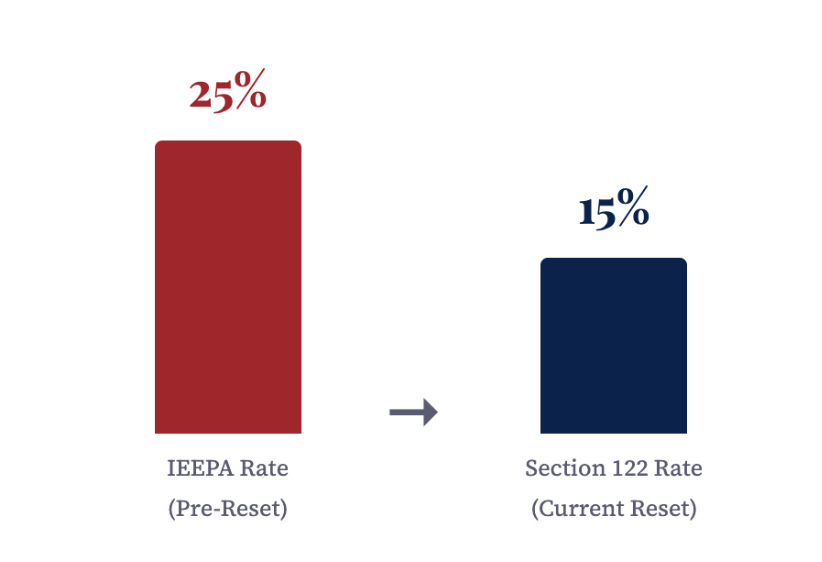
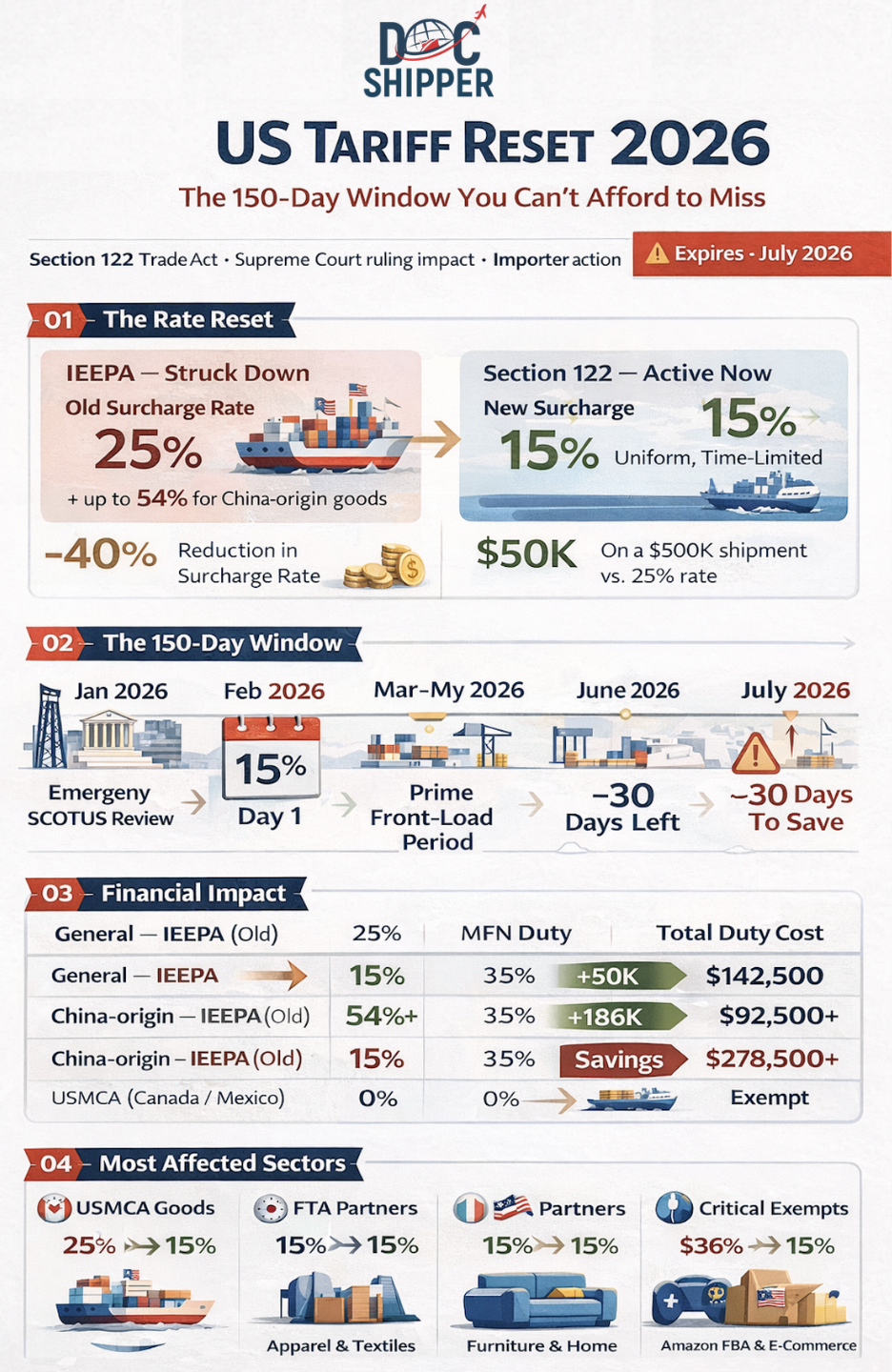
US tariff reset 2026: Comparing 25% vs 15% surcharge rates. The Section 122 surcharge represents a 40% reduction in the headline rate for affected goods.
Navigating the Section 122 Trade Act 150-day window
Section 122 of the Trade Act of 1974 is an obscure provision that has suddenly become the most important piece of trade legislation for every importer, freight forwarder, and customs broker operating in the US market. Understanding its precise contours is not optional, it is essential.
Why the Section 122 Trade Act 150-day window is a critical timeline for importers
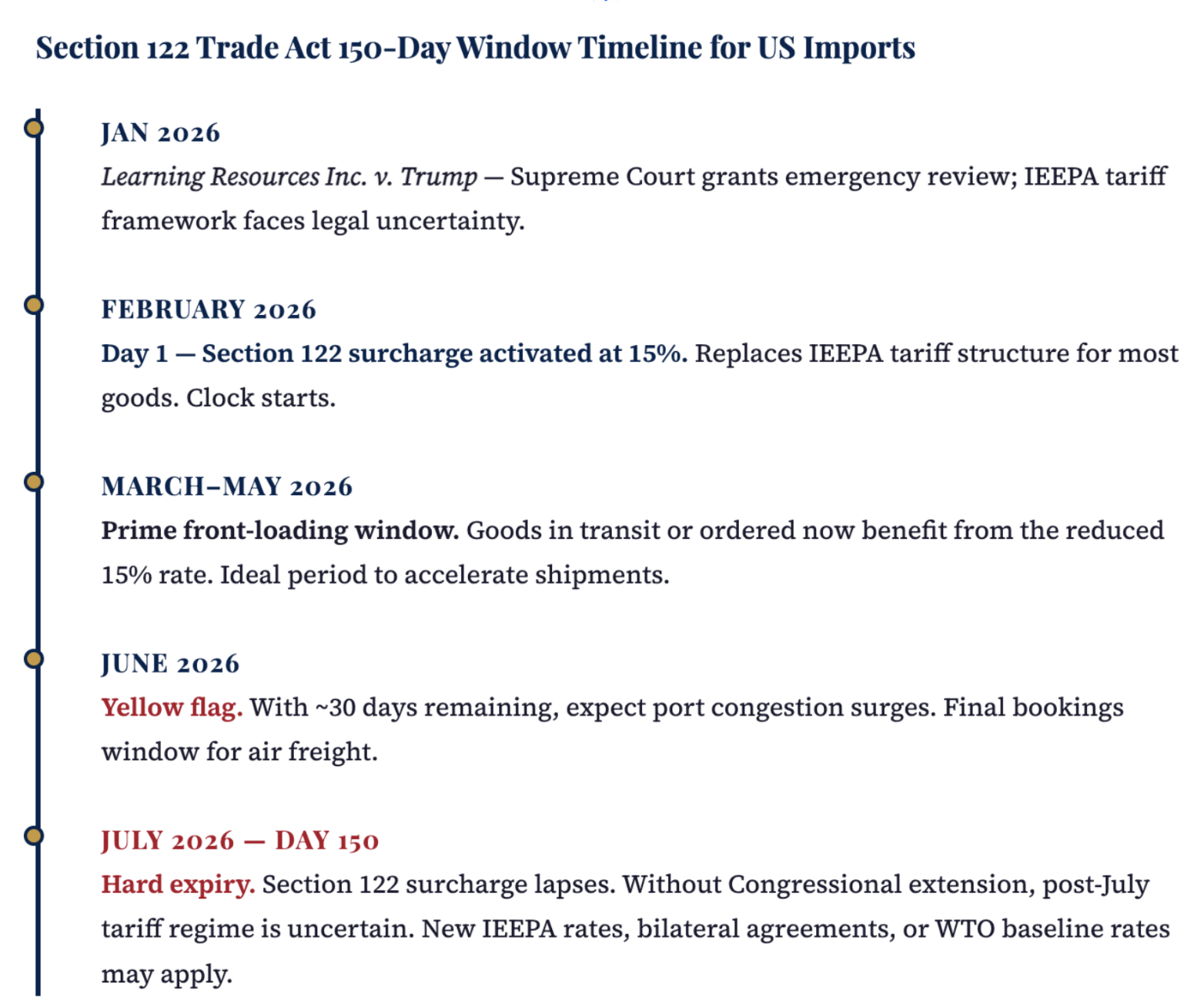
Under the statute, a Section 122 surcharge can remain in effect for a maximum of 150 days without explicit Congressional approval. This is not a guideline or a target, it is a hard legal ceiling baked into the text of the law.
Congress has not shown appetite for a new trade authorization vote in the current political environment, which means the February 2026 activation date creates a firm July 2026 expiry.
Why does this matter operationally? Because it creates a rare, predictable window. Unlike the IEEPA tariff era, where rates could change overnight by executive tweet, the Section 122 framework gives supply chain teams a known cost environment for approximately five months.
Companies that use this window intelligently, accelerating imports, renegotiating contracts, front-loading inventory, will have a measurable cost advantage over those that do not.
Key deadlines: When the US import surcharge 15% February 2026 expires
The key date every importer must have in their calendar is mid-July 2026, the 150th day following the surcharge’s February activation. Goods that clear US Customs before this date benefit from the 15% rate. Goods that arrive after, or whose entry documentation is filed after, face an as-yet-undefined post-reset environment that could be significantly more expensive. Given standard ocean freight transit times of 25–40 days from Asia, the effective booking deadline for the final wave of front-loaded shipments is approximately late May to early June 2026.
Impact on Costs: New importing to USA 2026 customs duties
Numbers matter more than narrative in trade finance. Let’s quantify exactly what the US tariff reset 2026 means for a real-world importer.
Calculating the financial shift of the US tariff reset 2026

Consider a company importing $500,000 USD of consumer electronics from China under the previous IEEPA regime. At a 25% surcharge (on top of existing MFN duty of 3.5%), total duties could reach 28.5%, or $142,500. Under the Section 122 reset at 15%, the same shipment incurs 18.5% total duties, or $92,500. That is a $50,000 saving on a single shipment, a margin shift that is not theoretical but immediately actionable.
Comparing the US import surcharge 15% February 2026 vs. the old 25% rates
Scenario | Shipment Value | Surcharge Rate | MFN Duty | Total Duty Cost | Saving vs. Old Rate |
Old IEEPA Rate | $500,000 | 25% | 3.5% | $142,500 | — |
Section 122 Reset | $500,000 | 15% | 3.5% | $92,500 | ↓ $50,000 |
China-specific (Pre-Reset) | $500,000 | 54%+ | 3.5% | $278,500+ | — |
China — Section 122 | $500,000 | 15% | 3.5% | $92,500 | ↓ $186,000 |
US tariff reset 2026: cost comparison across key import scenarios. China-origin goods see the largest savings under Section 122.
 The short answer is: virtually every company
 Strategic exceptions within the Section 122 Trade Act 150-day window
Not all goods are treated equally. Section 122 contains provisions allowing for exemptions on goods deemed critical to national supply chains, including certain pharmaceutical inputs, semiconductors, and agricultural commodities.
Additionally, goods entering under existing Free Trade Agreements (FTAs), such as USMCA for Canadian and Mexican origin goods, or KORUS for South Korean goods, may benefit from preferential treatment that reduces or eliminates the surcharge. A thorough quality control and HS code classification review can reveal exemption opportunities that many importers overlook.
Key Exception Note : USMCA-qualifying goods from Canada and Mexico are generally excluded from the Section 122 surcharge, making US sourcing from USMCA partners an even more attractive option during the 150-day window and beyond. |
The specific case of China and the Learning Resources Inc. v. Trump impact
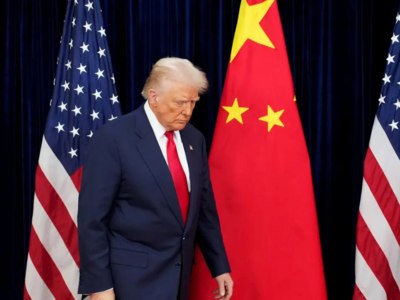 China-origin goods deserve special attention. Prior to the February 2026 reset, Chinese imports faced some of the highest effective tariff rates in US trade history, often exceeding 50% when IEEPA surcharges were stacked on top of pre-existing Section 301 tariffs.
The Learning Resources Inc. v. Trump ruling directly challenged the legal basis of this stacking. Under the Section 122 reset, China-origin goods are, at least temporarily, subject to the same 15% surcharge as other origins, representing a dramatic and unexpected reduction in landed costs for importers of Chinese goods. This window is unprecedented, and unlikely to be permanent.
Supply Chain Strategy for the Section 122 Trade Act 150-day window
The 150-day window is not just a legal footnote. It is an operational imperative. Companies that treat it as such will outperform those that don’t, not by a small margin, but by a structurally significant competitive edge.
Front-loading inventory to leverage the US tariff reset 2026
Front-loading, accelerating import timelines to take advantage of a known, time-limited cost environment, is not a new concept. It was widely practiced during the initial Section 301 tariff rollouts in 2018–2019. But the February 2026 window is uniquely favorable because the rate reduction is substantial (from 25%+ to 15%) and the deadline is legally fixed rather than politically contingent. For a company importing $2M of goods annually, front-loading 4 months of inventory in 2.5 months can generate $100,000+ in duty savings that directly flows to the bottom line.
That said, front-loading carries its own risks: working capital absorption, warehousing costs, and demand forecasting errors. The optimal front-loading volume is a quantitative exercise that balances duty savings against carrying costs, and it is one that our air freight and sea freight teams can model with precision.
Logistics planning: Managing the rush of importing to USA 2026 customs duties
The single biggest risk to front-loading strategies is port congestion. When thousands of importers simultaneously try to accelerate shipments before a known deadline, the results are predictable:
- vessel space tightens,
- freight rates spike,
- and port dwell times extend, particularly at Los Angeles/Long Beach, the primary US gateway for trans-Pacific cargo.
Our logistics planners recommend a tiered booking strategy: secure vessel space for the first wave of accelerated shipments immediately, use air freight for high-value or time-critical goods, and build in a buffer of at least 15 days before the July deadline for final shipments.
Proper customs brokerage support is also critical during this period. Errors in HS code classification, valuation, or entry filing can cause customs holds that push cargo past the Section 122 deadline, converting anticipated savings into unexpected costs.


Fill the Form
Prefer email? Send us your inquiry, and we’ll get back to you as soon as possible.
Contact us