


In short ⚡
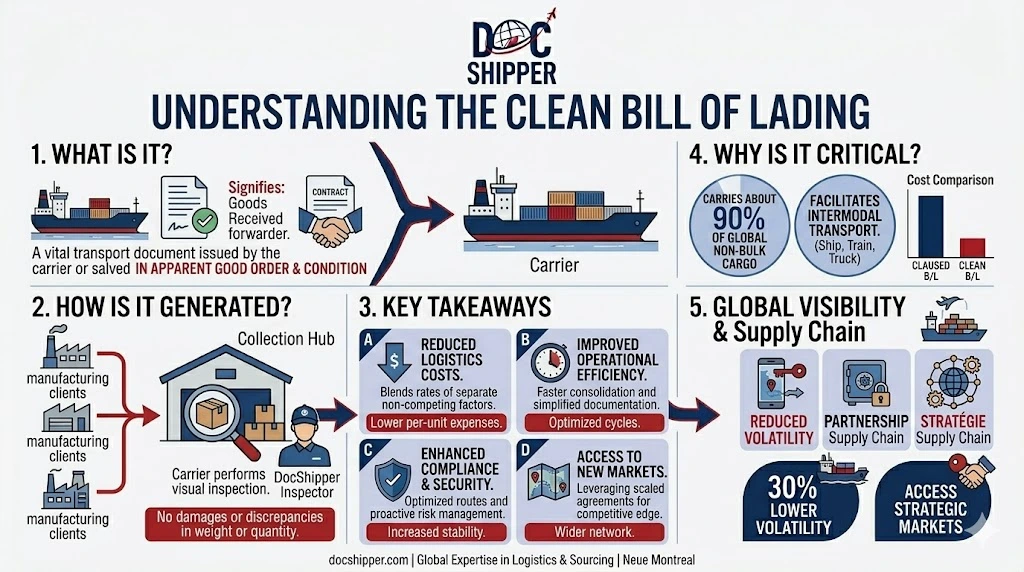
A Clean Bill of Lading is a transport document issued by a carrier certifying that goods were received in apparent good condition, without visible damage or defects. This document guarantees no reservations or clauses regarding the cargo's condition at the time of loading, making it essential for payment under letters of credit and international trade transactions.
=Introduction
Confusion between clean and claused bills of lading costs importers thousands in delayed payments and rejected letters of credit annually. The distinction determines whether banks release funds immediately or freeze transactions pending investigation.
In international shipping, the Clean Bill of Lading serves as the gold standard for cargo documentation. It directly impacts payment terms, insurance claims, and buyer-seller relationships across global supply chains.
- Payment trigger: Banks require clean bills before releasing funds under documentary credits
- Legal proof: Confirms carrier received cargo without visible defects or damage
- Negotiability: Enables transfer of ownership through endorsement and delivery
- Insurance prerequisite: Marine insurers base coverage on clean bill declarations
- Trade compliance: Meets UCP 600 requirements for international banking standards
Technical Requirements & Legal Framework
The Hague-Visby Rules establish the legal foundation for clean bills of lading in maritime transport. Article III mandates carriers issue receipts showing cargo condition upon receipt, creating liability frameworks for damaged goods.
UCP 600 Article 20 defines banking requirements for clean transport documents. Banks examine bills solely based on document face value, rejecting any notation suggesting defective condition, packaging, or quantity discrepancies.
A clean bill must contain zero reservations or superimposed clauses. Pre-printed clauses like “shipper’s load and count” remain acceptable, but handwritten annotations such as “rusty containers” or “torn packaging” immediately convert it to a claused bill.
The carrier’s liability increases significantly with clean bills. By certifying good condition, carriers accept responsibility for delivery matching the described state. This explains why shipping lines conduct thorough inspections before issuing clean documentation.
Negotiable versus non-negotiable clean bills serve different purposes. Negotiable bills (“to order”) enable cargo ownership transfer through endorsement, while straight bills (“consigned to”) restrict delivery to named consignees only.
At DocShipper, we systematically verify bill of lading clauses before presenting documents to banks, preventing costly rejections and ensuring smooth payment releases for our clients’ international transactions.
For detailed regulatory frameworks, consult the International Chamber of Shipping guidelines on transport documentation standards.
Practical Examples & Case Studies
Understanding clean bills requires examining real-world scenarios where documentation determines transaction outcomes. The following cases illustrate critical distinctions between clean and claused bills.
Comparative Analysis: Clean vs. Claused Bills
| Criterion | Clean Bill of Lading | Claused Bill of Lading |
|---|---|---|
| Cargo Condition | No visible damage or defects noted | Reservations recorded (damaged packaging, rust, shortages) |
| Bank Acceptance | Accepted under letters of credit | Rejected unless specifically authorized |
| Payment Release | Immediate upon document presentation | Delayed pending buyer approval or amendment |
| Carrier Liability | Full responsibility for delivery condition | Limited liability due to documented reservations |
| Insurance Claims | Simplified claim process | Complex claims requiring additional evidence |
Case Study: Electronics Shipment from Shanghai to Rotterdam
Scenario: A German importer ordered 500 laptops (CIF €250,000) under a documentary credit requiring clean bills of lading.
Situation: Upon loading in Shanghai, the carrier noticed two pallets with slightly torn shrink wrap but intact cartons. The shipper requested a clean bill to ensure payment.
Outcome: The carrier issued a claused bill noting “outer packaging damaged on 2 pallets.” The bank rejected the documents, freezing €250,000 payment. The buyer had to amend the L/C (costing €1,200 in fees and 14 days delay) before accepting the claused bill.
Financial impact: €1,200 amendment fees + €3,500 storage charges + potential sales loss from delayed delivery.
Key Decision Points for Exporters
- Pre-shipment inspection: Conduct thorough packaging checks before carrier arrival to prevent clausing
- Carrier negotiation: Address minor defects immediately rather than accepting claused bills
- Letter of indemnity: Some shippers offer indemnities to obtain clean bills despite minor issues (legally risky)
- Insurance coverage: Verify policies cover scenarios where clean bills cannot be obtained
- Contract terms: Negotiate L/C clauses allowing specific reservations if cargo characteristics justify them
DocShipper’s quality control teams inspect cargo before loading, documenting conditions photographically to support clean bill issuance and prevent disputes during the documentary credit process.
Conclusion
The Clean Bill of Lading remains the cornerstone of secure international trade, directly determining payment release and liability allocation. Understanding its requirements prevents costly transaction delays and protects commercial relationships.
Need expert guidance on shipping documentation or customs compliance? Contact DocShipper for comprehensive logistics support across your global supply chain.
📚 Quiz
Test Your Knowledge: Clean Bill of Lading
Q1. What does a Clean Bill of Lading certify?
Q2. A carrier stamps "shipper's load and count" on a bill of lading. Does this make it a claused bill?
Q3. A German importer opens a letter of credit requiring a clean bill of lading. The carrier notices torn shrink wrap on two pallets and issues a claused bill. What is the most likely immediate consequence?
🎯 Your Result
📞 Free Quote in 24hFAQ | Clean Bill of Lading: Definition, Requirements & Practical Examples
A clean bill contains no notations regarding cargo defects, damage, or packaging issues. Claused bills include carrier reservations about condition, quantity discrepancies, or visible damage at loading.
Banks typically reject claused bills unless the L/C specifically authorizes certain clauses. UCP 600 requires clean transport documents for standard documentary credits without explicit buyer approval for reservations.
No. Pre-printed standard clauses like "shipper's load and count" or "said to contain" do not constitute clausing. Only handwritten or stamped notations about actual cargo condition create claused bills.
The carrier bears liability for damage occurring during transport when a clean bill was issued. The consignee can file claims against the carrier for compensation based on the clean bill's certification.
Yes. Carriers must accurately document cargo condition. If visible damage, defective packaging, or quantity shortages exist, carriers are legally obligated to note these reservations, creating a claused bill.
Clean bills simplify marine insurance claims by establishing cargo was in good condition at shipment. Insurers use this baseline to determine whether damage occurred during transit versus pre-existing conditions.
A Letter of Indemnity (LOI) is a shipper's guarantee to compensate carriers for issuing clean bills despite minor defects. While common, LOIs carry legal risks and may not protect carriers in disputes.
Yes. Electronic bills (eBLs) follow the same clean/claused principles as paper documents. The CMI Rules for Electronic Bills govern their legal status, with clean eBLs accepted under UCP 600 provisions.
Bills of lading don't expire, but L/C terms typically require presentation within 21 days of shipment date. The clean status remains permanent unless physical evidence contradicts the documented condition.
Yes. "Clean" refers to the cargo's condition relative to its described state, not newness. Used machinery can receive clean bills if packaging and apparent condition match the commercial invoice description.
Negotiable clean bills ("to order") serve as documents of title. Endorsement and physical delivery transfer cargo ownership, making clean bills essential for trade financing and mid-transit sales.
No. Clean bills only certify apparent external condition at loading. They do not verify internal quality, specifications, or fitness for purpose—those require separate inspection certificates or quality surveys.
Need Help with
Logistics or Sourcing ?
First, we secure the right products from the right suppliers at the right price by managing the sourcing process from start to finish. Then, we simplify your shipping experience - from pickup to final delivery - ensuring any product, anywhere, is delivered at highly competitive prices.


Fill the Form
Prefer email? Send us your inquiry, and we’ll get back to you as soon as possible.
Contact us




