


In short ⚡
Freighters are cargo aircraft or vessels specifically designed and operated to transport goods rather than passengers. These specialized carriers form the backbone of international logistics, moving everything from perishable foods to industrial machinery across continents, with dedicated cargo holds, reinforced flooring, and loading systems optimized for freight handling rather than passenger comfort.Introduction
Every product you import—from smartphones manufactured in Asia to medical equipment from Europe—likely traveled aboard a freighter at some point in its journey. Yet many businesses underestimate the complexity behind selecting the right cargo carrier for their shipment.
The confusion often stems from terminology: Are we discussing air freighters, ocean freighters, or both? What differentiates a pure freighter from a combi aircraft? These distinctions directly impact transit times, costs, and cargo capacity—critical factors in international trade.
Freighters play an irreplaceable role in global supply chains by offering:
- Dedicated cargo capacity without passenger priority constraints
- Specialized loading equipment including nose-loading doors and side cargo hatches
- Flexible scheduling for charter operations and peak-season demand
- Heavy-lift capability for oversized industrial equipment and machinery
- Temperature-controlled compartments for pharmaceuticals and perishables
Types & Technical Specifications
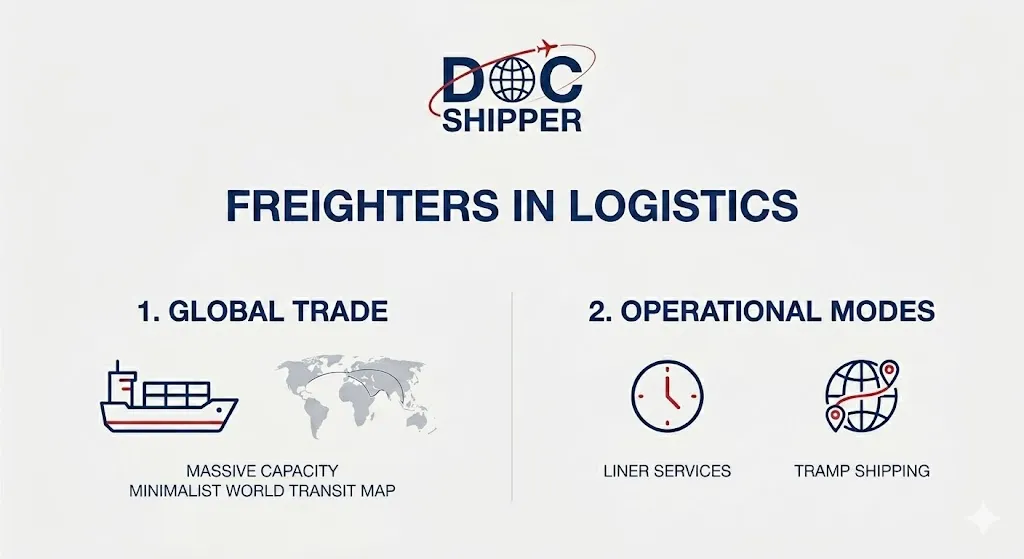
Freighters divide into two primary categories based on transport mode, each with distinct operational characteristics that determine their suitability for specific cargo types and routes.
Air freighters represent converted or purpose-built aircraft dedicated exclusively to cargo. The Boeing 747-8F, for instance, carries up to 134 tonnes with a main deck cargo volume of 858 cubic meters. These aircraft feature reinforced flooring rated for concentrated loads, hydraulic loading systems, and nose or side cargo doors accommodating palletized freight up to 3.2 meters tall. Major operators like FedEx Express and UPS Airlines operate fleets exceeding 200 dedicated freighters each.
Combi aircraft blend passenger and cargo functions, with the forward fuselage configured for travelers and the aft section for freight. This hybrid model offers airlines flexibility but limits cargo capacity compared to pure freighters. The Airbus A330-200F, a dedicated freighter variant, demonstrates 23% greater payload capacity than its combi equivalent.
Ocean freighters encompass various vessel types optimized for specific cargo categories. Container ships—the most common—transport standardized TEU containers, with the largest vessels carrying over 24,000 TEU. Bulk carriers handle unpackaged commodities like grain or coal in dedicated holds, while Ro-Ro vessels (Roll-on/Roll-off) feature ramps allowing wheeled cargo to drive aboard. Specialized reefer ships maintain controlled atmospheres for temperature-sensitive goods.
The legal framework governing freighter operations varies by mode. Air cargo falls under IATA regulations and the Montreal Convention for liability, while maritime freight operates under the Rotterdam Rules and Hague-Visby protocols. Both require specific dangerous goods documentation when transporting hazardous materials.
At DocShipper, we maintain partnerships with both air and ocean freighter operators to secure competitive rates and guaranteed space, particularly during peak seasons when capacity tightens. Our logistics coordinators select the appropriate freighter type based on your cargo dimensions, weight, urgency, and budget parameters.
Operational Data & Concrete Examples
Understanding freighter economics requires examining real-world operational metrics that influence shipping costs and transit reliability. The data reveals significant performance differences across carrier types and routes.
| Freighter Type | Capacity | Transit (Shanghai-LA) | Cost per Tonne | Best For |
|---|---|---|---|---|
| Boeing 777F | 103 tonnes | 11-13 hours | $4.50-6.80 | High-value electronics |
| Container Ship (14K TEU) | ~180,000 tonnes | 14-18 days | $0.08-0.15 | Volume consumer goods |
| Antonov AN-124 | 120 tonnes | 12-15 hours | $8.20-11.50 | Oversized machinery |
| Reefer Vessel | ~450,000 cu ft | 16-20 days | $0.22-0.35 | Perishable produce |
Case Study: Pharmaceutical Emergency Shipment
A European pharmaceutical manufacturer faced a critical deadline to deliver 8.5 tonnes of temperature-sensitive vaccines to Singapore within 72 hours. Standard ocean freight required 28 days, making air freight the only viable option. We chartered a Boeing 747-400F freighter with active temperature control, maintaining 2-8°C throughout the journey. Total transit time: 14 hours door-to-door. Cost premium over ocean: 47x higher per kilogram, but the client avoided production line shutdowns costing $340,000 daily.
Container Ship Optimization Example
An electronics importer shipping 18 TEU monthly from Shenzhen to Rotterdam initially used LCL (less than container load) services. By consolidating shipments and booking dedicated container space on Maersk’s AE7 service (a freighter route with 11,000 TEU vessels), they reduced per-unit costs by 31% and improved transit predictability. The switch from 23-day average to guaranteed 21-day schedules reduced inventory holding costs by $18,700 monthly.
According to IATA’s 2024 Air Cargo Market Analysis, global air freighter capacity increased by 8.3% year-over-year, driven primarily by dedicated cargo aircraft additions rather than passenger belly-hold recovery. This shift reflects long-term structural changes in logistics networks favoring pure freighter reliability.
Key Operational Insights:
- Load factor optimization: Air freighters average 68% capacity utilization versus 52% for passenger belly-hold
- Dimensional weight pricing: Air freighters charge based on volumetric weight (length × width × height ÷ 6000), not just actual weight
- Fuel surcharges: Account for 18-24% of total air freighter costs, updated monthly based on jet fuel prices
- Charter premiums: Dedicated freighter charters cost 2.3-3.8x scheduled service rates but guarantee space during peak seasons
- Emission factors: Ocean freighters emit 10-40g CO₂ per tonne-km versus 500-700g for air freighters, influencing carbon footprint calculations
Conclusion
Selecting between air and ocean freighters—or understanding when to use specialized variants—directly impacts your bottom line and supply chain resilience. The cost differential of 30-50x between modes demands strategic cargo routing based on value, urgency, and volume.
Need expert guidance on freighter selection for your next shipment? Contact DocShipper for customized logistics solutions backed by direct carrier relationships and real-time capacity insights.
📚 Quiz
Test Your Knowledge: Freighters
What defines a freighter in the logistics industry?
Which statement correctly describes the emission profile of ocean freighters versus air freighters?
A manufacturer needs to ship 8.5 tonnes of temperature-sensitive vaccines from Europe to Singapore within 72 hours. Which freighter solution is most appropriate?
🎯 Your Results
📞 Free Quote in 24hFAQ | Freighters: Definition, Types & Concrete Examples
Need Help with
Logistics or Sourcing ?
First, we secure the right products from the right suppliers at the right price by managing the sourcing process from start to finish. Then, we simplify your shipping experience - from pickup to final delivery - ensuring any product, anywhere, is delivered at highly competitive prices.


Fill the Form
Prefer email? Send us your inquiry, and we’ll get back to you as soon as possible.
Contact us




