



In short ⚡
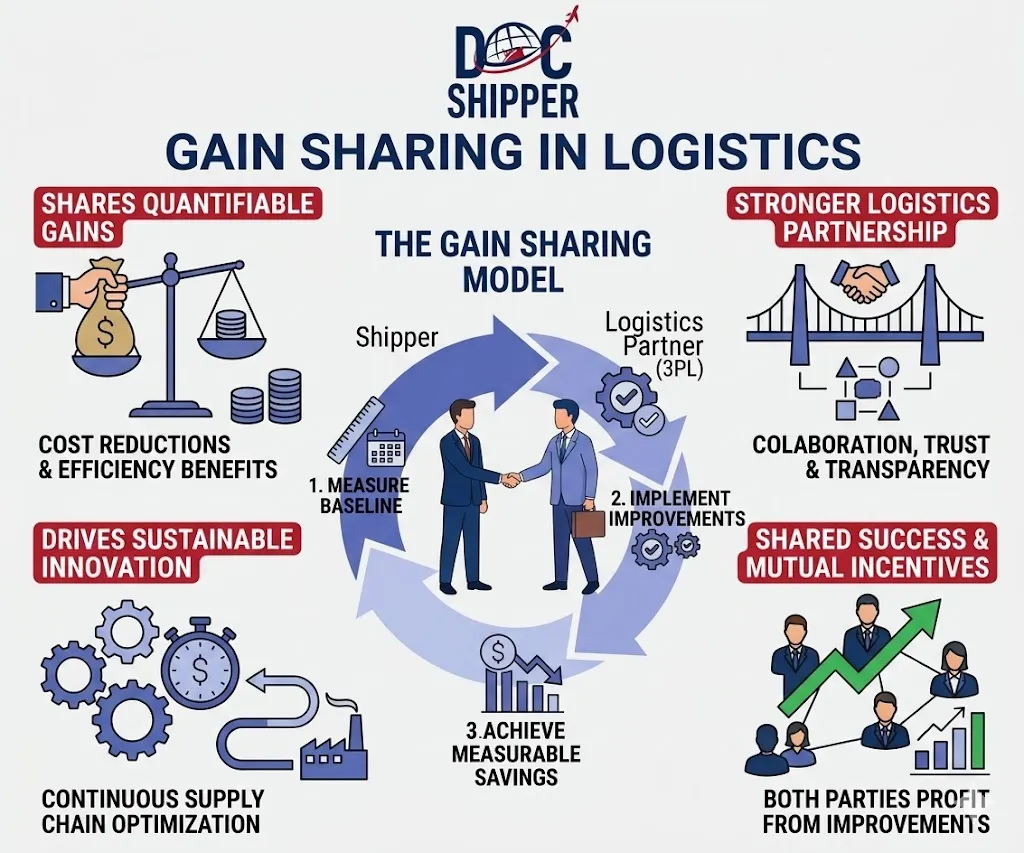
Gain Sharing is a collaborative supply chain practice where cost savings or efficiency improvements achieved through optimization efforts are equitably distributed between business partners. This incentive-based approach aligns supplier and buyer interests, fostering transparency and continuous improvement in logistics operations.Introduction
Many businesses struggle with adversarial supplier relationships where cost reductions feel like zero-sum negotiations. One party wins while the other loses, creating distrust and missed optimization opportunities. This traditional dynamic leaves significant logistics savings on the table.
Gain sharing transforms this equation by creating shared incentives. When freight forwarders, carriers, and shippers work together to reduce costs, both parties benefit proportionally. This collaborative framework proves particularly valuable in international trade, where complex supply chains offer multiple optimization opportunities.
Key characteristics of effective gain sharing programs include:
- Baseline establishment: Clear benchmarks for current costs and performance metrics
- Transparent measurement: Agreed-upon KPIs and data-sharing protocols
- Equitable distribution: Pre-negotiated split ratios (commonly 50/50 or 60/40)
- Continuous improvement focus: Regular reviews and adjustment mechanisms
- Contractual framework: Formal agreements defining terms, duration, and governance
Mechanisms & Strategic Expertise
Gain sharing operates through structured collaboration frameworks that require meticulous planning and execution. The process begins with establishing a performance baseline using historical data—typically 6 to 12 months of shipping records, costs, and service metrics.
Once baseline metrics are established, partners identify optimization opportunities across multiple dimensions. These may include route consolidation, mode shifting (air to ocean), packaging redesign, warehouse location optimization, or technology implementation. Each initiative receives specific targets and timelines.
The measurement framework must be both rigorous and transparent. Partners typically establish joint steering committees that review performance monthly or quarterly. According to the Council of Supply Chain Management Professionals, successful programs implement real-time data sharing systems allowing both parties to track savings as they accrue.
Distribution mechanisms vary by agreement structure. Some programs distribute savings quarterly, while others accumulate annually. The split ratio often reflects the investment and risk profile—if one party invests heavily in technology or process changes, they may negotiate a larger share of initial savings.
Legal considerations require attention to antitrust regulations, particularly in jurisdictions like the EU where information sharing between competitors faces scrutiny. Contracts must clearly define intellectual property rights for process improvements and technology developed during the partnership.
At DocShipper, we structure gain sharing agreements that protect both parties while maximizing collaborative potential. Our approach includes quarterly performance reviews and transparent cost tracking that builds trust throughout the partnership lifecycle.
Concrete Examples & Performance Data
Real-world gain sharing programs demonstrate measurable impact across industries. Consider these documented scenarios showcasing tangible savings and implementation models:
| Industry Sector | Optimization Focus | Annual Baseline Cost | Savings Achieved | Split Ratio |
|---|---|---|---|---|
| Electronics Manufacturing | Container consolidation + route optimization | $2.4M | $312,000 (13%) | 50/50 |
| Automotive Parts | Cross-docking implementation | $1.8M | $234,000 (13%) | 60/40 (buyer/supplier) |
| Fashion Retail | Modal shift (air to ocean) + packaging redesign | $3.2M | $576,000 (18%) | 55/45 (buyer/supplier) |
| Industrial Equipment | Inventory positioning + LCL-to-FCL conversion | $1.5M | $195,000 (13%) | 50/50 |
Use Case: Electronics Manufacturer (Asia-Europe Trade Lane)
A consumer electronics company partnered with their freight forwarder to optimize shipments from Shenzhen to Rotterdam. Initial analysis revealed 62% container utilization and inconsistent booking patterns causing premium freight charges.
The gain sharing initiative implemented three changes: consolidated weekly departures instead of ad-hoc bookings, redesigned secondary packaging to increase container density by 18%, and shifted 30% of non-urgent shipments from air to ocean. Over 12 months, these changes reduced total logistics spend by $287,000.
Under the 50/50 agreement, each party received $143,500. The manufacturer reinvested their share in warehouse automation, while the forwarder expanded their consolidation center capacity. This virtuous cycle led to additional optimization in year two, demonstrating how aligned incentives drive continuous improvement.
Critical success factors observed across programs:
- Executive sponsorship: Leadership commitment from both organizations ensures resource allocation
- Data infrastructure: Integrated systems enabling real-time cost and performance visibility
- Clear governance: Defined decision-making authority and escalation procedures
- Regular communication: Monthly operational reviews and quarterly strategic assessments
- Balanced metrics: Cost reduction balanced with service quality and sustainability goals
Conclusion
Gain sharing represents a paradigm shift from transactional to collaborative supply chain relationships. By aligning incentives and sharing both risks and rewards, businesses unlock optimization opportunities that traditional contracts leave untapped. The documented savings—averaging 12-18% of baseline costs—demonstrate significant financial impact while building stronger, more resilient partnerships.
Need guidance structuring a gain sharing program for your international logistics operations? Contact DocShipper for expert support in negotiation, implementation, and performance management.
📚 Quiz
Test Your Knowledge: Gain Sharing
What is the primary purpose of gain sharing in supply chain management?
A company signs a gain sharing agreement without establishing a performance baseline. What critical risk does this create?
An electronics manufacturer achieved $312,000 in annual savings through container consolidation under a 50/50 gain sharing agreement. How should the forwarder's share be applied?
🎯 Your Result
📞 Free Quote in 24hFAQ | Gain Sharing: Definition, Calculation & Concrete Examples
Need Help with
Logistics or Sourcing ?
First, we secure the right products from the right suppliers at the right price by managing the sourcing process from start to finish. Then, we simplify your shipping experience - from pickup to final delivery - ensuring any product, anywhere, is delivered at highly competitive prices.


Fill the Form
Prefer email? Send us your inquiry, and we’ll get back to you as soon as possible.
Contact us




