


In short ⚡
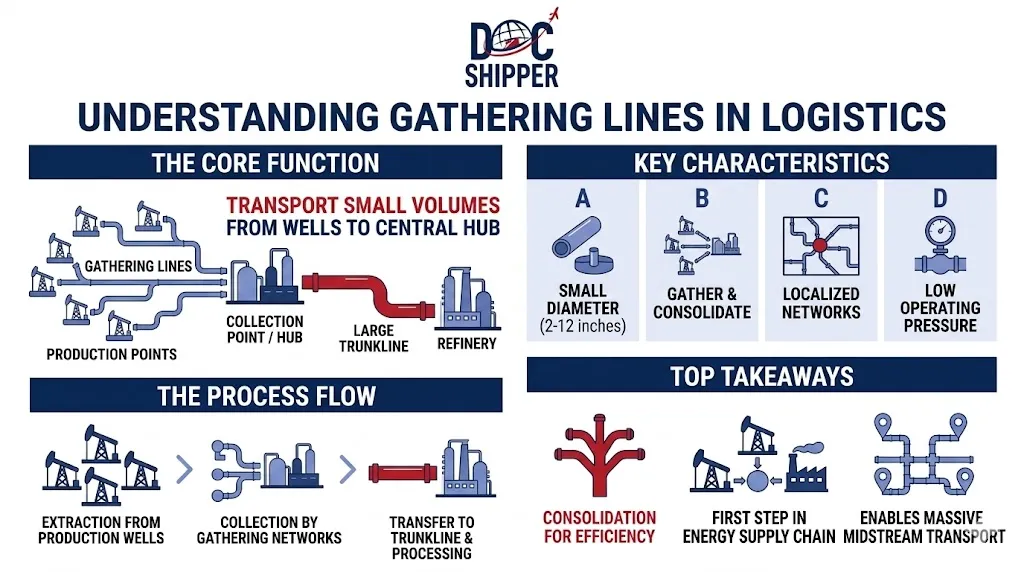
Gathering lines are pipelines that collect crude oil, natural gas, or other petroleum products from multiple wellheads or production sites and transport them to a central processing facility or main transmission pipeline. These short-to-medium distance conduits form the critical first link in the oil and gas supply chain.
Introduction
In oil and gas logistics, confusion often arises between gathering lines, transmission pipelines, and distribution networks. Many industry newcomers struggle to understand where gathering systems fit within the broader midstream infrastructure.
Gathering lines represent the foundational component of petroleum transportation. Without these initial collection systems, isolated production wells cannot economically deliver their output to refineries or export terminals.
Key characteristics of gathering systems include:
- Diameter range: Typically 2 to 16 inches, smaller than transmission pipelines
- Operating pressure: Generally lower than 20% SMYS (Specified Minimum Yield Strength)
- Network configuration: Star or dendritic patterns converging toward central facilities
- Regulatory classification: Subject to less stringent oversight than interstate transmission lines in many jurisdictions
- Material composition: Carbon steel, plastic, or composite materials depending on product and pressure requirements
Technical Infrastructure & Regulatory Framework
Gathering lines operate under distinct engineering parameters compared to transmission systems. The Pipeline and Hazardous Materials Safety Administration (PHMSA) in the United States defines gathering lines based on their function rather than solely on diameter or pressure specifications.
The system architecture typically involves three components: production gathering (wellhead to separator), gas gathering (separator to processing plant), and liquids gathering (separator to storage or transmission). Each segment requires different material specifications and pressure ratings.
Regulatory oversight varies significantly by jurisdiction. In the U.S., onshore gathering lines in rural areas face minimal federal regulation, while offshore systems and those in populated areas encounter stricter requirements. The Code of Federal Regulations Title 49 Part 192 provides specific exemptions for gathering lines meeting certain criteria.
Design considerations include flow assurance management to prevent hydrate formation, wax deposition, and corrosion. Gathering systems must accommodate multiphase flow (oil, gas, water, sand) unlike single-phase transmission pipelines. This complexity requires specialized monitoring and maintenance protocols.
At DocShipper, we coordinate with gathering line operators when planning export shipments of crude oil or LNG, ensuring seamless integration between upstream collection and international maritime logistics. Our expertise bridges production facilities with global supply chains.
The right-of-way acquisition process for gathering lines differs from transmission projects. Operators typically negotiate easements with individual landowners rather than exercising eminent domain, creating more flexible but potentially fragmented routing options.
Operational Examples & Industry Data
The Permian Basin in Texas provides a concrete illustration of gathering system scale. This region contains over 75,000 miles of gathering pipelines serving approximately 40,000 active wells, according to data from the Railroad Commission of Texas.
| System Type | Diameter Range | Typical Length | Primary Application |
|---|---|---|---|
| Gathering Lines | 2-16 inches | 0.5-50 miles | Wellhead to processing facility |
| Transmission Pipelines | 20-48 inches | 100-1,000+ miles | Regional to international transport |
| Distribution Lines | 0.5-6 inches | Variable local networks | Final delivery to consumers |
Use Case: Bakken Shale Development
In North Dakota’s Bakken formation, a typical gathering system serves 20-30 wells across a 15-square-mile area. The operator installed 45 miles of 6-inch and 8-inch gathering lines converging at a central battery (processing station). Initial throughput averaged 12,000 barrels of oil per day (BOPD) with associated gas volumes of 18 million cubic feet per day (MMCFD).
The project required investment of approximately $8.5 million for pipeline materials, installation, and right-of-way acquisition. With an operational lifespan exceeding 25 years, the per-barrel transportation cost through this gathering system averages $0.85, significantly lower than trucking alternatives at $3.50 per barrel.
Key operational metrics for modern gathering systems:
- Capacity utilization: Optimal systems operate at 70-85% capacity to accommodate production fluctuations
- Maintenance frequency: Inline inspections every 3-5 years for corrosion and integrity assessment
- Leak detection: Advanced systems employ fiber-optic sensors achieving 99.7% detection accuracy
- Energy efficiency: Modern compressor stations reduce power consumption by 15-20% compared to legacy equipment
- Environmental compliance: Fugitive methane emissions from gathering systems decreased 45% industry-wide between 2015-2023
Conclusion
Gathering lines constitute the essential first mile of petroleum logistics, connecting dispersed production sites to centralized infrastructure. Understanding their technical specifications and regulatory context proves critical for effective supply chain management in the energy sector.
Need assistance coordinating logistics from production facilities to international markets? Contact DocShipper for expert guidance bridging upstream operations with global freight solutions.
📚 Quiz
Test Your Knowledge: Gathering Lines
What is the primary function of gathering lines in the oil and gas supply chain?
Which characteristic distinguishes gathering lines from transmission pipelines?
A company is developing a new oil field in a rural area with 25 wells spread across 15 square miles. Which infrastructure component would they install first to begin production?
🎯 Your Result
📞 Free Quote in 24hFAQ | Gathering Lines: Definition, Applications & Concrete Examples
Gathering lines collect product from multiple production points over short distances (typically under 50 miles) with smaller diameters (2-16 inches) and lower pressures. Transmission pipelines transport large volumes over long distances (hundreds to thousands of miles) using larger diameters (20-48 inches) and higher pressures. Regulatory requirements also differ significantly, with transmission systems facing stricter federal oversight.
In the United States, gathering lines in rural areas with minimal population density are generally exempt from federal PHMSA regulations under 49 CFR Part 192. However, offshore gathering systems, lines in Class 3 or 4 locations (populated areas), and those downstream of processing facilities face increasing regulatory requirements. State agencies may impose additional oversight depending on jurisdiction.
Carbon steel remains the predominant material for oil and high-pressure gas gathering systems due to strength and durability. Plastic (polyethylene or PVC) serves low-pressure gas applications in some regions. Fiberglass-reinforced composite materials are increasingly deployed in corrosive environments or where electrical isolation is required. Material selection depends on product characteristics, pressure ratings, and environmental conditions.
Corrosion management involves multiple strategies: internal coating or lining of pipelines, chemical inhibitor injection, cathodic protection systems (impressed current or sacrificial anodes), regular inline inspections using smart pigs, and corrosion monitoring through coupons or probes. Water removal at separators and dehydration units also minimizes corrosive conditions within gathering lines.
Properly maintained gathering lines typically operate for 25-40 years. Lifespan depends on product characteristics (corrosivity), material quality, installation standards, maintenance practices, and operating conditions. Some systems in benign environments have functioned for over 50 years, while those handling corrosive fluids may require replacement or rehabilitation within 15-20 years despite rigorous maintenance.
Yes, gathering lines commonly handle multiphase flow containing crude oil, natural gas, water, and solids (sand, scale) simultaneously. This differs from transmission pipelines that typically transport single-phase products. Gathering systems require separator facilities at collection points to partition these phases before entering dedicated transmission infrastructure for oil, gas, or produced water disposal.
Safety protocols include regular leak detection surveys, pressure monitoring systems, emergency shutdown valves, right-of-way inspections, public awareness programs in populated areas, and emergency response planning. Operators implement integrity management programs even when not federally mandated, conducting risk assessments and preventive maintenance to minimize incident probability and consequence severity.
Temperature extremes impact gathering systems significantly. Cold weather can cause hydrate formation, wax deposition, and equipment freezing, requiring insulation, heat tracing, or chemical injection. Flooding may expose buried pipelines to scour damage or buoyancy stress. Extreme heat affects aboveground components and can alter soil characteristics around buried lines, potentially compromising support and stability.
Permit requirements vary by location but typically include environmental assessments (wetlands, endangered species, cultural resources), state pipeline construction permits, water crossing authorizations, road crossing permits from transportation agencies, and local zoning or land-use approvals. Federal lands require additional Bureau of Land Management or U.S. Forest Service permits. International projects involve national regulatory agencies and environmental ministries.
Capacity calculations consider pipeline diameter, length, elevation changes, product viscosity, operating pressure, temperature, and multiphase flow characteristics. Engineers use specialized software (PIPESIM, OLGA) to model hydraulic performance. Design capacity typically includes 15-25% margin above initial production forecasts to accommodate well productivity variations and future field development without immediate system expansion.
Emerging carbon capture, utilization, and storage (CCUS) initiatives repurpose existing gathering infrastructure or construct new dedicated systems to collect CO2 from emission sources. These networks transport captured carbon dioxide to injection sites for enhanced oil recovery or geological sequestration. The technology parallels traditional gathering systems but requires materials resistant to CO2 corrosion and specialized compression equipment.
Gathering lines feed processing facilities that prepare crude oil or natural gas for transmission to export terminals. Product quality specifications at gathering system outlets must meet downstream requirements for pipeline transmission and eventual loading onto tankers or LNG carriers. Coordination between gathering operators, transmission companies, and export terminal operators ensures continuous flow and scheduling efficiency throughout the supply chain.
Need Help with
Logistics or Sourcing ?
First, we secure the right products from the right suppliers at the right price by managing the sourcing process from start to finish. Then, we simplify your shipping experience - from pickup to final delivery - ensuring any product, anywhere, is delivered at highly competitive prices.


Fill the Form
Prefer email? Send us your inquiry, and we’ll get back to you as soon as possible.
Contact us




