


In short ⚡
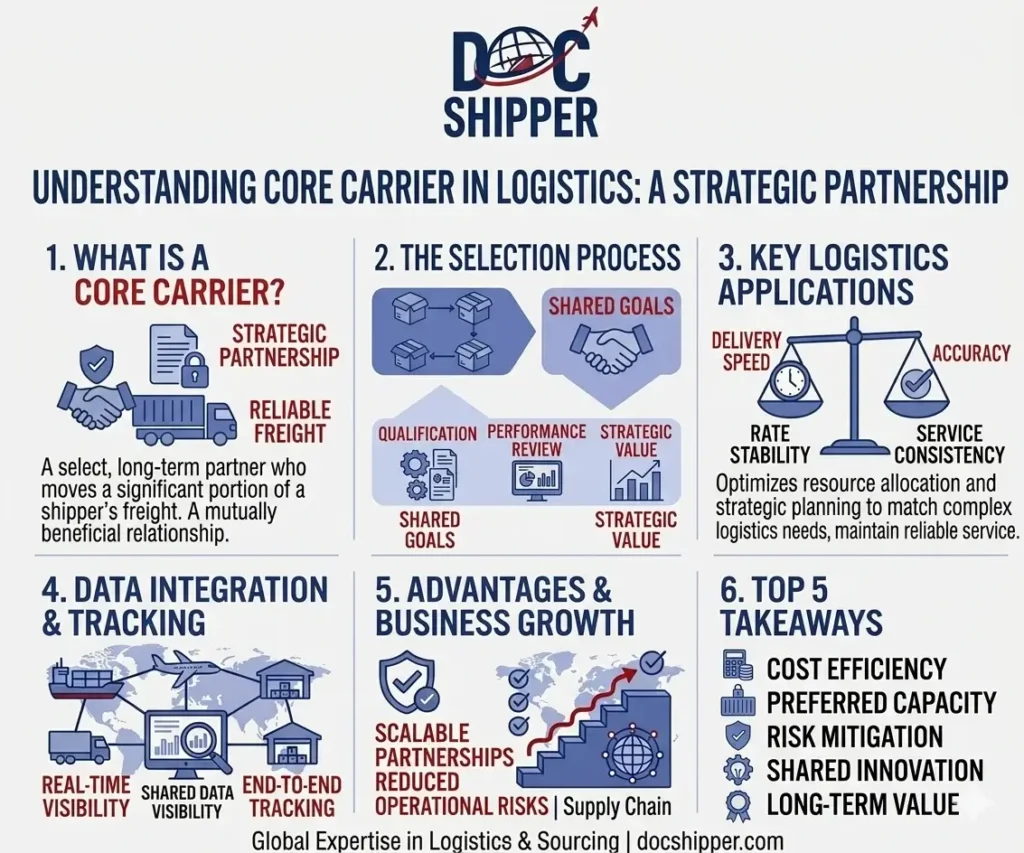
A Core Carrier is a primary transportation provider selected by a shipper to handle the majority of their freight volumes on specific routes or lanes. This strategic partnership typically involves negotiated rates, priority service, and performance guarantees, forming the backbone of a company's logistics network.
Introduction
Many importers and exporters struggle with carrier fragmentation—juggling multiple providers without leveraging volume for better rates or service consistency. The Core Carrier model addresses this inefficiency by consolidating freight with select partners.
In international trade, establishing core carrier relationships is essential for supply chain stability. These partnerships reduce transit variability, streamline documentation, and create predictable cost structures across ocean, air, and ground transportation.
- Volume commitment: Shippers guarantee minimum freight volumes in exchange for preferential pricing
- Service priority: Core carriers allocate equipment and capacity to preferred partners during peak seasons
- Contract duration: Agreements typically span 12-36 months with performance metrics
- Route specialization: Carriers focus on specific trade lanes where they demonstrate operational excellence
- Technology integration: Shared platforms enable real-time tracking and automated documentation
Strategic Partnership Framework & Expertise
Core carrier selection involves rigorous evaluation beyond basic rate comparison. Shippers analyze on-time performance metrics, claims ratios, financial stability, and geographic coverage before committing significant volumes.
The contractual framework typically includes service level agreements (SLAs) with penalties for missed deliveries or damaged cargo. These agreements define transit time standards, communication protocols, and dispute resolution mechanisms. Most contracts incorporate quarterly business reviews to assess performance against benchmarks.
From a regulatory perspective, core carrier partnerships must comply with Federal Maritime Commission regulations for ocean freight and IATA standards for air cargo. Documentation requirements include service contracts filed with regulatory bodies and insurance certificates meeting minimum coverage thresholds.
Capacity allocation represents a critical advantage. During container shortages or peak shipping seasons, core carriers prioritize their committed partners for equipment and vessel space. This preferential treatment prevents costly delays that spot market shippers frequently experience.
At DocShipper, we negotiate core carrier agreements on behalf of clients, leveraging our consolidated volumes across multiple shippers to secure rates and service levels typically available only to Fortune 500 companies. Our procurement team conducts annual carrier evaluations using proprietary scoring systems that weight reliability over pure cost savings.
Operational Examples & Performance Data
Consider a U.S. electronics importer shipping 150 TEUs monthly from Shenzhen to Los Angeles. By designating a core carrier, they reduced their all-in costs by 18% compared to spot rates while improving on-time delivery from 82% to 96%.
| Metric | Spot Market | Core Carrier | Improvement |
|---|---|---|---|
| Average Rate per TEU | $2,450 | $2,010 | -18% |
| On-Time Delivery | 82% | 96% | +14 pts |
| Claims per 1,000 TEUs | 12 | 3 | -75% |
| Average Transit Time | 21 days | 18 days | -14% |
| Equipment Availability | 67% | 98% | +31 pts |
Use Case: Automotive Parts Distribution
A German automotive supplier consolidated 80% of their North American air freight with two core carriers. Annual volume: 1,200 shipments averaging 850 kg each. Results after 12 months: 22% cost reduction, 94% on-time performance (vs. 79% previously), and zero security incidents compared to 4 under previous multi-carrier approach.
Industry data shows that shippers with core carrier programs achieve 12-25% lower total logistics costs when factoring in reduced claims, fewer expedited shipments, and lower administrative overhead. The concentration of volumes also improves negotiating leverage during annual contract renewals.
Multi-modal integration represents another advantage. Leading core carriers offer seamless ocean-to-rail or air-to-truck transitions with single-point accountability. This eliminates the coordination challenges inherent in managing separate providers for each transportation leg.
Seasonal flexibility clauses allow volume adjustments of ±15-20% without penalty, accommodating demand fluctuations while maintaining core carrier benefits. This contractual element proves essential for businesses with cyclical sales patterns or promotional periods requiring surge capacity.
Conclusion
Core carrier partnerships transform logistics from transactional to strategic, delivering cost predictability and service reliability that spot market approaches cannot match. The commitment required from both parties creates alignment that benefits long-term supply chain performance.
Need assistance structuring core carrier agreements or evaluating provider performance? Contact DocShipper for expert guidance on optimizing your transportation network.
📚 Quiz
Test Your Knowledge: Core Carrier
Q1 — What best defines a Core Carrier in logistics?
Q2 — A shipper's freight volume drops significantly mid-contract with their Core Carrier. What typically happens?
Q3 — A U.S. importer ships 150 TEUs/month from Shenzhen to Los Angeles. They switch from spot market booking to a Core Carrier agreement. Which outcome is most consistent with real-world Core Carrier performance data?
🎯 Your Result
📞 Free Quote in 24hFAQ | Core Carrier: Definition, Role & Concrete Examples in Logistics
Most carriers require 50+ shipments monthly or $500K+ annual spend, though thresholds vary by trade lane and mode. Smaller shippers can access core carrier benefits through freight forwarders who aggregate volumes.
Contract rates typically run 8-20% below spot market during stable periods but provide protection from rate spikes during capacity crunches. The savings increase during peak seasons when spot rates surge 40-60%.
Yes, most shippers maintain 2-4 core carriers across different modes or regions to avoid single-source dependency while still concentrating enough volume for preferential treatment.
Contracts include minimum volume commitments with penalties for shortfalls, typically 10-15% of the unmet volume value. Renegotiation clauses allow adjustments for documented business changes like market downturns.
SLAs define metrics, measurement methods, and remedy procedures. Most agreements specify tiered penalties: service credits for minor delays, freight charge waivers for significant failures, and contract termination rights for repeated violations.
Core carrier agreements often include enhanced liability limits (up to $250K per shipment vs. standard $100K) and expedited claims processing with dedicated account managers.
EDI connectivity, API access for real-time tracking, automated customs documentation, and shared TMS platforms are typical. Advanced partnerships include predictive analytics and AI-driven routing optimization.
Quarterly business reviews assess KPIs against SLA targets, with annual comprehensive evaluations including competitive benchmarking and contract renewal negotiations.
Increasingly, yes. Modern contracts incorporate carbon emission reporting, fuel efficiency targets, and modal shift incentives as shippers prioritize ESG objectives alongside traditional performance measures.
Standard agreements require 60-90 days written notice, though material breach provisions allow immediate termination for safety violations, regulatory non-compliance, or repeated service failures.
Most provide integrated customs brokerage with pre-clearance capabilities, duty drawback management, and compliance consulting. This single-source approach reduces clearance delays by 30-40% compared to using separate brokers.
Ocean carrier service contracts must be filed with the FMC but specific rates remain confidential. Air and trucking agreements are private commercial arrangements with no public disclosure requirements.
Need Help with
Logistics or Sourcing ?
First, we secure the right products from the right suppliers at the right price by managing the sourcing process from start to finish. Then, we simplify your shipping experience - from pickup to final delivery - ensuring any product, anywhere, is delivered at highly competitive prices.


Fill the Form
Prefer email? Send us your inquiry, and we’ll get back to you as soon as possible.
Contact us




