


In short ⚡
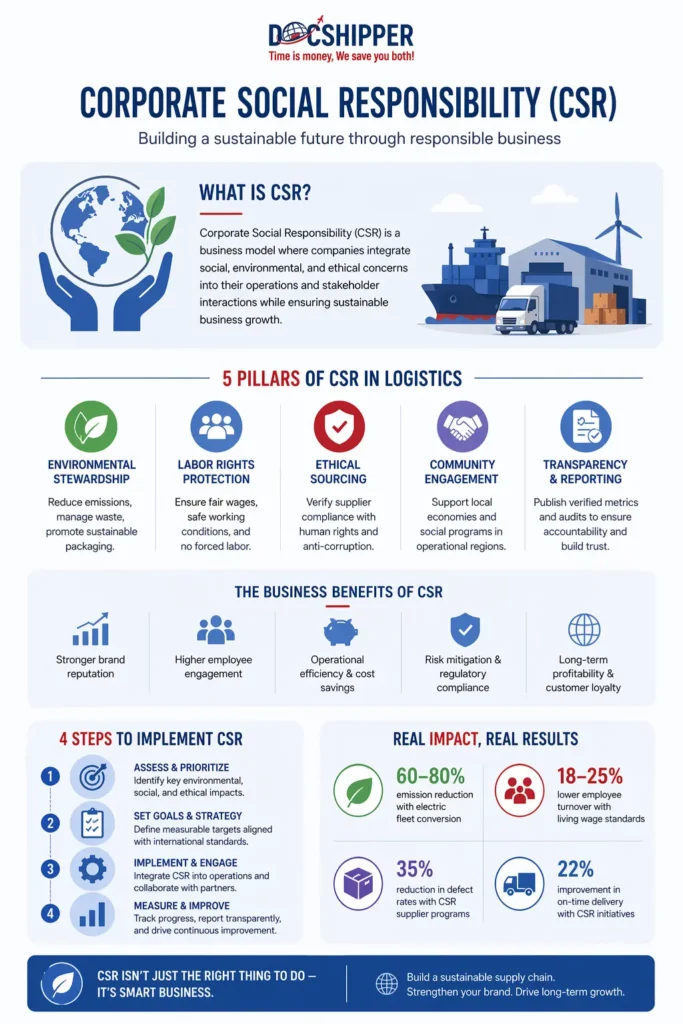
Corporate Social Responsibility (CSR) is a business model where companies integrate social, environmental, and ethical concerns into their operations and stakeholder interactions. It encompasses practices that benefit society while ensuring sustainable business growth, covering areas such as environmental protection, labor rights, ethical sourcing, and community engagement.Introduction
Many businesses struggle to balance profitability with ethical operations. The challenge intensifies in international logistics, where supply chains span multiple jurisdictions with varying labor laws, environmental regulations, and ethical standards. Corporate Social Responsibility addresses this complexity by establishing frameworks that align business success with positive societal impact.
In global trade and logistics, CSR has become a competitive differentiator. Customers, investors, and regulatory bodies increasingly demand transparency regarding environmental footprints, fair labor practices, and ethical sourcing. Companies that ignore CSR risk reputational damage, legal penalties, and loss of market access.
- Environmental stewardship: Reducing carbon emissions, waste management, and sustainable packaging in logistics operations
- Labor rights protection: Ensuring fair wages, safe working conditions, and no forced labor throughout the supply chain
- Ethical sourcing: Verifying supplier compliance with human rights standards and anti-corruption measures
- Community engagement: Supporting local economies and social programs in operational regions
- Transparency and reporting: Publishing verified CSR metrics and third-party audits to maintain accountability
CSR Framework & Strategic Implementation
Implementing effective CSR requires structured methodologies aligned with international standards. The ISO 26000 guideline provides comprehensive principles covering organizational governance, human rights, labor practices, environment, fair operating practices, consumer issues, and community involvement. Unlike certification standards, ISO 26000 offers guidance for integrating social responsibility into core business strategies.
The Global Reporting Initiative (GRI) establishes reporting frameworks that enable companies to disclose economic, environmental, and social impacts. GRI standards facilitate comparability across industries and geographies, making them essential for multinational logistics providers. According to the Global Reporting Initiative, over 10,000 organizations worldwide use GRI standards for sustainability reporting.
In logistics, carbon footprint measurement represents a critical CSR component. Companies calculate emissions across Scope 1 (direct operations), Scope 2 (purchased energy), and Scope 3 (supply chain activities). The Science Based Targets initiative (SBTi) provides methodologies for setting emission reduction targets aligned with climate science, ensuring commitments support limiting global warming to 1.5°C.
Supplier Code of Conduct programs establish minimum standards for business partners. These codes typically address child labor prohibition, workplace safety, environmental compliance, and anti-bribery measures. Regular audits verify adherence, with non-compliance triggering corrective action plans or contract termination. At DocShipper, we systematically verify supplier certifications and conduct due diligence to ensure our partners meet international CSR standards, protecting our clients from supply chain risks.
The circular economy model transforms traditional linear supply chains by designing out waste and pollution. In logistics, this involves reusable packaging systems, reverse logistics for product returns, and partnerships with recycling facilities. Companies adopting circular principles reduce resource consumption while creating new revenue streams from recovered materials.
Concrete Examples & Industry Data
Quantifiable CSR initiatives demonstrate measurable impact across logistics operations. The following comparative analysis illustrates how different approaches yield varying results:
| CSR Initiative | Investment Required | Environmental Impact | ROI Timeline |
|---|---|---|---|
| Electric Fleet Conversion | High (€150K-€300K per vehicle) | 60-80% emission reduction | 5-7 years |
| Route Optimization Software | Medium (€20K-€50K annually) | 15-25% fuel savings | 1-2 years |
| Reusable Packaging Systems | Medium (€30K-€80K setup) | 40-50% waste reduction | 2-3 years |
| Solar Warehouse Infrastructure | High (€100K-€500K) | 30-40% energy independence | 6-10 years |
| Ethical Supplier Audits | Low (€5K-€15K annually) | Risk mitigation (non-quantifiable) | Immediate compliance value |
Use Case: European Apparel Importer — A mid-sized fashion retailer importing from Southeast Asia implemented comprehensive CSR measures in 2021. They invested €120,000 in third-party factory audits, worker training programs, and environmental compliance upgrades at supplier facilities. Within 18 months, they documented a 35% reduction in defect rates, 22% improvement in on-time delivery, and achieved B Corp certification. Customer retention increased 14%, with surveys attributing improved brand perception directly to publicized CSR commitments.
Carbon Neutrality Pathway: Maritime shipping accounts for approximately 3% of global CO₂ emissions. A container shipping company transporting 500,000 TEUs annually generates roughly 1.5 million tons of CO₂. Achieving carbon neutrality requires combinations of fuel efficiency improvements (10-15% reduction), alternative fuels like LNG or methanol (20-30% reduction), and carbon offset programs for remaining emissions. Total investment ranges from €50-€80 million over five years, with regulatory compliance increasingly mandating such transitions under EU and IMO regulations.
Living Wage Implementation: Companies adopting living wage standards (versus minimum wage) in manufacturing regions report 18-25% lower employee turnover and 12-17% productivity gains. For a logistics provider employing 200 warehouse workers, upgrading from minimum wage (€10/hour) to living wage (€13.50/hour) costs approximately €1.4 million annually but reduces recruitment costs by €180,000 and improves operational efficiency worth an estimated €220,000.
Transparency Technology: Blockchain-enabled supply chain tracking allows end-to-end visibility of product origins, labor conditions, and environmental compliance. Implementation costs range from €40,000-€150,000 depending on complexity, but provides verifiable proof for CSR claims, increasingly required by major retailers and regulatory frameworks like the EU Corporate Sustainability Reporting Directive (CSRD).
Conclusion
Corporate Social Responsibility in logistics transcends regulatory compliance, representing strategic investments that enhance operational resilience, brand reputation, and long-term profitability. Companies integrating CSR into core business models position themselves advantageously in markets demanding ethical transparency and environmental accountability.
Need guidance implementing CSR frameworks in your international logistics operations? Contact DocShipper for expert consultation on sustainable supply chain management.
📚 Quiz
Test Your Knowledge: Corporate Social Responsibility (CSR)
1. What best describes Corporate Social Responsibility (CSR)?
2. A logistics company claims its CSR program is complete because it meets all local environmental regulations. Is this assessment correct?
3. A mid-sized freight forwarder wants to start implementing CSR with a limited budget. Which approach best reflects a practical, low-cost CSR entry point?
🎯 Your Result
📞 Free Quote in 24hFAQ | Corporate Social Responsibility (CSR): Definition, Implementation & Concrete Examples
CSR encompasses four primary pillars: environmental responsibility (reducing ecological impact), ethical labor practices (fair treatment of workers), philanthropic engagement (community support), and economic responsibility (sustainable profitability that benefits stakeholders).
Sustainability focuses specifically on environmental and resource longevity, while CSR is broader, including social equity, ethical governance, and stakeholder welfare. Sustainability is a critical component within the larger CSR framework.
Requirements vary by jurisdiction. The EU Corporate Sustainability Reporting Directive (CSRD) mandates CSR reporting for companies meeting size thresholds. Many countries enforce specific environmental and labor regulations that constitute CSR elements, though comprehensive CSR programs often exceed minimum legal requirements.
ROI varies by initiative but typically includes reduced operational costs (15-25% through efficiency gains), improved brand value (10-20% premium pricing capability), lower risk exposure (avoiding penalties and disruptions), and enhanced access to capital (ESG-focused investors).
Start with low-cost high-impact measures: route optimization software, digital documentation to reduce paper, energy-efficient warehouse lighting, supplier code of conduct agreements, and community engagement programs. These require minimal investment while demonstrating commitment to CSR principles.
Key certifications include B Corp (comprehensive social and environmental performance), ISO 14001 (environmental management), SA8000 (social accountability), Fair Trade certification, and industry-specific standards like Responsible Business Alliance (RBA) for electronics supply chains.
Many countries implement preferential tariffs for products meeting CSR criteria. The EU's Carbon Border Adjustment Mechanism (CBAM) will impose costs on high-emission imports. Documented CSR compliance facilitates smoother customs clearance and reduces scrutiny from regulatory authorities.
Scope 3 covers indirect emissions throughout the value chain, including supplier manufacturing, product transportation by third parties, employee commuting, and end-of-life product disposal. For logistics companies, Scope 3 typically represents 70-90% of total carbon footprint.
Yes. Diversified supplier relationships built on ethical standards reduce dependency risks. Environmental monitoring prevents disruptions from climate events. Fair labor practices decrease strikes and turnover. Companies with strong CSR programs recover 30-40% faster from supply chain disruptions.
Third-party audits, published sustainability reports following GRI standards, certification bodies, blockchain supply chain tracking, and regulatory filings provide verification. Greenwashing (false CSR claims) faces increasing legal penalties and reputational consequences.
Technology enables real-time monitoring of environmental metrics, automated compliance tracking, transparent supply chain visibility, AI-optimized logistics routes reducing emissions, and data analytics identifying CSR improvement opportunities. Digital tools reduce manual reporting costs by 40-60%.
Increasingly, shippers require freight forwarders to demonstrate CSR credentials through carbon reporting, ethical labor verification, and environmental certifications. Forwarders without documented CSR programs face exclusion from tenders, particularly from multinational corporations with strict sustainability procurement policies.
Need Help with
Logistics or Sourcing ?
First, we secure the right products from the right suppliers at the right price by managing the sourcing process from start to finish. Then, we simplify your shipping experience - from pickup to final delivery - ensuring any product, anywhere, is delivered at highly competitive prices.


Fill the Form
Prefer email? Send us your inquiry, and we’ll get back to you as soon as possible.
Contact us




