


In short ⚡
A date code is an alphanumeric marking printed on products or packaging that indicates manufacturing date, batch number, or expiration information. Essential for inventory management, quality control, and regulatory compliance, date codes enable precise product traceability throughout the international supply chain, ensuring freshness verification and facilitating recalls when necessary.
Introduction
Confusion between date codes, lot numbers, and expiration dates causes significant delays at customs checkpoints worldwide. Many importers mistakenly treat these identifiers interchangeably, leading to compliance failures.
In international logistics, date codes serve as critical tracking mechanisms. They enable manufacturers, distributors, and customs authorities to verify product authenticity and monitor shelf life across borders.
Key characteristics of date codes include:
- Manufacturing traceability: Links products to specific production batches
- Regulatory compliance: Meets FDA, EU, and international labeling requirements
- Quality assurance: Facilitates targeted recalls without disrupting entire inventories
- Inventory rotation: Enables FIFO (First In, First Out) warehouse management
- Customs verification: Proves product freshness for perishable goods clearance
Technical Expertise & Regulatory Framework
Date codes operate under multiple international standards. The ISO 8601 format (YYYY-MM-DD) provides universal readability, while industry-specific systems like Julian dating compress information into fewer characters.
Pharmaceutical products must comply with FDA serialization requirements, mandating unique identifiers that include production dates. Electronics manufacturers often use week-year codes (e.g., 2318 = 23rd week of 2018) for warranty tracking.
The GS1 Application Identifier (AI) system standardizes date code formatting in barcodes. AI (11) designates production date, while AI (17) indicates expiration. This standardization eliminates ambiguity during automated scanning at distribution centers.
Regulatory implications vary by product category. The EU requires “best before” dates on food products, while cosmetics mandate a Period After Opening (PAO) symbol. Misalignment between date code formats and destination country regulations triggers customs holds.
At DocShipper, we systematically verify date code compliance before shipment departure. Our pre-clearance audits identify formatting discrepancies that could delay customs release, ensuring your goods meet destination country labeling standards.
Batch–level traceability becomes critical during product recalls. Date codes enable manufacturers to isolate affected units without removing entire product lines from circulation. This precision minimizes financial losses and protects brand reputation.
Practical Examples & Data
Understanding date code formats prevents costly logistics errors. Different industries employ distinct encoding systems based on operational requirements.
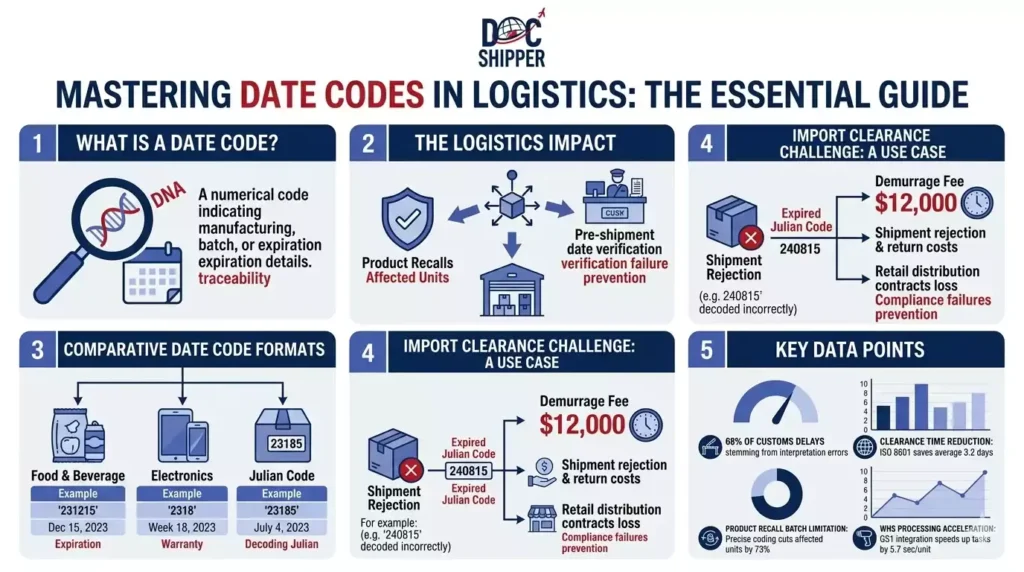
Comparative Date Code Formats
| Industry | Format Example | Decoding | Shelf Life Tracking |
|---|---|---|---|
| Food & Beverage | 231215 | December 15, 2023 | Explicit expiration date |
| Electronics | 2318 | Week 23, Year 2018 | Warranty calculation base |
| Pharmaceuticals | EXP 12/25 | Expires December 2025 | Regulatory compliance marker |
| Cosmetics | 38M01 | Batch 01, March 2018 | PAO symbol reference |
| Automotive Parts | 8C15 | March 15, 2018 (Julian) | Warranty claim validation |
Use Case: Import Clearance Challenge
A European importer received 5,000 units of canned goods with date code “240815.” Customs authorities interpreted this as August 15, 2024, flagging the shipment for exceeding the 18-month shelf life limit. The actual format was Julian (day 240 of 2015), meaning the products were expired.
The importer faced:
- €12,000 in demurrage fees (10 days port storage)
- Complete shipment rejection and return costs
- Loss of retail distribution contracts
This scenario illustrates why pre-shipment date code verification is non-negotiable. DocShipper’s quality control teams decode manufacturer markings before goods leave origin ports, preventing such compliance failures.
Key Data Points
- 68% of customs delays for perishable goods stem from date code interpretation errors
- ISO 8601 adoption reduces clearance time by average 3.2 days compared to proprietary formats
- Pharmaceutical recalls cost $8M on average; precise date coding limits affected batches by 73%
- FIFO inventory systems reduce waste by 41% when date codes are machine-readable
- GS1 barcode integration accelerates warehouse processing by 5.7 seconds per unit
Conclusion
Date codes function as the logistical DNA of products, enabling traceability and compliance across international borders. Mastering their formats and regulatory implications prevents costly clearance delays.
Need expert guidance on date code compliance for your shipments? Contact DocShipper for pre-clearance audits and regulatory consulting.
📚 Quiz
Test Your Knowledge: Date Code
Q1 — What is the primary purpose of a date code on a product or its packaging?
Q2 — A shipment of canned goods is marked with date code "240815." A customs officer interprets this as August 15, 2024. What is the key risk this scenario illustrates?
Q3 — An electronics manufacturer stamps its components with the code "2318." According to industry date code conventions, what does this marking indicate?
🎯 Your Result
📞 Free Quote in 24hFAQ | Date Code: Definition, Calculation & Practical Examples
A date code indicates manufacturing or batch information, while an expiration date specifies when a product becomes unsafe or ineffective. Date codes may require decoding; expiration dates are explicit.
Requirements vary by country and product category. Food, pharmaceuticals, and cosmetics typically require date markings, while non-perishable industrial goods may not. Check destination country regulations.
Julian codes use day-of-year numbering (001-365). For example, "23185" means day 185 of 2023 (July 4). The first digits indicate the year, followed by the day count.
While manufacturers have flexibility, customs authorities and retailers often require specific formats. GS1 standards and ISO 8601 ensure international compatibility and automated scanning.
Customs may hold or reject the shipment. Corrections require re-labeling at origin or destination, incurring storage fees, labor costs, and delivery delays. Prevention through pre-shipment audits is critical.
Yes, for warranty validation and component traceability. Many countries require manufacturing dates on electronics to combat counterfeit goods and ensure consumer protection compliance.
They must stay readable throughout the product's intended shelf life. Ink quality, label adhesion, and environmental resistance (moisture, temperature) affect longevity. Laser etching offers superior durability.
Yes. Fines range from $500 to $50,000 depending on jurisdiction and product type. Repeat violations can result in import bans or license revocations for serious compliance breaches.
Some countries permit post-production labeling if done before customs clearance. However, permanent marking (printing, embossing) is preferred and reduces tampering risks. Verify destination regulations first.
Lot numbers identify production batches for quality control. Date codes indicate timing. A product may have both: lot "A12345" and date code "230615." Together, they enable precise traceability.
Absolutely. Insurers require date codes to verify product age during damage claims. Missing or illegible codes can void coverage, as they prevent authentication of the goods' condition at shipment time.
Our quality control teams cross-reference manufacturer markings against destination country regulations before shipment. We decode formats, verify legibility, and ensure alignment with customs requirements to prevent clearance issues.
Need Help with
Logistics or Sourcing ?
First, we secure the right products from the right suppliers at the right price by managing the sourcing process from start to finish. Then, we simplify your shipping experience - from pickup to final delivery - ensuring any product, anywhere, is delivered at highly competitive prices.


Fill the Form
Prefer email? Send us your inquiry, and we’ll get back to you as soon as possible.
Contact us




