



In short ⚡
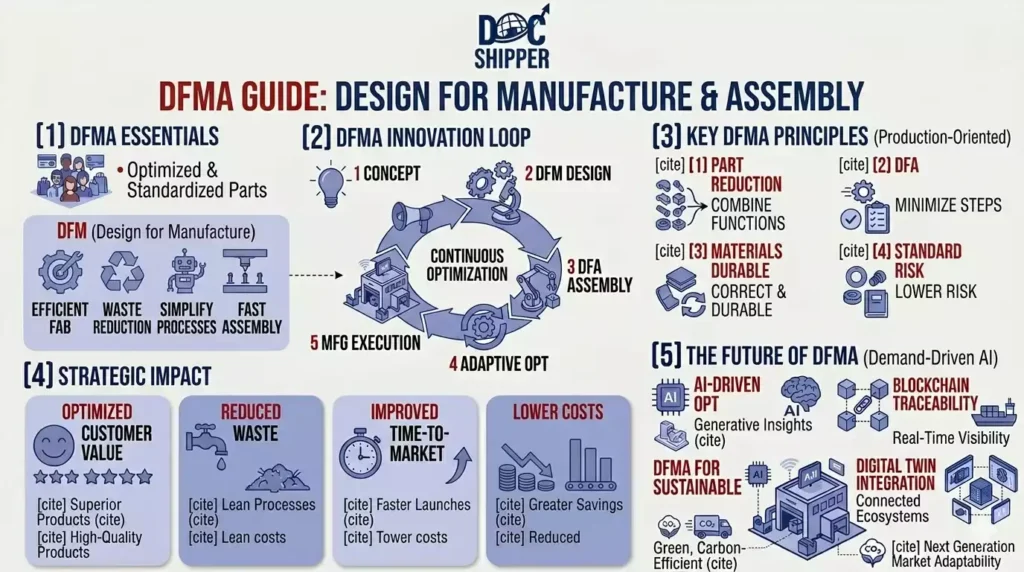
DFMA (Design for Manufacture and Assembly) is a systematic engineering methodology that optimizes product design to reduce manufacturing costs, simplify assembly processes, and improve overall production efficiency. It combines two complementary approaches: Design for Manufacture (DFM), which focuses on simplifying component fabrication, and Design for Assembly (DFA), which streamlines product assembly operations.
Introduction
Many companies struggle with excessive production costs, complex assembly procedures, and quality inconsistencies—problems that often originate at the design stage. When engineers design products without considering manufacturing constraints, the result is costly tooling, extended lead times, and logistical complications during international shipping.
DFMA addresses these challenges by integrating manufacturing and assembly considerations directly into the product development process. This approach is particularly critical in global supply chains where design decisions impact sourcing strategies, freight costs, and customs compliance.
- Cost reduction: Eliminates unnecessary components and simplifies manufacturing processes
- Quality improvement: Reduces assembly errors and manufacturing defects
- Supply chain optimization: Facilitates supplier selection and procurement strategies
- Time-to-market acceleration: Shortens development cycles and production ramp-up
- Logistics efficiency: Simplifies packaging, handling, and international transportation
DFMA Methodology & Technical Expertise
The DFMA methodology operates through two integrated phases that work synergistically to optimize product design. Design for Manufacture focuses on individual component production, while Design for Assembly concentrates on how these components fit together efficiently.
Design for Manufacture (DFM) analyzes each component’s fabrication process. Engineers evaluate material selection, manufacturing processes (injection molding, CNC machining, stamping), and production tolerances. The goal is selecting processes that minimize tooling costs and production complexity while maintaining quality standards. Common DFM principles include minimizing part count, standardizing materials, and designing for common manufacturing processes.
Design for Assembly (DFA) systematically reduces assembly operations and simplifies product structure. This involves analyzing insertion directions, fastener types, and assembly sequence. The Boothroyd-Dewhurst method, the most widely recognized DFA framework, assigns efficiency ratings to different assembly operations and guides designers toward optimal configurations.
The implementation process typically follows these stages: initial design review, component analysis, assembly evaluation, cost-benefit calculation, and redesign iteration. Cross-functional teams including design engineers, manufacturing specialists, and supply chain professionals collaborate throughout this process. According to the National Institute of Standards and Technology (NIST), companies implementing structured DFMA programs achieve 30-50% cost reductions on average.
International logistics implications are significant. Simplified designs reduce packaging complexity, lower shipping weights, and minimize customs classification disputes. Standardized components facilitate global sourcing and reduce inventory carrying costs across multiple distribution centers.
At DocShipper, we integrate DFMA principles into our sourcing consultations, helping clients identify manufacturers capable of producing optimized designs while ensuring compliance with international shipping regulations and customs requirements.
Practical Examples & Industry Data
Real-world applications demonstrate DFMA’s transformative impact across industries. The methodology delivers measurable improvements in cost, quality, and production efficiency when properly implemented.
Comparative Analysis: Before vs. After DFMA Implementation
| Metric | Before DFMA | After DFMA | Improvement |
|---|---|---|---|
| Part Count | 150 components | 68 components | 55% reduction |
| Assembly Time | 45 minutes | 18 minutes | 60% reduction |
| Manufacturing Cost | $87 per unit | $41 per unit | 53% reduction |
| Defect Rate | 4.2% | 0.8% | 81% reduction |
| Shipping Weight | 12.4 kg | 8.1 kg | 35% reduction |
Industry Case Study: Consumer Electronics Manufacturer
A European electronics company redesigning a wireless speaker system applied DFMA principles with remarkable results. The original design contained 142 unique parts requiring 23 different fastener types and 38 assembly steps. The DFMA analysis identified opportunities for part consolidation and assembly simplification.
The redesigned product featured 61 components (57% reduction), used only 4 fastener types, and required 14 assembly steps. Manufacturing costs decreased from €52 to €23 per unit. More significantly for international logistics, the simplified design reduced packaging volume by 40% and shipping weight by 32%, directly lowering freight costs and carbon footprint.
Key Success Factors
- Early integration: Applying DFMA during conceptual design phases yields 10x greater savings than post-design modifications
- Cross-functional collaboration: Teams including design, manufacturing, procurement, and logistics ensure comprehensive optimization
- Supplier involvement: Early manufacturer engagement identifies production constraints and cost-saving opportunities
- Iterative refinement: Multiple design cycles with continuous evaluation produce optimal results
- Quantitative metrics: Tracking specific KPIs (assembly time, part count, cost per unit) validates improvements and guides decisions
Conclusion
DFMA represents a fundamental shift from traditional sequential design processes to integrated product development that considers manufacturing and assembly from the outset. This methodology delivers substantial cost savings, quality improvements, and supply chain efficiencies that directly impact international logistics operations.
Need guidance on implementing DFMA principles in your product development or sourcing strategy? Contact DocShipper for expert consultation on optimizing designs for global manufacturing and logistics.
📚 Quiz
Test Your Knowledge: DFMA
1. What does DFMA stand for, and what is its primary purpose?
2. A common misconception about DFMA is that simplifying a product's design compromises its quality or functionality. What does the methodology actually state?
3. A European electronics company applies DFMA to a wireless speaker. The original design had 142 parts, 23 fastener types, and 38 assembly steps. After DFMA, which outcome best reflects the real-world results described in the article?
🎯 Your Result
📞 Free Quote in 24hFAQ | DFMA (Design for Manufacture and Assembly): Definition, Methodology & Real-World Examples
DFM (Design for Manufacture) focuses on simplifying individual component production processes, material selection, and fabrication methods. DFA (Design for Assembly) concentrates on reducing assembly operations, simplifying product structure, and minimizing assembly time. Together, they form the comprehensive DFMA methodology.
DFMA delivers maximum value when applied during early conceptual and detailed design phases. Implementing DFMA principles before finalizing designs allows fundamental structural changes that yield significant cost savings. Post-design DFMA applications still provide benefits but with limited optimization potential.
DFMA reduces costs through part count reduction, simplified assembly processes, standardized components, optimized material selection, reduced tooling requirements, and minimized quality defects. These improvements lower labor costs, material expenses, inventory carrying costs, and scrap rates throughout production.
While applicable across all manufacturing sectors, DFMA delivers particularly strong results in consumer electronics, automotive, aerospace, medical devices, and industrial equipment. High-volume production environments with complex assemblies typically see the most dramatic cost reductions and efficiency gains.
Properly implemented DFMA improves quality by reducing assembly errors, minimizing part variations, and simplifying manufacturing processes. The methodology focuses on eliminating unnecessary complexity while maintaining or enhancing functional performance. Design simplification typically increases reliability and reduces failure modes.
Popular DFMA software includes Boothroyd Dewhurst DFM/DFA software, aPriori, Siemens Teamcenter Manufacturing, and Autodesk Fusion 360 with manufacturing extensions. These tools provide cost estimation, assembly analysis, and design optimization recommendations based on manufacturing process databases.
DFMA timeline varies by product complexity. Simple products may require 2-4 weeks for initial analysis and redesign. Complex assemblies with hundreds of components might need 3-6 months for comprehensive optimization. Iterative refinement continues throughout product development cycles.
Yes, DFMA principles can improve existing products through value engineering and cost reduction initiatives. While redesigning established products offers less optimization potential than new designs, companies frequently achieve 15-30% cost reductions on mature products through systematic DFMA reviews.
Most companies achieve positive ROI within the first production year. Initial DFMA investments (training, software, consulting) typically range from $50,000-$200,000, while annual savings often exceed $500,000-$2,000,000 for medium-volume products. High-volume products deliver even more substantial returns.
DFMA simplifies global sourcing by standardizing components, reducing supplier complexity, and facilitating manufacturing process selection. Optimized designs allow greater supplier flexibility, reduce quality variation between manufacturers, and simplify logistics coordination across international supply chains.
Successful DFMA implementation requires mechanical design expertise, manufacturing process knowledge, cost estimation capabilities, and cross-functional collaboration skills. Teams benefit from formal DFMA training, hands-on manufacturing experience, and understanding of supply chain dynamics including procurement and logistics considerations.
DFMA and lean manufacturing share common objectives of waste elimination and efficiency improvement. DFMA addresses design-level optimization while lean focuses on process-level improvements. Combining both methodologies creates comprehensive optimization from product conception through manufacturing execution and delivery.
Need Help with
Logistics or Sourcing ?
First, we secure the right products from the right suppliers at the right price by managing the sourcing process from start to finish. Then, we simplify your shipping experience - from pickup to final delivery - ensuring any product, anywhere, is delivered at highly competitive prices.


Fill the Form
Prefer email? Send us your inquiry, and we’ll get back to you as soon as possible.
Contact us




:%20Definition,%20Methodology%20&%20Real-World%20Examples)