


In short ⚡
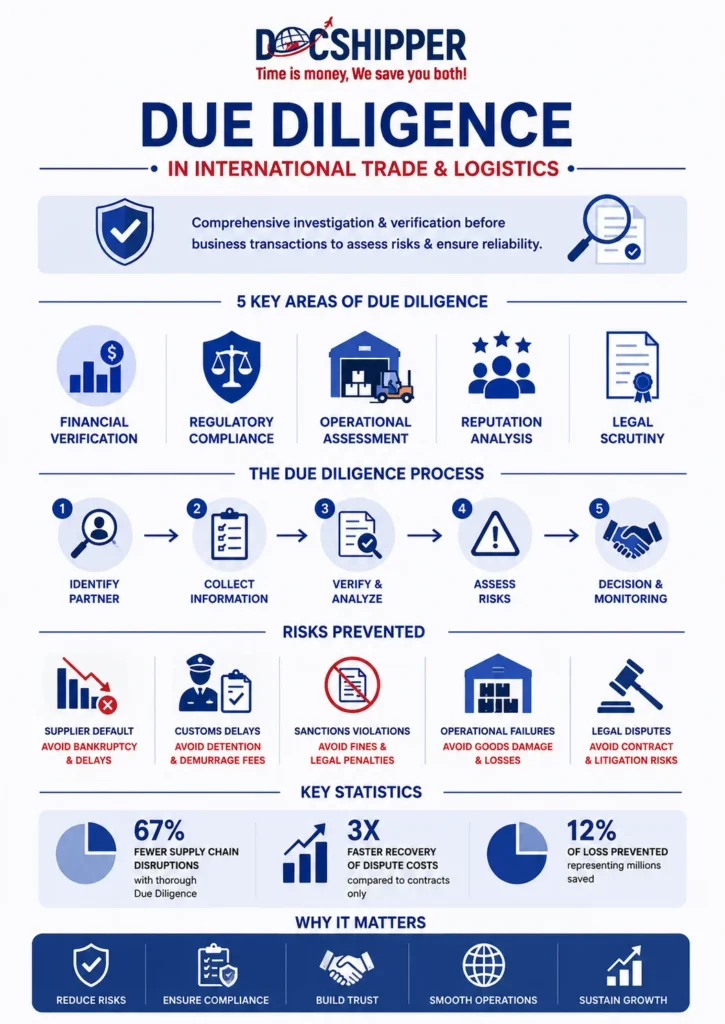
Due Diligence is the comprehensive investigation and verification process conducted before entering into a business transaction, partnership, or contractual agreement. In international trade and logistics, it involves assessing the reliability, financial stability, legal compliance, and operational capabilities of suppliers, freight forwarders, customs brokers, and trading partners to mitigate risks and ensure smooth operations.Introduction
Imagine partnering with an overseas supplier only to discover they have unpaid debts, unresolved legal disputes, or poor track records. Such oversights cost businesses millions annually in disrupted supply chains and contractual breaches.
Due Diligence has become indispensable in international logistics. It protects companies from fraudulent partners, regulatory violations, and operational failures that could paralyze import-export activities.
Key characteristics of effective Due Diligence in logistics include:
- Financial verification: Assessing creditworthiness and financial health of business partners
- Regulatory compliance: Confirming adherence to customs regulations, trade sanctions, and export controls
- Operational assessment: Evaluating infrastructure, capacity, and service reliability
- Reputation analysis: Investigating past performance, customer reviews, and industry standing
- Legal scrutiny: Reviewing contracts, licenses, certifications, and pending litigations
In cross-border trade, thorough Due Diligence prevents costly delays, ensures compliance with international laws, and establishes trustworthy partnerships that sustain long-term business growth.
In-Depth Analysis & Expertise
Due Diligence in international logistics extends beyond simple background checks. It encompasses multi-layered verification across financial, legal, operational, and reputational dimensions.
Financial Due Diligence involves analyzing balance sheets, profit-loss statements, and cash flow patterns. Companies must verify whether potential partners have adequate liquidity to fulfill contractual obligations without sudden bankruptcies disrupting shipments.
Regulatory Due Diligence is critical for compliance with customs authorities. This includes verifying AEO (Authorized Economic Operator) certifications, export licenses, and screening against international sanctions lists maintained by entities like the U.S. Office of Foreign Assets Control (OFAC) and the European Union.
Operational Due Diligence assesses warehouse capacity, transportation networks, and technological infrastructure. A freight forwarder lacking modern tracking systems or adequate storage facilities may compromise delivery timelines and cargo safety.
Reputational Due Diligence examines industry feedback, dispute histories, and service quality metrics. Platforms like trade associations and online logistics directories provide valuable insights into partner reliability.
At DocShipper, we systematically conduct Due Diligence on all partners in our global network, ensuring every supplier, carrier, and customs broker meets stringent reliability standards before being integrated into client supply chains. This proactive approach minimizes disruptions and protects against unforeseen operational failures.
Concrete Examples & Data
Understanding Due Diligence through real-world scenarios clarifies its practical importance. Consider these comparative situations:
| Scenario | Without Due Diligence | With Due Diligence |
|---|---|---|
| Supplier Selection | Company selects cheapest supplier; supplier goes bankrupt mid-contract, leaving 50 containers stranded | Financial analysis reveals instability; company chooses more reliable alternative, avoiding disruption |
| Freight Forwarder Partnership | Forwarder lacks proper customs certifications; shipment detained for 3 weeks, incurring €15,000 in demurrage fees | Verification confirms AEO status and compliance history; smooth customs clearance in 48 hours |
| Sanctions Compliance | Business unknowingly partners with sanctioned entity; faces $500,000 fine and license suspension | Screening identifies sanctions risk; partnership avoided, legal compliance maintained |
| Warehouse Capacity | Partner lacks adequate storage; goods left exposed to weather, resulting in €30,000 damage claim | Site inspection confirms climate-controlled facilities meeting pharmaceutical storage standards |
Use Case: Electronics Importer from China
A European electronics retailer planned to import €2 million worth of consumer electronics from a new Chinese manufacturer offering prices 20% below market rates.
During Due Diligence, investigators discovered:
- The manufacturer had been operational for only 8 months with no verifiable export history
- Business registration documents contained inconsistencies
- No quality certifications (CE, RoHS) could be independently verified
- Previous company at the same address had dissolved following fraud allegations
- No financial records or bank references were available
The retailer terminated negotiations, avoiding potential fraud. Later investigations revealed the entity was indeed fraudulent, with 15 European companies collectively losing over €8 million to the same scheme.
According to a 2023 International Trade Centre report, companies conducting comprehensive Due Diligence experience 67% fewer supply chain disruptions and recover dispute costs 3 times faster than those relying solely on contractual terms.
Conclusion
Due Diligence is not merely a precautionary measure—it is a strategic imperative in international trade. Thorough investigation of partners protects investments, ensures regulatory compliance, and builds resilient supply chains capable of withstanding market volatility.
Need expert assistance conducting Due Diligence on your logistics partners? Contact DocShipper for comprehensive partner verification and risk assessment services tailored to your international trade operations.
📚 Quiz
Test Your Knowledge: Due Diligence
1. What is the primary purpose of Due Diligence in international logistics?
2. A common misconception about Due Diligence is that it can be replaced by:
3. An electronics importer discovers during Due Diligence that a Chinese supplier offering 20% below-market prices has inconsistent registration documents and no verifiable export history. The correct action is to:
🎯 Your Result
📞 Free Personalized QuoteFAQ | Due Diligence: Definition, Process & Concrete Examples in International Trade
Due Diligence timelines vary based on complexity and geographic scope. Basic partner verification typically requires 5-10 business days, while comprehensive financial and operational assessments may take 3-6 weeks. Rush Due Diligence for time-sensitive deals can be completed in 48-72 hours with premium services, though thoroughness may be somewhat compromised.
Costs range from €500-€2,000 for basic supplier verification to €5,000-€15,000 for comprehensive multi-jurisdictional assessments. Many logistics providers like DocShipper include preliminary Due Diligence as part of their service packages. For small importers, prioritizing financial and regulatory verification delivers the best risk-to-cost ratio.
Online reviews provide supplementary insights but should never constitute the sole Due Diligence method. Reviews can be manipulated, and critical financial or legal issues rarely appear in public feedback. Professional Due Diligence combines independent financial analysis, regulatory database checks, and direct verification of certifications and licenses.
Essential documents include: business registration certificates, tax identification numbers, export licenses, financial statements (2-3 years), bank references, quality certifications (ISO, CE, FDA as applicable), insurance policies, references from existing clients, and proof of physical address. For manufacturing suppliers, add factory audit reports and compliance certifications specific to your industry.
Annual Due Diligence reviews are recommended for strategic partners handling significant volumes. Trigger immediate re-assessment if partners undergo ownership changes, relocate facilities, experience financial difficulties, or if your industry faces new regulatory requirements. Continuous monitoring of sanctions lists should occur with each transaction.
Warning signs include reluctance to provide documentation, inconsistent information across sources, recently established companies with no track record, absence of professional certifications, lack of physical infrastructure, pressure for upfront payments without proper guarantees, and unwillingness to accept third-party inspections or audits.
While not universally mandated, Due Diligence is legally required in specific contexts: sanctions compliance (U.S., EU regulations), anti-money laundering protocols, Conflict Minerals reporting (Dodd-Frank Act), and Modern Slavery Act compliance (UK). Even absent legal requirements, negligent partner selection can result in liability for damages, making Due Diligence a legal safeguard.
Supplier Due Diligence emphasizes product quality, manufacturing capacity, and financial stability. Freight forwarder Due Diligence focuses on regulatory compliance (customs certifications), operational infrastructure (tracking systems, warehouse facilities), insurance coverage, and geographic network capabilities. Both require financial verification, but operational metrics differ significantly.
Yes, through tiered approaches. Small businesses should prioritize regulatory compliance verification and basic financial checks (€500-€1,500 range). Many trade associations offer subsidized Due Diligence resources for members. Alternatively, partial Due Diligence on highest-risk elements (payment terms, sanctions screening) provides cost-effective protection for limited budgets.
Technology accelerates Due Diligence through automated sanctions screening, AI-powered financial analysis, blockchain-verified certifications, and real-time data aggregation from public registries. Platforms integrate multiple data sources, reducing manual research time by 60-70%. However, technology should complement—not replace—human expertise in interpreting complex legal or contextual factors.
Independent verification methods include: requesting notarized documents authenticated by local embassies, hiring local investigation agencies in the partner's jurisdiction, cross-referencing business registries and court records, conducting site visits or commissioning third-party audits, and requesting bank confirmation letters directly from financial institutions rather than accepting partner-provided statements.
When issues surface, companies have several options: negotiate risk mitigation measures (escrow payments, performance bonds, increased insurance), request corrective actions with verification timelines, structure contracts with enhanced protections, or terminate discussions and seek alternative partners. The severity of findings determines the appropriate response—minor administrative issues may be resolvable, while financial instability or fraud indicators typically warrant partnership termination.
Need Help with
Logistics or Sourcing ?
First, we secure the right products from the right suppliers at the right price by managing the sourcing process from start to finish. Then, we simplify your shipping experience - from pickup to final delivery - ensuring any product, anywhere, is delivered at highly competitive prices.


Fill the Form
Prefer email? Send us your inquiry, and we’ll get back to you as soon as possible.
Contact us




