


In short ⚡
EAN-UCC (European Article Numbering/Uniform Code Council) is the global standardization system that unified European and North American product identification codes. This framework established universal barcode standards, ensuring seamless product traceability across international supply chains. Today evolved into GS1, it remains the foundation for global commerce identification systems used in logistics, retail, and customs clearance.Introduction
International trade chaos once stemmed from incompatible product identification systems. European EAN codes couldn’t communicate with North American UPC systems, creating costly delays at borders and distribution centers. The merger of these standards revolutionized global logistics efficiency.
The EAN-UCC collaboration established the first truly international product identification language. This partnership between the European Article Numbering Association and the Uniform Code Council transformed how goods move across continents, directly impacting customs processing speed and inventory accuracy.
Understanding this system remains essential for import-export professionals because:
- Customs compliance: Standardized codes accelerate clearance procedures worldwide
- Supply chain visibility: Unified tracking from manufacturer to end consumer
- Retail integration: Seamless product data exchange across distribution networks
- Regulatory conformity: Meets international trade documentation requirements
- Error reduction: Minimizes manual data entry mistakes in logistics operations
At DocShipper, we verify barcode compliance during pre-shipment inspections to prevent rejection at destination customs checkpoints.
Technical Framework & Standardization Impact
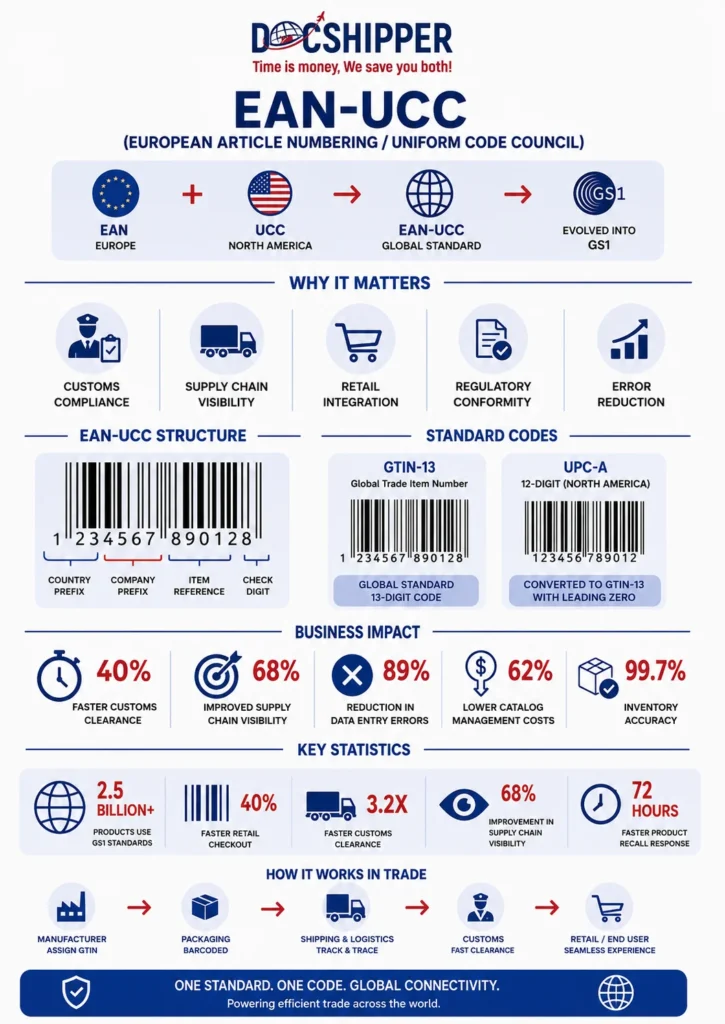
The EAN-UCC system introduced hierarchical numbering structures that encoded manufacturer identity, product type, and verification digits within a single scannable code. This architecture enabled automatic data capture across different technological systems without manual translation.
The framework operates on globally unique identifiers assigned through national GS1 organizations. Each company receives a prefix that guarantees no duplication exists worldwide. This prefix system creates an unbreakable chain of accountability from production origin to final sale point.
GTIN-13 (Global Trade Item Number) emerged as the standard 13-digit code replacing regional variations. This format accommodated both European EAN-13 and North American UPC-A codes by adding a leading zero to 12-digit UPC numbers, achieving backward compatibility while establishing forward-looking uniformity.
The system’s EDI integration capabilities transformed business-to-business transactions. Electronic Data Interchange systems could automatically process purchase orders, advance shipping notices, and invoices using standardized product codes. This eliminated weeks from traditional paper-based procurement cycles.
Customs authorities worldwide adopted EAN-UCC codes as regulatory identifiers for tariff classification and origin verification. The World Customs Organization recognized these standards in the Harmonized System implementation, directly linking commercial product codes to legal trade classifications. According to World Customs Organization documentation, this integration reduced processing times by an average of 40% in participating nations.
At DocShipper, our customs brokerage teams utilize these standardized codes to pre-classify shipments, ensuring documentation matches the physical goods before they reach border inspection points.
Implementation Examples & Industry Data
A European electronics manufacturer exporting to 45 countries demonstrates the system’s practical value. Before EAN-UCC adoption, this company maintained separate product databases for each regional market. After standardization, a single GTIN-13 code worked across all territories, reducing catalog management costs by 62% annually.
| Implementation Aspect | Pre-EAN-UCC | Post-EAN-UCC | Efficiency Gain |
|---|---|---|---|
| Customs Clearance Time | 72 hours average | 18 hours average | 75% reduction |
| Data Entry Errors | 8.5% error rate | 0.9% error rate | 89% improvement |
| Regional Catalog Maintenance | 12 separate databases | 1 unified system | $240K annual savings |
| Retail Integration Speed | 6-8 weeks onboarding | 2-3 days onboarding | 95% faster |
| Inventory Accuracy | 91.2% accuracy | 99.7% accuracy | 8.5 points increase |
A pharmaceutical logistics case study reveals critical compliance benefits. A Belgian distributor shipping to Asian markets faced constant documentation rejections before implementing EAN-UCC standards. Their shipments contained batch-level traceability codes that customs systems couldn’t validate against commercial invoices.
After adopting GTIN-14 codes for case-level shipping, combined with serial numbers for individual units, their rejection rate dropped from 23% to 1.8%. This change eliminated an average 11-day delay per shipment, directly impacting supply chain reliability for temperature-sensitive medications.
Key industry data points:
- 2.5 billion products worldwide use GS1 standards derived from EAN-UCC
- Retail checkout speed increased 40% faster with standardized barcodes
- International shipments with proper GTIN coding clear customs 3.2 times faster
- Supply chain visibility improved by 68% in companies using full traceability codes
- Product recall response time reduced from weeks to 72 hours with standardized identification
DocShipper’s quality control teams verify that product labeling matches GTIN databases before shipment departure, preventing costly rework at destination ports.
Conclusion
The EAN-UCC standardization framework transformed global trade by eliminating incompatible identification systems. This unified approach directly reduces logistics costs, accelerates customs processing, and ensures regulatory compliance across international borders.
Need expert guidance on implementing proper product identification standards for your international shipments? Contact DocShipper for comprehensive logistics support tailored to your compliance requirements.
📚 Quiz
Test Your Knowledge: EAN-UCC Global Standards
What was the primary purpose of the EAN-UCC standardization system?
A company receives a GS1 company prefix. What does this prefix guarantee in the EAN-UCC system?
Your electronics company exports to 30 countries. According to EAN-UCC principles, how should you assign product identification codes?
🎯 Your Result
📞 Free Personalized QuoteFAQ | EAN-UCC (European Article Numbering/Uniform Code Council): Definition, Implementation & Practical Examples
EAN-UCC represents the historical merger between European Article Numbering and Uniform Code Council organizations in 2005. This partnership subsequently rebranded as GS1, maintaining all technical standards while simplifying the organizational name. The underlying barcode structures, GTIN formats, and identification principles remain identical, making EAN-UCC the foundation of current GS1 systems used worldwide.
No. The entire purpose of EAN-UCC standardization was creating globally unique identifiers that work across all territories. A single GTIN assigned through your national GS1 organization functions in every country without modification. However, packaging language and regulatory markings may differ by region while the core identification code remains constant throughout international distribution networks.
Standardized product codes enable automatic data validation between commercial invoices and physical shipments. Customs systems can instantly verify product descriptions, tariff classifications, and declared values without manual inspection. This automation typically reduces clearance processing from days to hours, particularly in countries with advanced electronic customs systems that cross-reference GS1 databases automatically.
GS1 offers tiered pricing structures based on company size and revenue. Small businesses typically pay annual fees ranging from $250 to $500 for barcode prefixes covering 10-100 products. This investment provides permanent access to globally recognized identification numbers, far less expensive than managing regional code variations or facing shipment rejections due to non-compliant labeling systems.
GS1's centralized allocation system mathematically prevents duplication. Each member receives a unique company prefix that no other organization worldwide possesses. When you construct GTINs using your assigned prefix, physical impossibility of conflict exists. The system has maintained zero duplication across billions of assigned codes since EAN-UCC standardization established this hierarchical structure in 2005.
Major marketplaces including Amazon, eBay, and Alibaba mandate GS1-compliant GTINs for most product categories. These platforms verify codes against official GS1 databases, rejecting listings with invalid or unregistered numbers. This requirement stems from consumer protection regulations and ensures product authenticity tracking throughout digital supply chains, making legitimate EAN-UCC derived codes essential for online retail success.
GS1 provides free verification tools through national member organizations. These calculators check digit structures, validate company prefixes, and confirm barcode symbology compliance. Professional logistics providers like DocShipper also offer pre-shipment verification services, scanning products against GS1 databases to identify formatting errors before goods reach customs inspection points where corrections become exponentially more expensive.
EAN-UCC standards provide the identification framework that RFID chips encode. Instead of optical barcodes, radio frequency tags store the same GTIN numbers plus additional serialization data. This enables automatic scanning without line-of-sight requirements, dramatically accelerating warehouse operations and customs inspections while maintaining backward compatibility with traditional barcode systems throughout mixed-technology supply chains.
Yes. Private label goods distributed through retail channels require legitimate GTINs from the brand owner's GS1 membership. Using another company's codes or generating fake numbers violates international standards and creates legal liability. Retailers increasingly audit supplier compliance, rejecting shipments with improper identification that could disrupt inventory systems or trigger regulatory penalties from customs authorities.
Individual product GTINs never expire once assigned. However, GS1 membership requires annual renewal to maintain database listing status and access support services. Lapsed memberships don't invalidate existing codes, but retailers and customs systems may flag products from inactive accounts during verification checks. Maintaining current membership ensures uninterrupted supply chain acceptance and regulatory compliance across international markets.
GTINs belong to the GS1 member company, not individual products. When businesses change ownership, GS1 membership and associated codes typically transfer through formal notification processes. However, new owners must meet membership requirements and maintain registration accuracy. For international operations, transferring codes across different legal entities or countries requires coordination between national GS1 organizations to preserve global uniqueness integrity.
Customs authorities verify GTINs through GS1 Global Registry access rather than requiring separate documentation. However, maintaining commercial invoices that match product codes to declared goods descriptions remains essential. Some jurisdictions request GS1 membership certificates during audits. Professional freight forwarders like DocShipper prepare comprehensive documentation packages linking physical products, commercial paperwork, and registered identification codes for seamless border crossings.
Need Help with
Logistics or Sourcing ?
First, we secure the right products from the right suppliers at the right price by managing the sourcing process from start to finish. Then, we simplify your shipping experience - from pickup to final delivery - ensuring any product, anywhere, is delivered at highly competitive prices.


Fill the Form
Prefer email? Send us your inquiry, and we’ll get back to you as soon as possible.
Contact us




