


In short ⚡
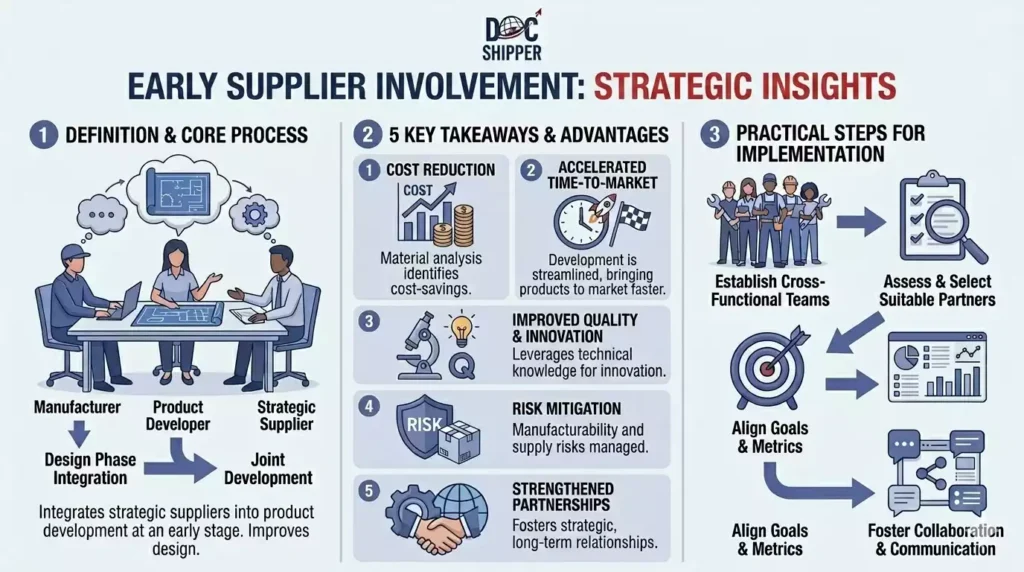
Early Supplier Involvement (ESI) is a collaborative procurement strategy where suppliers are integrated into the product development process at the earliest stages. This approach leverages supplier expertise in design, materials, and manufacturing to reduce costs, accelerate time-to-market, and improve product quality through shared innovation and technical knowledge.
Introduction
Many companies discover costly design flaws or manufacturing inefficiencies only after finalizing product specifications—when modifications become expensive and time-consuming. This reactive approach increases procurement costs and delays market entry.
Early Supplier Involvement transforms this paradigm by integrating suppliers as strategic partners from the concept phase. In international supply chains, where complexity multiplies across borders, ESI becomes essential for optimizing logistics, compliance, and production feasibility.
The strategic advantages of ESI include:
- Design optimization: Suppliers contribute technical expertise on materials, tolerances, and manufacturability before specifications are locked.
- Cost reduction: Early identification of expensive components or processes enables value engineering without compromising quality.
- Risk mitigation: Suppliers assess regulatory compliance, customs requirements, and supply chain vulnerabilities during planning.
- Innovation acceleration: Collaborative R&D leverages supplier knowledge of emerging technologies and alternative solutions.
- Time-to-market compression: Parallel development reduces sequential delays between design approval and production readiness.
Strategic Framework & Implementation
Successful ESI requires structured integration beyond traditional transactional relationships. The process begins with supplier selection criteria that prioritize technical capability, collaborative culture, and strategic alignment over price alone.
The ESI framework typically follows five phases. Pre-development engagement establishes confidentiality agreements and defines collaboration scope. During concept development, suppliers provide technical input on feasibility, materials, and cost implications. The design phase involves joint problem-solving through value analysis and design-for-manufacturing workshops.
Cross-functional teams are essential—procurement, engineering, quality, and logistics must participate alongside supplier representatives. Regular design reviews ensure alignment and rapid issue resolution. At DocShipper, we facilitate these multi-stakeholder collaborations by coordinating communication between international suppliers and client teams across time zones and technical languages.
Legal and intellectual property frameworks must be established early. Non-disclosure agreements, joint development contracts, and clear IP ownership terms protect both parties. The European Commission’s guidelines on collaborative innovation provide useful frameworks for structuring these relationships (see EC Industrial Strategy).
Performance measurement is critical. Key metrics include design cycle time reduction, cost savings achieved, defect rates, supplier-generated innovations, and time-to-production. These quantifiable outcomes justify the investment in deeper supplier relationships and guide continuous improvement.
Practical Cases & Performance Data
Industry data demonstrates ESI’s tangible impact. Studies show companies implementing ESI achieve 15-30% cost reductions through design optimization and reduce development time by 20-40% compared to traditional sequential approaches.
Automotive Industry Case Study
A European automotive manufacturer engaged a tier-1 supplier during the concept phase of a new electric vehicle battery housing. The supplier recommended switching from aluminum die-casting to composite materials based on their advanced materials expertise.
Results achieved:
- Component weight reduced by 22%, improving vehicle range
- Manufacturing costs decreased by 18% through simplified assembly
- Development timeline shortened by 6 months
- Improved thermal management performance identified through supplier testing
Consumer Electronics Implementation
A technology company developing a new product line involved Asian component suppliers from the industrial design phase. Suppliers provided input on miniaturization techniques, supply chain constraints, and customs classification implications for multi-region launches.
| Metric | Without ESI | With ESI | Improvement |
|---|---|---|---|
| Design Iterations | 7 cycles | 3 cycles | 57% reduction |
| Prototype to Production | 14 months | 9 months | 36% faster |
| Unit Manufacturing Cost | $87 | $68 | 22% savings |
| Quality Issues (first year) | 127 incidents | 34 incidents | 73% reduction |
| Supplier-Led Innovations | 0 | 12 implemented | New capability |
The international logistics dimension proved particularly valuable. Supplier knowledge of harmonized system codes and regional certification requirements prevented costly compliance delays. DocShipper integrates this regulatory expertise into ESI engagements, ensuring designs accommodate customs requirements, packaging regulations, and import restrictions across target markets.
Critical Success Factors
Analysis of successful ESI implementations reveals five common elements:
- Executive sponsorship: Leadership commitment to collaborative rather than adversarial supplier relationships
- Transparent cost modeling: Shared understanding of cost drivers and margin expectations
- Structured communication: Regular touchpoints with clear agendas and decision-making authority
- Technology enablement: Collaborative platforms for design sharing, version control, and change management
- Long-term orientation: Multi-year commitments that justify supplier investment in joint development
Conclusion
Early Supplier Involvement transforms procurement from a transactional function into a strategic innovation driver. The documented benefits—cost reduction, faster development, improved quality, and enhanced innovation—make ESI essential for companies competing in global markets. Success requires cultural commitment to partnership, structured processes, and appropriate legal frameworks.
Need guidance on implementing ESI in your international supply chain? Contact DocShipper to discuss how we can facilitate supplier collaboration across borders.
📚 Quiz
Test Your Knowledge: Early Supplier Involvement (ESI)
1. What is the primary objective of Early Supplier Involvement?
2. A common misconception about ESI is that it always requires single-sourcing. What is the correct approach?
3. In which scenario would Early Supplier Involvement deliver the greatest value?
🎯 Your Result
📞 Free Quote in 24hFAQ | Early Supplier Involvement (ESI): Definition, Benefits & Practical Implementation
ESI delivers maximum value for complex products with significant manufacturing content, custom components, or innovative features. Industries like automotive, aerospace, electronics, and medical devices see substantial benefits. Products requiring specialized materials, tight tolerances, or regulatory compliance gain from supplier technical expertise. However, even simpler products benefit when suppliers possess unique process knowledge or cost optimization capabilities.
IP protection requires multi-layered approaches. Begin with comprehensive non-disclosure agreements before sharing technical information. Joint development agreements should clearly define ownership of background IP, foreground IP (jointly developed), and improvements. Consider selective disclosure—share only information necessary for supplier contribution. For high-risk situations, segment work across multiple suppliers so no single partner has complete specifications. Register patents before broad disclosure and include IP audit rights in contracts.
Optimal timing is during the concept phase, before detailed specifications are finalized. This allows suppliers to influence fundamental design decisions with maximum cost and performance impact. Waiting until detailed design locks in suboptimal choices. However, ESI can be implemented at any stage—even late involvement provides value through manufacturability assessment and production planning. The key is engaging suppliers before committing to tooling or production equipment.
For critical components, involve 2-3 qualified suppliers to maintain competitive tension while building collaborative relationships. This approach balances innovation benefits with supply security. Avoid single-sourcing during development unless the supplier has truly unique capabilities. For commodity components, traditional competitive bidding after design finalization remains appropriate. The ESI investment should focus on components representing significant cost, technical complexity, or strategic importance.
Cross-border ESI faces communication barriers (language, time zones, technical terminology), cultural differences in collaboration styles, and IP protection concerns in varying legal jurisdictions. Technical data transfer may face export control restrictions. Building trust requires more effort without face-to-face interaction. Currency fluctuations complicate long-term cost commitments. However, technology (collaborative design platforms, video conferencing) and experienced intermediaries can bridge these gaps effectively.
ROI calculation compares development costs (additional coordination time, travel, legal agreements) against quantified benefits. Measure cost savings through design-to-cost comparisons, tooling expense reductions, and material optimization. Calculate time-to-market acceleration value using revenue opportunity costs. Quantify quality improvements through reduced warranty claims and field failures. Track supplier-generated innovations and their commercial impact. Most companies see positive ROI within 6-18 months for substantial projects.
Absolutely. Suppliers in emerging markets often possess significant manufacturing process expertise despite potentially limited R&D resources. Focus ESI engagement on their core competencies—production techniques, local materials, labor-intensive processes, or regional supply networks. Provide technical support where needed while leveraging their practical knowledge. Many Asian manufacturers have evolved sophisticated engineering capabilities and actively contribute to product innovation when given opportunity.
Essential terms include: IP ownership and licensing arrangements, confidentiality obligations extending beyond project completion, cost transparency requirements, volume commitments or minimum purchase guarantees, exclusivity provisions (if appropriate), liability limitations for design contributions, change management procedures, quality standards and acceptance criteria, termination provisions, and dispute resolution mechanisms. Consider separate development agreements from production purchase orders to clarify obligations and protect both parties.
ESI shifts pricing discussions from pure cost negotiation to value-based conversations. Suppliers investing development resources expect reasonable margins and longer-term commitments. Transparent cost modeling (should-cost analysis) replaces adversarial bidding. Target pricing established early guides design decisions toward cost objectives. Suppliers may offer more favorable pricing in exchange for technology collaboration, volume commitments, or preferred partner status. The relationship becomes mutually dependent rather than transactional.
Contingency planning is essential. Maintain relationships with alternative qualified suppliers who receive periodic updates on project direction without full involvement. Document all technical decisions and supplier contributions to enable knowledge transfer. Structure IP agreements to retain necessary design rights if switching suppliers. Build modularity into designs to isolate supplier-specific components. Include clear termination provisions addressing IP transfer, tooling ownership, and work-in-progress compensation. Have transition plans ready even for successful relationships.
ESI significantly advances sustainability objectives. Suppliers contribute expertise on recyclable materials, energy-efficient manufacturing processes, and circular economy design principles. Early engagement enables life-cycle assessment and carbon footprint optimization before specifications lock. Suppliers can identify alternative materials reducing environmental impact while maintaining performance. Transportation and packaging optimization during design reduces logistics emissions. Collaborative innovation often discovers solutions balancing sustainability with cost and quality requirements more effectively than isolated development.
ESI requires breaking down functional silos. Procurement must shift from purely cost-focused to strategic partnering. Engineering needs protocols for external collaboration and IP protection. Legal teams should streamline partnership agreements rather than defaulting to restrictive terms. Quality assurance must engage earlier in development rather than post-design inspection. Executive leadership should recognize and reward collaborative achievements. Performance metrics should value long-term partnership benefits over short-term cost savings. Cross-functional ESI teams need clear authority and dedicated time allocation.
Need Help with
Logistics or Sourcing ?
First, we secure the right products from the right suppliers at the right price by managing the sourcing process from start to finish. Then, we simplify your shipping experience - from pickup to final delivery - ensuring any product, anywhere, is delivered at highly competitive prices.


Fill the Form
Prefer email? Send us your inquiry, and we’ll get back to you as soon as possible.
Contact us




:%20Definition,%20Benefits%20&%20Practical%20Implementation)