


In short ⚡
An ECMC (Empty Container Management Company) is a specialized logistics operator that manages the repositioning, storage, maintenance, and availability of empty shipping containers across global trade networks. These companies optimize container fleet utilization, reducing deadhead costs and ensuring equipment availability where demand exists, thereby supporting efficient international supply chains.
Introduction
Global container trade creates a persistent challenge: imbalanced trade lanes generate millions of empty containers in wrong locations. Export-heavy regions face equipment shortages while import-dominated areas accumulate surplus containers. This imbalance costs the industry billions annually in repositioning and storage.
ECMCs emerged as the solution to this structural inefficiency. They act as intermediaries between shipping lines, depots, and shippers, ensuring containers reach demand points cost-effectively. Their role has become critical as global trade volumes exceed 200 million TEU annually.
Key characteristics of ECMCs include:
- Fleet optimization: Strategic repositioning of empty containers based on forecasted demand patterns
- Depot network management: Coordination of storage facilities across ports and inland locations
- Maintenance services: Inspection, repair, and cleaning to maintain container operational standards
- Technology integration: Real-time tracking systems and predictive analytics for inventory management
- Cost reduction: Minimizing empty miles through intelligent routing and shared capacity models
ECMC Operations & Strategic Expertise
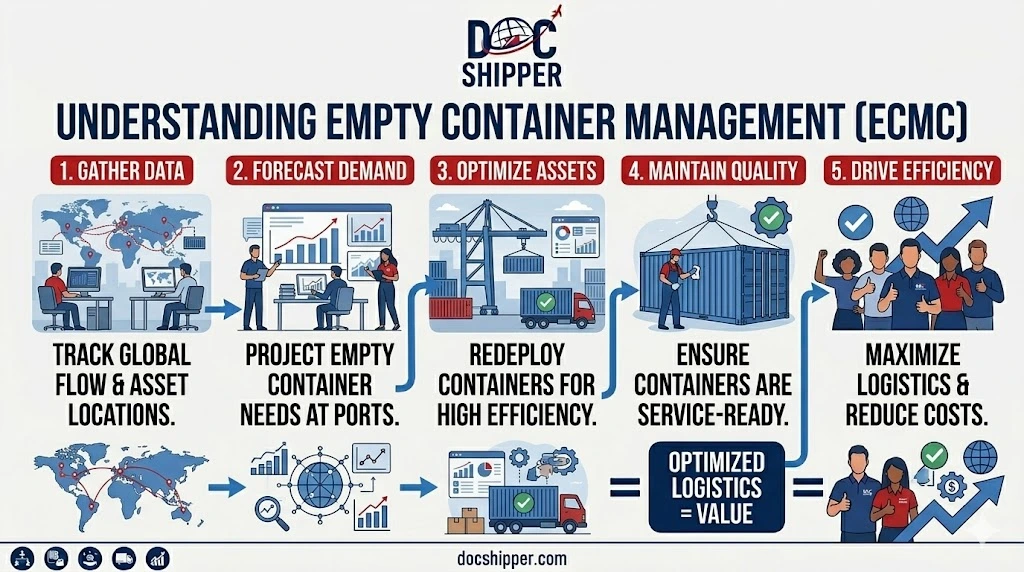
The core function of an ECMC revolves around solving the container imbalance equation. When a shipping line delivers goods to an import-heavy region, empty containers accumulate. Simultaneously, export regions face shortages. ECMCs bridge this gap through sophisticated logistics planning.
Their operations encompass five critical domains:
Strategic repositioning involves analyzing trade patterns to move empty containers from surplus to deficit areas. ECMCs utilize historical shipping data, seasonal forecasts, and carrier schedules. This requires coordination with multiple shipping lines, rail operators, and trucking companies to minimize repositioning costs.
Depot management constitutes another pillar. ECMCs operate or partner with container depots at strategic locations—typically near ports and inland hubs. These facilities provide storage, handling, and gate services. Efficient depot networks reduce dwell time and enable rapid container availability when exporters need equipment.
Maintenance and repair services ensure containers meet operational and regulatory standards. ECMCs coordinate inspections following IICL (Institute of International Container Lessors) guidelines, manage repairs ranging from minor patches to structural work, and handle cleaning between uses. This maintains fleet quality and prevents cargo damage.
Technology platforms differentiate modern ECMCs. Advanced systems provide real-time visibility into container locations, conditions, and availability. Predictive analytics forecast demand by region and season, enabling proactive positioning. Integration with shipping lines’ systems automates booking and reduces administrative friction.
Financial optimization extends beyond physical logistics. ECMCs negotiate favorable storage rates, consolidate repositioning moves to achieve economies of scale, and structure flexible lease agreements with container owners. At DocShipper, we work with leading ECMCs to ensure our clients access containers cost-effectively, particularly during peak seasons when equipment shortages impact shipping schedules.
Regulatory compliance represents an often-overlooked ECMC function. They ensure containers meet CSC (Container Safety Convention) certification requirements, manage customs documentation for cross-border repositioning, and coordinate with port authorities regarding storage regulations. This expertise prevents costly delays.
The European Union’s Customs Code and similar international frameworks govern temporary import/export of empty containers, requiring specialized documentation that ECMCs handle routinely.
Concrete Examples & Industry Data
The global ECMC market manages approximately 40 million TEU of empty container movements annually. Understanding practical applications clarifies their operational impact.
Case Study: Asia-Europe Trade Imbalance
The Asia-Europe trade lane illustrates classic ECMC challenges. Europe imports significantly more from Asia than it exports, creating container deficits in Asian ports and surpluses in European depots. Major ECMCs position empty 40-foot containers from Hamburg, Rotterdam, and Antwerp back to Shanghai, Ningbo, and Shenzhen.
Without ECMC intervention, shipping lines would face equipment shortages during peak export seasons (August-October). Industry data shows ECMCs reduce repositioning costs by 15-25% through consolidated rail services and optimized routing compared to ad-hoc carrier movements.
| Trade Lane | Imbalance Ratio | Primary ECMC Service | Cost Impact |
|---|---|---|---|
| Asia-Europe | 3:1 (Import:Export) | Rail repositioning via China-Europe routes | 20% reduction vs. ocean backhaul |
| Trans-Pacific (Asia-USWC) | 2:1 | Depot consolidation in LA/Long Beach | Storage cost optimization by 30% |
| Intra-Asia | 1.5:1 | Short-sea feeder network management | 15% faster turnaround time |
| North America-South America | 1.8:1 | Intermodal positioning via Panama | 25% cost reduction through triangulation |
Operational Metrics: Leading ECMCs track performance through specific KPIs. Average container turnaround time (from return to next dispatch) ranges from 7-14 days in efficient markets. Depot utilization rates typically target 70-85%—sufficient availability without excessive idle inventory.
Technology Impact: A major Asian ECMC implemented IoT sensors across its fleet, reducing “lost” containers by 40%. Real-time tracking enabled predictive maintenance, decreasing repair-related delays by 30%. These improvements translated to millions in cost savings annually.
Sustainability Initiatives: Modern ECMCs prioritize environmental efficiency. By consolidating empty container movements onto rail rather than road, carbon emissions decrease by approximately 70% per TEU-kilometer. Several ECMCs now participate in carbon offset programs and report emissions reductions as part of corporate sustainability goals.
Peak Season Challenges: During 2021’s unprecedented demand surge, ECMCs faced extreme pressure. Container availability in key Asian export hubs dropped below 5% of normal levels. ECMCs responded by expediting repositioning, negotiating premium rail capacity, and deploying emergency leasing of additional units. Their agility prevented complete supply chain breakdown.
Conclusion
ECMCs serve as essential infrastructure in global containerized trade, transforming empty container management from a cost burden into an optimized logistics function. Their expertise in repositioning, depot management, and technology-driven forecasting ensures equipment availability while minimizing systemic inefficiencies.
Need support navigating container availability for your shipments? Contact DocShipper for expert guidance on securing equipment and optimizing your international logistics operations.
📚 Quiz
Test Your Knowledge: ECMC Operations
What is the primary function of an ECMC?
Which statement correctly describes container trade imbalances that ECMCs address?
Your company needs 50 containers for urgent exports from Shanghai during peak season. Who should your freight forwarder contact?
🎯 Your Results
📞 Free Quote in 24hFAQ | ECMC (Empty Container Management Company): Definition, Operations & Concrete Examples
Shipping lines own vessels and operate ocean transport services, while ECMCs specialize exclusively in managing empty container logistics—repositioning, storage, maintenance, and availability optimization. ECMCs typically work with multiple shipping lines simultaneously, providing neutral infrastructure services across carriers.
ECMCs typically use fee structures based on: per-diem storage charges after free time periods, per-move handling fees at depots, repositioning charges calculated per kilometer/mile, maintenance costs itemized by repair type, and technology platform access fees. Pricing varies by region, equipment type (20' vs 40' vs specialty), and contract volume commitments.
Generally, ECMCs contract primarily with shipping lines and container leasing companies rather than individual shippers. However, large-volume shippers may establish direct relationships for specialized needs like SOC (Shipper-Owned Container) fleet management. Freight forwarders like DocShipper leverage ECMC networks to secure competitive container availability for clients.
Leading ECMCs utilize cloud-based Container Management Systems (CMS) with GPS/IoT tracking, predictive analytics powered by machine learning for demand forecasting, EDI integration with carrier and terminal systems, mobile applications for field operations, and blockchain pilots for transparent transaction records. These systems provide real-time visibility across global depot networks.
Empty repositioning costs constitute 15-20% of total container operating expenses industry-wide. Efficient ECMC management reduces these costs through consolidated movements, optimized routing, and demand-based positioning. Poor empty container management can add $200-$500 per TEU in unnecessary costs, directly impacting freight rates.
ECMCs coordinate repairs through approved depot facilities following IICL standards. Minor damage (small dents, paint) receives on-site fixes, while major structural issues require specialized repair centers. Severely damaged containers beyond economic repair are scrapped and recycled. Repair decisions balance cost against remaining container lifespan (typically 10-15 years).
Yes, specialized ECMCs handle reefer containers requiring additional expertise: electrical system maintenance, refrigeration unit servicing, pre-trip inspections (PTI), and temperature monitoring during storage. Reefer management involves higher operational costs due to power requirements and technical complexity, reflected in premium service fees.
Structural trade imbalances create predictable empty container flows—from import-heavy regions back to export hubs. ECMCs develop specialized corridors addressing these patterns, such as Europe-to-Asia rail services or North America-to-Asia backhaul programs. Severe imbalances (above 2.5:1 ratios) strain ECMC capacity during peak seasons, sometimes causing equipment shortages.
During crises (port congestion, labor strikes, pandemic disruptions), ECMCs provide critical flexibility by rapidly repositioning containers to alternative ports, securing emergency storage capacity when terminals reach capacity, expediting maintenance to return damaged units to service faster, and coordinating with inland depots to bypass congested coastal facilities.
ECMCs reduce environmental impact through: consolidated empty movements via rail instead of truck (70% emissions reduction), optimized routing minimizing total kilometers traveled, extended container lifespan through preventive maintenance, recycling programs for end-of-life containers, and digital documentation reducing paper waste. Many ECMCs now publish annual sustainability reports tracking carbon footprint reductions.
ECMCs operate under: ISO 9001 (quality management), ISO 14001 (environmental management), CSC (Container Safety Convention) compliance for structural integrity, IICL repair standards, ISPM-15 wood packaging regulations, and regional customs frameworks governing temporary container movements. Leading ECMCs maintain third-party audits verifying adherence to these standards.
Digital transformation drives consolidation toward technology-enabled ECMCs offering: real-time container visibility across global networks, predictive analytics forecasting regional demand 30-90 days ahead, automated booking integration with carrier platforms, blockchain-based smart contracts for transparent billing, and AI-optimized repositioning recommendations. Traditional depot-only operators face pressure to upgrade or partner with tech-forward competitors.
Need Help with
Logistics or Sourcing ?
First, we secure the right products from the right suppliers at the right price by managing the sourcing process from start to finish. Then, we simplify your shipping experience - from pickup to final delivery - ensuring any product, anywhere, is delivered at highly competitive prices.


Fill the Form
Prefer email? Send us your inquiry, and we’ll get back to you as soon as possible.
Contact us




:%20Definition,%20Operations%20&%20Concrete%20Examples)