


In short ⚡
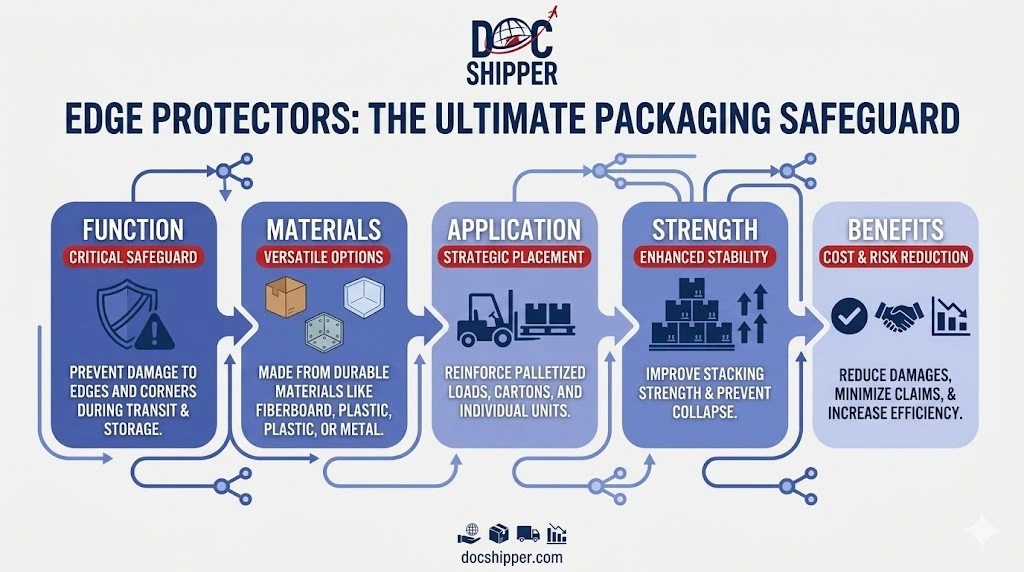
An edge protector is a protective packaging component made from cardboard, plastic, or composite materials designed to reinforce and safeguard the corners and edges of palletized cargo during transportation and storage. It distributes strapping tension, prevents load damage, and enhances stacking stability in international logistics.
Introduction
Every year, billions of dollars in cargo damage occur due to inadequate corner protection during shipping. Edge protectors solve this critical vulnerability by reinforcing the weakest points of palletized loads.
In international freight forwarding, edge protectors serve as the first line of defense against strapping cuts, crushing forces, and stacking pressure. They’re essential for maintaining cargo integrity from warehouse to final destination.
Key characteristics of edge protectors include:
- Load distribution: Spreads strapping and banding pressure across wider surface areas
- Corner reinforcement: Protects vulnerable edges from impact and compression
- Stacking support: Enables vertical load stability for multi-tier pallets
- Surface protection: Prevents strap marking and product surface damage
- Compliance compatibility: Meets international packaging standards (ISPM 15, ISTA protocols)
Technical Specifications & Material Types
Edge protectors come in three primary material categories, each engineered for specific load protection requirements. Understanding these distinctions is crucial for optimizing packaging costs and cargo security.
Cardboard edge protectors remain the industry standard for dry goods shipments. Manufactured from compressed layers of recycled paperboard, they offer excellent rigidity-to-weight ratios. Standard thicknesses range from 2mm to 8mm, with load-bearing capacities up to 1,500 kg per meter. According to Fibre Box Association standards, quality cardboard protectors must withstand minimum edge crush tests of 32 ECT.
Plastic edge protectors provide superior moisture resistance for refrigerated containers and tropical route shipments. Manufactured from PP (polypropylene) or PE (polyethylene), they resist humidity degradation and maintain structural integrity in temperature extremes from -40°C to +60°C. Their reusability makes them cost-effective for closed-loop supply chains.
Composite edge protectors combine paper core construction with plastic film coating, delivering balanced performance. These hybrid solutions protect against both mechanical stress and environmental moisture, ideal for automotive parts and electronics shipments.
Dimensional specifications follow standardized profiles: L-shaped cross-sections with leg widths ranging from 35mm to 120mm. Custom profiles accommodate specialized loads like steel coils or glass panels. At DocShipper, we specify edge protector dimensions based on load weight distribution analysis and strapping tension calculations to prevent both under-protection and packaging waste.
Critical performance metrics include compression strength (vertical stacking resistance), puncture resistance (strapping cut-through prevention), bending stiffness (maintaining right angles under load), moisture resistance (structural stability in humid conditions), and impact absorption (shock mitigation during handling).
Practical Applications & Load Protection Standards
Edge protectors prevent an estimated 30-40% of transit damage in containerized shipments. Their strategic placement transforms standard pallets into reinforced shipping units capable of withstanding multi-modal transport stress.
Common application scenarios demonstrate their versatility:
| Cargo Type | Protector Specification | Protection Benefit |
|---|---|---|
| Corrugated boxes (stacked pallets) | 3mm cardboard, 50x50mm profile | Prevents box corner collapse under strapping |
| Steel coils/metal products | 8mm composite, 100x100mm heavy-duty | Distributes extreme strapping tension (2,000+ kg) |
| Refrigerated containers (food/pharma) | Plastic PP protectors, 60x60mm | Maintains integrity in -25°C to +4°C range |
| Electronics/fragile goods | 5mm cardboard with foam insert | Vibration dampening + edge reinforcement |
| Furniture/white goods | 4mm cardboard, 70x70mm wraparound | Surface protection against strap marking |
Installation best practices significantly impact protection effectiveness. Position protectors vertically along all four pallet corners, extending from base to top surface. For loads exceeding 800 kg, add horizontal mid-level protectors to prevent lateral bulging. Secure with stretch film before applying strapping to maintain alignment during tensioning.
Cost-benefit analysis reveals compelling economics: a standard 1,200mm cardboard edge protector costs $0.40-$1.20 per unit, while preventing damage claims averaging $850 per incident. Investment-to-protection ratio reaches 1:700 in high-value shipments.
Regulatory compliance considerations include ISTA 3A testing protocols for packaged products and UN packaging requirements for hazardous materials. Edge protectors contribute to overall package integrity ratings required for air freight certification.
At DocShipper, we conduct pre-shipment packaging audits to ensure edge protector specifications match cargo weight distribution, transit mode requirements, and destination climate conditions, minimizing damage risk across your entire supply chain.
Conclusion
Edge protectors represent a low-cost, high-impact solution for safeguarding cargo investments throughout international transportation. Proper material selection and strategic placement prevent damage while optimizing load stability and compliance with shipping standards.
Need expert guidance on packaging solutions for your specific freight? Contact DocShipper for customized cargo protection strategies.
📚 Quiz
Test Your Knowledge: Edge Protector
What is the primary function of an edge protector in palletized cargo shipments?
A logistics manager claims cardboard edge protectors are suitable for refrigerated container shipments at -25°C with 95% humidity. Is this recommendation correct?
You're shipping a 1,800 kg steel coil pallet. Which edge protector specification would be appropriate for this heavy-duty application?
🎯 Your Result
📞 Get Free Quote in 24hFAQ | Edge Protector: Definition, Types & Practical Applications
For EUR pallets (1200x800mm) with loads up to 600 kg, use 50x50mm profile protectors with minimum 3mm thickness. Extend protectors 50-100mm beyond the top carton layer. Heavier loads require 70x70mm or larger profiles with proportionally increased thickness to distribute strapping pressure effectively.
Plastic and composite edge protectors withstand 15-30 reuse cycles depending on handling conditions. Cardboard protectors typically remain functional for 3-5 cycles if undamaged by moisture or crushing. Inspect for cracks, delamination, or compression deformation before reapplication. Reusability reduces per-shipment costs by 40-60%.
While not universally mandated, IATA cargo screening standards recommend edge protection for palletized air cargo to prevent load shifting during turbulence. Carriers may require protectors for loads exceeding 500 kg or containing fragile goods. Check airline-specific packaging requirements before tender.
Standard L-profile protectors add 6-12mm per corner dimension, negligible for most container loads. Their load stabilization benefits enable higher stacking (up to 2.4m in 40' HC containers) without collapse risk, potentially increasing container utilization by 15-20% compared to unsecured loads.
These terms are often used interchangeably. Technically, corner boards refer specifically to L-shaped protectors placed at pallet vertical edges, while edge protectors include flat strips used horizontally along carton edges. Functionally, both serve identical load reinforcement purposes in logistics applications.
Cardboard edge protectors made from processed paper pulp are exempt from ISPM 15 heat treatment requirements, unlike solid wood packaging. This makes them advantageous for international shipments to countries with strict wood import regulations. Plastic and composite variants similarly avoid phytosanitary restrictions.
Standard cardboard protectors lose 40-60% structural strength when saturated. For moisture-prone routes (tropical shipping, refrigerated containers), specify plastic or wax-coated composite protectors. These maintain integrity in 95%+ humidity environments while still providing mechanical edge reinforcement.
Loads exceeding 1,500 kg demand 6-8mm thickness protectors with 100x100mm profile dimensions. For extreme applications (coiled steel, industrial machinery), consider plastic protectors rated for 3,000+ kg compression strength. Calculate required thickness using the formula: Load Weight (kg) ÷ 200 = Minimum Thickness (mm).
Minimum configuration requires four vertical corner protectors (one per edge). Standard 1,200mm pallets typically use four 1,200mm protectors. Add four horizontal pieces if load height exceeds 1,500mm. High-value or fragile cargo may require eight additional mid-level protectors for comprehensive reinforcement.
By distributing tension more evenly, quality edge protectors can reduce required strapping bands by 20-30%. A protected load achieving stability with three straps might need five without corner reinforcement. This offsets protector costs through reduced strapping consumption and labor time.
Modern cardboard protectors contain 70-100% recycled content and remain fully recyclable after use. Their carbon footprint is approximately 85% lower than plastic alternatives. Biodegradable options made from molded pulp offer complete compostability for environmentally sensitive supply chains.
Manufacturers produce U-shaped, wraparound, and flat profiles for non-standard applications. Custom die-cutting accommodates cylindrical objects, machinery protrusions, or asymmetric loads. Minimum order quantities for custom profiles typically start at 500-1,000 units depending on complexity.
Need Help with
Logistics or Sourcing ?
First, we secure the right products from the right suppliers at the right price by managing the sourcing process from start to finish. Then, we simplify your shipping experience - from pickup to final delivery - ensuring any product, anywhere, is delivered at highly competitive prices.


Fill the Form
Prefer email? Send us your inquiry, and we’ll get back to you as soon as possible.
Contact us




