


In short ⚡
EDI Interchange is a standardized electronic envelope containing one or more EDI transaction sets exchanged between trading partners. It serves as the digital container enabling automated, structured business document exchange without manual intervention, facilitating seamless integration between different companies' IT systems in international trade and logistics operations.
Introduction
In global supply chains, manual document processing creates delays, errors, and operational bottlenecks. Every purchase order, invoice, or shipping notice handled manually increases costs and risks miscommunication between trading partners.
EDI Interchange addresses this challenge by creating a universal electronic language for business documents. This technology eliminates paper-based workflows while ensuring data integrity across international borders and diverse IT platforms.
Key characteristics of EDI Interchange include:
- Standardized format: Uses protocols like EDIFACT, ANSI X12, or XML to ensure universal readability
- Envelope structure: Contains headers, transaction sets, and control segments for routing and validation
- Trading partner identification: Unique identifiers ensure documents reach the correct recipient systems
- Acknowledgment mechanisms: Built-in confirmation protocols verify successful transmission and receipt
- Security layers: Encryption and authentication protect sensitive commercial data during transmission
Technical Structure & Standards
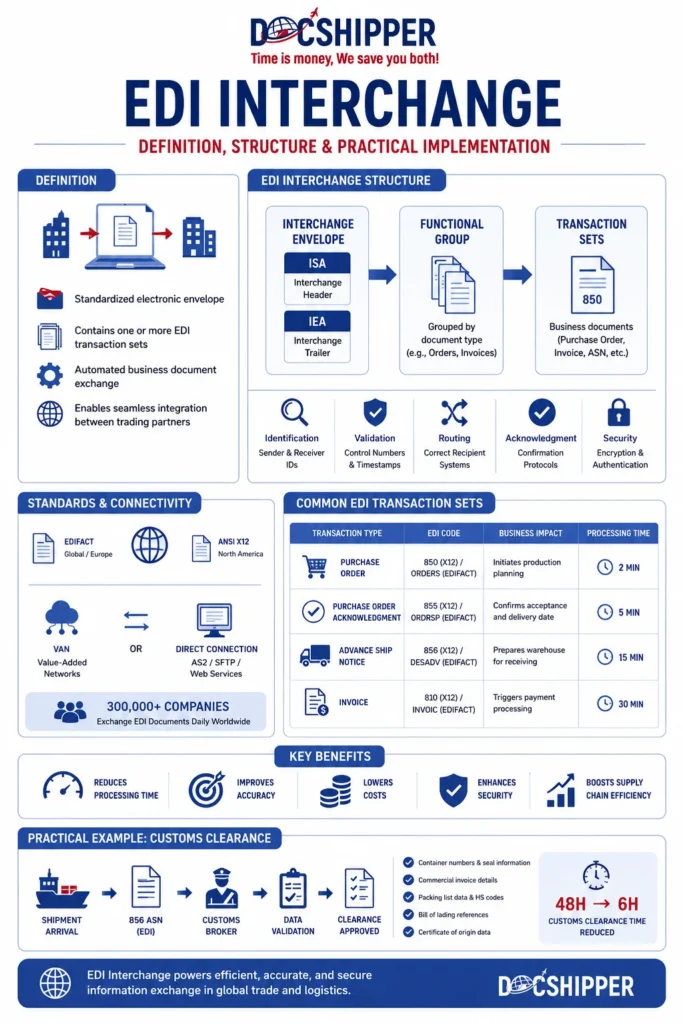
An EDI Interchange operates through a hierarchical structure consisting of three primary levels: the interchange envelope, functional groups, and transaction sets. This architecture enables organizations to bundle multiple documents into a single transmission while maintaining precise identification and routing.
The interchange header (ISA) and trailer (IEA) form the outermost layer, containing sender and receiver identification codes, interchange control numbers, and timestamp information. These segments establish the communication session between trading partners and provide essential metadata for processing.
Within the interchange, functional groups organize related transaction sets by document type. For example, all purchase orders travel together, separate from invoices or advance shipping notices. This grouping improves processing efficiency and simplifies error handling when issues arise.
Two dominant standards govern EDI implementations worldwide. EDIFACT (Electronic Data Interchange for Administration, Commerce and Transport), developed by the United Nations, dominates European and international trade. ANSI X12, created by the American National Standards Institute, prevails in North American commerce. Both standards define precise syntax rules for data elements, segments, and document structures.
Modern EDI systems support Value-Added Networks (VANs) and direct point-to-point connections via AS2, SFTP, or web services. VANs provide translation services, protocol conversion, and delivery confirmation, acting as intermediaries between partners with different technical capabilities. According to the GS1 organization, over 300,000 companies worldwide actively exchange EDI documents daily, processing billions of transactions annually.
At DocShipper, we configure EDI connections between shippers, customs brokers, and carriers to ensure real-time visibility throughout the shipping process, automatically triggering actions based on document receipt and validation.
Implementation Examples & Use Cases
Consider a European automotive manufacturer sourcing components from Asian suppliers. The procurement cycle involves multiple EDI transaction sets within a single business day:
| Transaction Type | EDI Code | Business Impact | Processing Time |
|---|---|---|---|
| Purchase Order | 850 (X12) / ORDERS (EDIFACT) | Initiates production planning | 2 minutes |
| Purchase Order Acknowledgment | 855 (X12) / ORDRSP (EDIFACT) | Confirms acceptance and delivery date | 5 minutes |
| Advance Ship Notice | 856 (X12) / DESADV (EDIFACT) | Prepares warehouse for receiving | 15 minutes |
| Invoice | 810 (X12) / INVOIC (EDIFACT) | Triggers payment processing | 30 minutes |
In this scenario, the EDI Interchange eliminates manual data entry, reducing order processing costs by 65% compared to paper-based systems. The automotive manufacturer processes 1,200 orders daily with 99.8% accuracy, significantly improving just-in-time manufacturing efficiency.
Another practical application involves customs clearance automation. When a container arrives at Rotterdam port, the shipping line automatically transmits an 856 ASN (Advance Ship Notice) to the customs broker. This EDI Interchange includes:
- Container numbers and seal information for security validation
- Commercial invoice details matching the original purchase order
- Packing list data specifying quantities and HS codes for tariff classification
- Bill of lading references linking shipment to contractual terms
- Certificate of origin data for preferential duty calculation under trade agreements
This integrated approach reduces customs clearance time from 48 hours to 6 hours, minimizing demurrage charges and accelerating supply chain velocity. DocShipper implements similar EDI connections for clients handling high-volume shipments, ensuring seamless data flow between all parties in the logistics chain.
Conclusion
EDI Interchange represents the backbone of modern digital commerce, enabling frictionless information exchange across global supply networks. Its standardized structure and proven reliability make it indispensable for companies seeking operational efficiency and competitive advantage.
Need assistance implementing EDI solutions for your international shipping operations? Contact DocShipper for expert guidance on integrating EDI systems with your logistics processes.
📚 Quiz
Test Your Knowledge: EDI Interchange
What is an EDI Interchange?
What is the primary characteristic of EDI Interchange's hierarchical structure?
In the automotive manufacturer scenario, what was the business impact of implementing EDI Interchange for order processing?
🎯 Your Result
📞 Free Quote in 24hFAQ | EDI Interchange: Definition, Structure & Practical Implementation
An EDI transaction is a single business document (like an invoice or purchase order), while an EDI Interchange is the complete transmission package containing one or more transactions, including envelope headers, control segments, and acknowledgment data. The interchange serves as the digital container enabling secure transmission between systems.
EDI Interchanges employ multiple security layers including encryption protocols (SSL/TLS), digital signatures for authentication, and secure transmission methods like AS2 or SFTP. Value-Added Networks provide additional security through controlled access and audit trails, while interchange control numbers prevent duplicate processing and enable tracking of all transmissions.
Yes, cloud-based EDI solutions and web portals enable small businesses to participate in EDI networks without extensive IT investments. Many providers offer subscription-based services handling translation, mapping, and transmission, allowing companies to exchange documents through browser interfaces while maintaining standard compliance and trading partner requirements.
Modern EDI systems include acknowledgment protocols (997 in X12, CONTRL in EDIFACT) that confirm successful receipt and processing. If transmission fails, the sending system receives error notifications specifying the failure point. Most implementations include automatic retry logic, error queues, and alert mechanisms ensuring issues are addressed promptly without data loss.
Implementation timelines vary from two weeks to three months depending on technical complexity and testing requirements. The process involves mapping business processes to EDI standards, configuring communication protocols, conducting integration testing, and validating data accuracy. Experienced EDI service providers can accelerate this timeline through pre-built templates and implementation expertise.
Yes, specialized industries have developed additional standards. Healthcare uses HL7 for clinical data, automotive employs ODETTE for European suppliers, and retail has developed VICS standards for merchandise transactions. However, these specialized formats often operate within EDIFACT or X12 envelope structures, maintaining compatibility with broader supply chain systems.
EDI integration typically connects to ERP systems through middleware or direct API connections, automatically importing received documents into purchasing, inventory, or accounting modules while extracting outbound data for transmission. Modern ERP platforms include native EDI capabilities or certified integration partners, minimizing customization requirements and ensuring data consistency across business systems.
Organizations typically reduce document processing costs by 50-70% through EDI implementation, saving on paper, postage, manual data entry, and error correction. Additional benefits include reduced order cycle times, lower inventory carrying costs through improved forecasting, and decreased payment processing expenses. ROI typically occurs within 12-18 months for medium-volume trading relationships.
Yes, EDI standards support multiple character sets including UTF-8 encoding for international languages. EDIFACT particularly accommodates European characters and various date formats. Trading partners agree on character set usage during implementation, ensuring proper display and processing of regional requirements like currency symbols, measurement units, and address formats.
Compliance validation occurs at multiple levels: syntax validation ensures proper segment structure, business rule validation confirms logical consistency (like quantity matching between order and invoice), and trading partner agreements specify additional requirements. Many organizations employ EDI validators testing documents against standard specifications before transmission, preventing rejection and processing delays.
Robust EDI implementations include redundant communication paths, failover systems, and contingency protocols. Most Value-Added Networks maintain 99.9% uptime with automatic rerouting during outages. Organizations typically establish emergency procedures including manual document submission portals, batch processing queues holding transactions until system recovery, and notification protocols alerting trading partners of processing delays.
Standards organizations release new versions annually, incorporating industry feedback and technological advances. X12 publishes updates each spring, while UN/EDIFACT follows biannual release cycles. However, trading partners typically adopt new versions gradually, with many organizations maintaining multiple version support during transition periods lasting two to three years, ensuring backward compatibility and uninterrupted operations.
Need Help with
Logistics or Sourcing ?
First, we secure the right products from the right suppliers at the right price by managing the sourcing process from start to finish. Then, we simplify your shipping experience - from pickup to final delivery - ensuring any product, anywhere, is delivered at highly competitive prices.


Fill the Form
Prefer email? Send us your inquiry, and we’ll get back to you as soon as possible.
Contact us




